
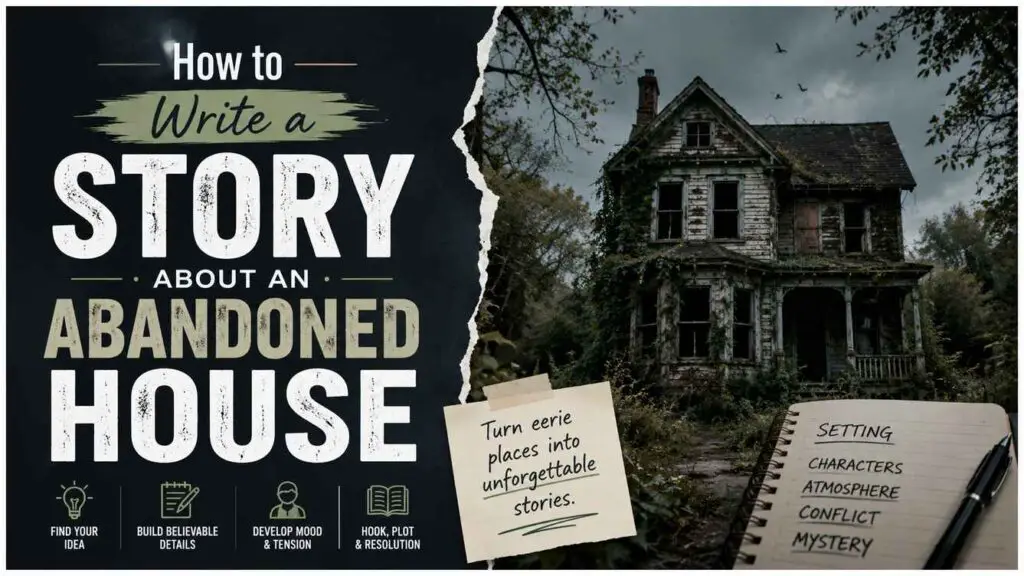
An abandoned house is a story that has already happened, standing at the end of a lane waiting for someone to read it. That’s its power and its trap: because the setting arrives pre-loaded with mood, writers often stop there — cobwebs, creaks, done — and deliver atmosphere with no story attached. But the house poses questions that plot is made of: who left, why, how fast, and who has finally come through the door after all these years, wanting what? Answer those and the dust becomes evidence, the rooms become chapters, and the mood earns its keep.
Here’s how to build the story, not just the cobwebs.
How to Write a Story About an Abandoned House
#1. Decide Why It Was Abandoned — It Decides Everything
Foreclosure, scandal, a death without heirs, a flight in the night — the reason for abandonment is your story’s buried engine, and it flavors every detail. A house left slowly reads differently from one fled: choose the backstory first and let the physical evidence carry it.
The bank’s notice was still tacked to the door, sun-bleached to a whisper, and everything inside was orderly — packed boxes never collected, a broom leaned mid-sweep — a leaving with paperwork.
Whatever happened here had happened between dinner and dessert: plates on the table, chairs pushed back, one overturned, and forty years of dust settling on an interrupted evening.
The old man had simply run out of family — the house emptied by funerals, one bedroom at a time, until the last door closed politely on its own.
The mine closed in ’84 and the street emptied within the year, this house neither first nor last — abandonment by economics, one moving van at a time, until only the curtains stayed to face the pit.
Nobody fled and nobody died; the sisters simply quarreled past the point of return, and the house they couldn’t divide sat locked between them for thirty years, kept empty out of spite so preserved it looked like love.
#2. Make the Entry a Scene
Getting in is your story’s first set piece — the forced window, the key under the dead geranium, the gap in the boards every local kid knows. The manner of entry characterizes your protagonist instantly: trespasser, heir, historian, or thief, each opens the house differently.
The key was where her mother swore it would be, under the third flowerpot, waiting thirty years — and it turned, which meant the house had been expecting someone, if not her.
The boys went in the way boys had gone in for a generation: through the pantry window with the soft frame, feet first, into the dark and the dare.
The surveyor entered with bolt cutters and a clipboard, all business — and stopped three steps in, where the business ended and the hallway of framed faces began.
She had a lawyer’s letter and a locksmith and every legal right, and still stood on the porch a full minute, knocking twice on her own inherited door — some houses you enter; this one you asked.
#3. Read the Interrupted Life
The house’s objects are a stopped clock — a calendar of the last month, a child’s height marks, medicine on the nightstand, a letter half-written. Choose artifacts that date the abandonment and imply its story; each one is exposition disguised as furniture.
The kitchen calendar said March 1979, with a dentist appointment on the 14th that nobody kept, and a birthday — “Susan, 8” — circled twice in red.
On the desk lay a letter that got as far as “Dear Frank, I have thought about it and” — and forty years of dust had thought about it since.
A single small red boot stood at the bottom of the stairs, its pair missing, and every person who ever broke into that house rearranged their theories around it.
The record still sat on the turntable, needle lifted mid-side, and when he read the label — a dance band, 1961 — he understood the parlor had been waiting out its intermission for sixty years.
The medicine bottles on the nightstand were full, dated the same week, never opened — and that small unopened fact rewrote everything the town thought it knew about how the end had gone.
#4. Let Nature Do Its Slow Burglary
Abandonment’s visible clock is nature’s re-entry — ivy through the sash, a birch in the gutter, swallows in the parlor, damp drawing maps on the ceilings. Write the reclamation as gradual, patient work; its progress dates the emptiness and gives the house a second cast of inhabitants.
Ivy had come in through the broken sash and crossed the parlor wall like slow green handwriting, and it had reached the mantel photographs, and was opening its own doors.
Swallows ran the upstairs now — mud nests in the cornices, the air busy with their commerce — a house not empty at all, merely under new management.
A birch sapling stood knee-high in the hall’s rotted carpet, planted by wind through a broken pane — the forest’s first surveyor, taking measurements.
Damp had drawn its brown continents across every ceiling, expanding by the winter, and the wallpaper hung in slow tongues — the house being unpasted, page by page, by weather with no deadline.
#5. Your Protagonist Needs a Reason
Curiosity gets characters to the porch; a motive gets a story through the door — the inheritance with conditions, the childhood home revisited, the rumor of what’s hidden, the developer’s survey, the dare that goes wrong. The wanting defines what the house means and what finding costs.
The will gave her the house on one condition — that she live in it a year — and the lawyer’s face while reading that clause was her first warning.
He told his wife he was going back for the photographs. He was going back for the loose brick in the cellar, and whatever his brother had put behind it in 1994.
The dare was simple — touch the top-floor window and come down — and it stayed simple for exactly as long as the front door stayed open behind them.
The historical society sent her to photograph the moldings before demolition; she stayed four hours past the moldings, because the third bedroom’s wallpaper matched a photograph in her own grandmother’s album, and that needed explaining.
He bought it at auction sight unseen, a number on a spreadsheet, a flip — and the house began its patient work of becoming, against his entire business model, personal.
#6. The Town Remembers — Use It
An abandoned house has a public: neighbors who mow the verge but not an inch farther, kids with legends, old-timers who knew the family and go quiet at the name. The community’s managed memory delivers backstory in dialogue and gives your protagonist sources — and resistance.
Everyone in town mowed around the subject the way Hendricks mowed around the property line — neat, close, and never once across it.
The children’s version had a witch; the barber’s version had a debt; and old Mrs. Aldana’s version, offered once and never repeated, had a night in October and two cars, and no witch at all.
“You bought the Verrell place?” the hardware clerk said, and the register’s small drawer of a silence opened and stayed open.
The library’s newspaper archive had been clipped — someone, decades ago, had gone through with scissors and removed one week of 1979 — and the librarian watched her discover the gap with the expression of a woman who had watched others discover it.
#7. Trespass Has a Heartbeat
Being where you shouldn’t is the scene’s engine — floors of uncertain honesty, the listening pauses, the exit route mentally rechecked, the sudden sound that reorganizes everything. Write the body’s trespass alertness and the house needs no ghost to be unbearable.
She moved through the rooms in the trespasser’s tempo — three steps, listen, three steps — her own heartbeat loud enough to seem like a third party.
Every floorboard was a negotiation, and halfway across the parlor one answered from the room above — the same creak, half a beat later, like an echo that had thought about it first.
He kept the front door in the corner of his eye the whole time, the way swimmers keep the shore, and when the wind shut it, the house got instantly, mathematically larger.
Her phone said 4:51 and thirty percent, and both numbers had begun to matter in a way they hadn’t on the porch — dusk and battery, the trespasser’s two candles, burning down together.
#8. Time-Structure the Reveal
Abandoned-house stories are two timelines braided: the present exploration and the past reconstructed from what’s found. Control the alternation — each room’s discovery unlocking one scene of then — so the reader assembles the history at the pace you choose, wrong theories first.
Each room gave up one card: the nursery said there’d been a child, the locked study said there’d been trouble, and the cellar — the cellar reshuffled everything the house had told her so far.
The letters were bundled by year, and she read them in the house they were written in, in the chair they were written from, the past catching up to the present one rubber band at a time.
He had the story wrong twice — the town’s version, then his own clever one — and the photographs in the attic trunk corrected them both, patiently, in order.
She saved the locked room for last without deciding to — circling it for three chapters of her own life, cleaning around it, sleeping across from it — the story keeping its own best card at the bottom of the deck.
#9. Choose the Ending the House Deserves
The story must decide the house’s fate — demolition, restoration, sale, or being left to the ivy — and each ending states a theme: erasure, redemption, commerce, surrender. Match the fate to what your story said about memory, and let the final image be the house’s last word.
She restored one room only — the kitchen, her grandmother’s kingdom — and let the rest of the house keep its dust, a museum with a single lit exhibit.
The excavator took the house in an afternoon, and the neighbors watched from lawn chairs, and nobody cheered, and nobody cried, and everyone stayed to the end.
In the end he did what the town had done for thirty years: locked the door on all of it, returned the key to its flowerpot for whoever came next, and drove away lighter by exactly one house.
The new family moved in the following spring, knowing nothing, painting everything, and the story’s last image was their daughter’s height being penciled onto a doorframe that already held, under three coats, a ladder of vanished children.
She gave the letters to the archive, the furniture to the auction, and the house to the fire department to burn for practice — and stood at the tape line while it went, the only mourner at the only funeral the house was ever going to get, which was, she had decided, exactly why she’d come.
#10. Evict the Automatic Ghost
The genre’s autopilot — creaking doors, cold spots, a pale face at the window, “as if the house were watching” — turns a singular property into a theme-park ride. You don’t have to banish the supernatural; you have to earn it, or beat it: the documented sadness of a real family’s leavings unsettles longer than any specter.
Nothing in the house was haunted. That was the hard part — every sad thing in it had an ordinary explanation, and the explanations were worse.
No cold spots, no whispers: just a phone off its hook for forty years, and the fact that someone, once, had been in enough of a hurry to leave it that way.
If anything watched them, it was the portraits’ ordinary trick of following eyes — though she noticed nobody in the party said so out loud, and nobody stood with their back to the stairs.
The paranormal crew came with cameras and left with four hours of a house settling in the cold — and the real chill arrived later, at the archive, in a coroner’s report written in the mildest possible clerk’s hand.
Closing Thoughts
The reframe that organizes everything here: an abandoned house is not a setting, it’s a character witness — the last party present at whatever happened, holding its testimony in calendars, boots, and half-written letters until your protagonist arrives to take the deposition. Write the story as that interview: a questioner with a motive, a witness that answers slowly and only in objects, a town outside managing what it remembers. Do that, and you’ll never need the automatic ghost. The house has something better than a haunting to offer. It has evidence.