
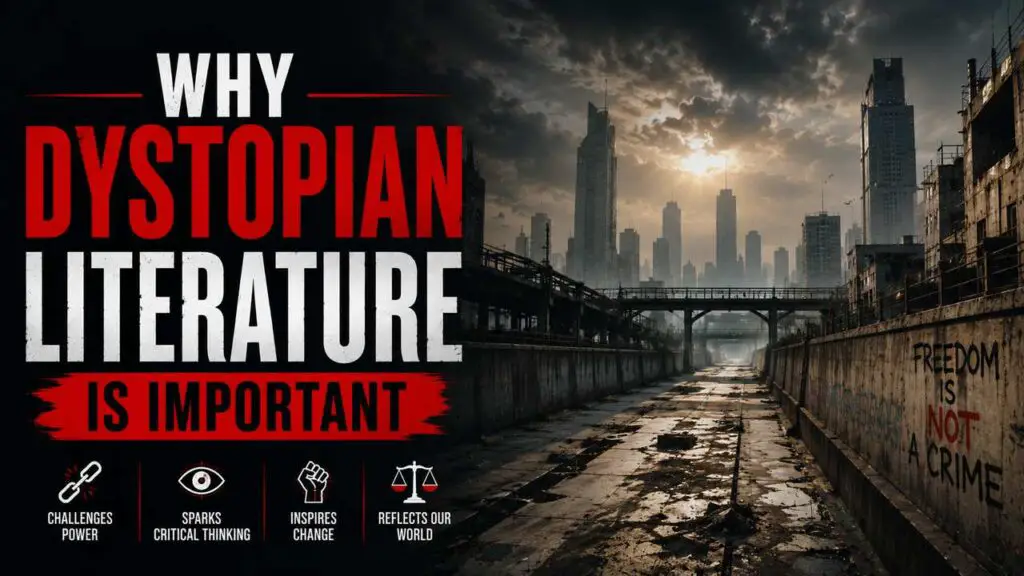
Dystopian literature has a strange power. It shows broken worlds, oppressive governments, damaged societies, and futures that feel dark or frightening. Yet people keep reading it because dystopian stories are not only about disaster. They are also about warning, resistance, survival, and hope.
These stories help readers look at the real world more carefully. They take problems that already exist in society and push them to extreme conclusions. Through this, dystopian literature asks important questions about power, freedom, technology, justice, and human nature.
An Introduction to Dystopian Literature
Dystopian literature presents an imagined society where life has gone deeply wrong. The world may look organized, advanced, or peaceful on the surface. But underneath, people often live under fear, control, inequality, violence, or emotional emptiness.
A dystopia is usually the opposite of a utopia. A utopia imagines an ideal society. A dystopia imagines a society that has failed in serious ways. These failures often come from corrupt leadership, extreme social control, environmental collapse, technological abuse, or the loss of individual freedom.
Classic dystopian novels often focus on ordinary people trapped inside these systems. The main character may begin by accepting the world as normal. Over time, they start to see the truth. This journey helps readers understand how dangerous systems can grow slowly and become accepted by society.
Dystopian literature is not just about the future. It is often about the present. Writers use fictional worlds to criticize real problems in politics, culture, economics, technology, and human behavior.
Why Dystopian Literature Is Important
Dystopian literature matters because it helps readers think deeply about the world they live in. It does not simply entertain. It challenges, warns, and provokes reflection. These stories reveal what can happen when power goes unchecked, when people stop questioning authority, or when society sacrifices freedom for comfort and order.
The importance of dystopian literature can be seen in several powerful ways.
#1. It Warns Society About Dangerous Paths
One of the most important functions of dystopian literature is warning. These stories show what might happen if harmful trends continue without resistance.
A dystopian novel may explore censorship, surveillance, dictatorship, propaganda, environmental destruction, or social inequality. By exaggerating these problems, the story makes them impossible to ignore. The reader sees the possible consequences of silence, fear, and passive acceptance.
This is why dystopian fiction often feels unsettling. It does not describe a distant fantasy with no connection to real life. Instead, it reflects real dangers in a sharper form. It asks readers to notice warning signs before they become normal.
In this way, dystopian literature acts like an alarm. It reminds society that freedom, justice, and truth can be lost gradually if people are not careful.
#2. It Encourages Critical Thinking
Dystopian literature pushes readers to question the world around them. It asks them not to accept every rule, slogan, policy, or social habit without thought.
In many dystopian stories, the society controls how people think. It may rewrite history, limit language, punish disagreement, or use media to shape public opinion. These elements encourage readers to ask serious questions about information and authority.
Who controls the truth? Who benefits from the system? What happens when people stop thinking for themselves? These questions are central to dystopian literature.
By reading these stories, readers become more alert. They learn to look beneath the surface of society. They begin to recognize manipulation, hypocrisy, and injustice more clearly.
#3. It Shows the Value of Freedom
Dystopian worlds often take away basic freedoms. Characters may lose the freedom to speak, love, read, travel, believe, or make personal choices.
Because these freedoms are removed, readers begin to see how valuable they are. A right that feels ordinary in daily life becomes precious when a story shows a world without it.
This is one reason dystopian literature is so powerful. It makes abstract ideas feel personal. Freedom is no longer just a political word. It becomes something connected to identity, dignity, and survival.
Dystopian fiction reminds readers that freedom should never be taken for granted. It must be protected, defended, and understood.
#4. It Exposes the Abuse of Power
Many dystopian stories are built around powerful institutions that control people. These may be governments, corporations, religious authorities, scientific systems, or social elites.
The abuse of power is often shown through surveillance, punishment, propaganda, forced conformity, or economic control. The people in charge usually claim they are creating peace, safety, progress, or stability. But their real goal is often domination.
This helps readers understand how power can disguise itself. Oppression does not always announce itself openly. It may appear as protection. It may use beautiful language. It may promise security while slowly removing rights.
Dystopian literature teaches readers to be suspicious of power that refuses accountability. It shows why transparency, resistance, and moral courage matter.
#5. It Helps Readers Understand Human Nature
Dystopian literature is not only about systems. It is also about people. These stories explore how human beings behave under pressure.
Some characters become brave. Others obey out of fear. Some betray others to survive. Some remain silent because silence feels safer. Others risk everything for truth, love, or justice.
This makes dystopian literature deeply human. It shows that oppression is not only maintained by rulers. It can also be supported by ordinary people who are afraid, distracted, selfish, or unwilling to act.
At the same time, these stories often show the strength of the human spirit. Even in dark worlds, people may still hope, resist, remember, and love. This makes dystopian literature more than a study of fear. It is also a study of courage.
#6. It Makes Readers More Politically and Socially Aware
Dystopian literature often deals with political and social issues in a powerful way. It can help readers understand topics such as class division, authoritarianism, censorship, discrimination, environmental crisis, and technological control.
Because these issues are presented through story, they become easier to feel and understand. Readers do not only learn about injustice in theory. They experience it through characters and conflicts.
This emotional connection can make the message stronger. A reader may finish a dystopian novel with a deeper concern for society and a stronger desire to question injustice.
In this way, dystopian literature can shape awareness. It can make people more thoughtful citizens and more responsible members of society.
#7. It Shows the Danger of Conformity
Dystopian societies often depend on conformity. People are expected to think the same way, behave the same way, and accept the same beliefs.
Those who are different are often punished, isolated, or erased. This shows the danger of a society that values obedience more than truth.
Dystopian literature reminds readers that individuality matters. Independent thought matters. The courage to disagree matters.
A society without disagreement may look peaceful, but it can become morally empty. When everyone is forced to conform, injustice becomes easier to hide. Dystopian fiction shows that real progress often begins with people who are willing to question the accepted order.
#8. It Keeps Hope Alive Through Resistance
Although dystopian literature is dark, it is not always hopeless. Many dystopian stories include acts of resistance, even if they are small.
A character may read a forbidden book. They may speak the truth. They may protect someone vulnerable. They may refuse to obey an unjust rule. These actions matter because they show that humanity can survive even inside oppressive systems.
This is one of the most meaningful parts of dystopian literature. It does not only show what can go wrong. It also shows why resistance matters.
Even when the ending is tragic, the act of resistance can still be powerful. It reminds readers that moral courage has value, even when victory is uncertain.
Closing Thoughts
Dystopian literature is important because it helps people see the dangers hidden within society. It warns against unchecked power, blind obedience, censorship, inequality, and the loss of freedom.
These stories may describe imaginary worlds, but their lessons are real. They teach readers to think critically, value liberty, question authority, and recognize injustice before it becomes normal.
At its best, dystopian literature is not just about fear. It is about awareness. It shows how fragile society can be, but it also shows how powerful human courage can become. That is why dystopian literature continues to matter in every generation.