
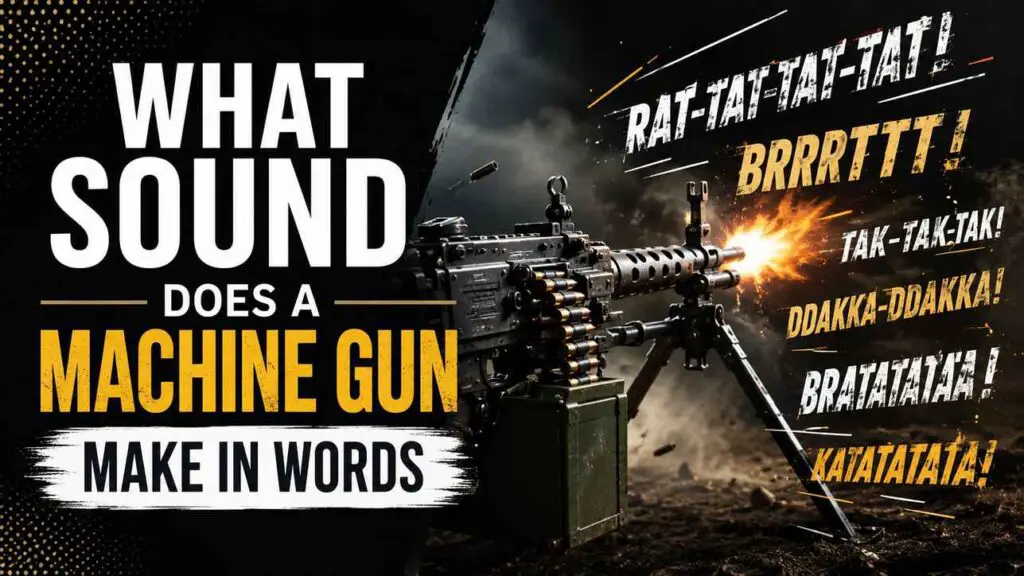
“Rat-a-tat-tat” has been the default sound for automatic gunfire since roughly the invention of the comic strip, and it’s outlived its usefulness — a real machine gun sounds less like a cartoon typewriter and more like a sustained, mechanical tearing of the air. Capturing that on the page means thinking about rate of fire, rhythm, and the sound’s effect on the body, not just picking a familiar onomatopoeia. Below are the techniques for describing a machine gun’s sound with real specificity, each with examples you can study and adapt.
What Sound Does a Machine Gun Make in Words
#1. Use Onomatopoeia Sparingly and Precisely
A single, well-chosen onomatopoeic word can anchor the sound without needing repetition — the trick is choosing one that reflects the weapon’s actual rate and tone rather than defaulting to the cartoon standard. Used once or twice, deliberately, it lands harder than a string of syllables meant to mimic every round.
The gun tore through its magazine in one unbroken chatter, more buzz than individual shots.
It stuttered rather than cracked, a rapid, mechanical stammer that didn’t sound like anything else in nature.
The burst came out as a single sustained snarl, individual shots no longer distinguishable from each other.
#2. Convey Rate of Fire Through Rhythm
The specific cadence of automatic fire — how fast the rounds come, whether the sound is evenly spaced or accelerating — can be suggested through sentence rhythm and punctuation as much as word choice. Short, tight phrasing mimics rapid succession more effectively than a single descriptive adjective.
The shots came so fast they blurred into a single continuous roar, no space left between them at all.
It fired in short, controlled bursts, three or four rounds at a time, with a deliberate pause between each.
The rate climbed as the shooter’s finger settled in, individual shots dissolving into an unbroken buzz.
#3. Distinguish Automatic Fire From Single Shots
Placing a burst of automatic fire beside a single shot in the same scene sharpens the contrast between the two sounds, helping the reader register just how different — and how much more relentless — sustained fire actually feels.
The single shot from before had been almost polite by comparison to what came next.
Where the pistol had cracked once, sharp and isolated, this weapon didn’t seem to stop at all.
One shot she could brace for. This continuous tearing sound gave her nothing to brace against.
#4. Use Comparison to Familiar Sustained Sounds
Comparing automatic fire to a familiar mechanical or industrial sound — a jackhammer, tearing fabric, a zipper pulled violently fast — helps a reader who’s never heard it in person grasp its actual sustained, mechanical texture.
It sounded, absurdly, like a jackhammer, if a jackhammer could somehow also be lethal.
The burst tore through the air like fabric ripping, fast and continuous and wrong.
It reminded him, horribly, of a zipper being yanked shut too fast, if a zipper were the size of a building.
#5. Show the Sound’s Physical Effect on Nearby Characters
Sustained automatic fire produces a physical toll beyond hearing — a vibration felt in the chest, an instinctive full-body flinch, disorientation from the sheer duration of the noise. Showing this bodily reaction conveys intensity more effectively than describing the sound alone.
She felt it in her chest before she consciously registered hearing it, a vibration that seemed to bypass her ears entirely.
He curled instinctively into the dirt, every muscle responding before his mind had finished catching up.
The sustained noise left her disoriented in a way a single shot never had, unable to tell which direction it was even coming from.
#6. Use Environment to Shape the Sound’s Character
Automatic fire echoes and distorts differently depending on setting — flattened in open terrain, magnified and doubled in an enclosed space. Reflecting this environmental shaping adds specificity and helps establish the scene alongside the sound.
In the open field, the sound thinned quickly, carried off by the wind before it could really register.
Inside the concrete stairwell, the noise multiplied on itself until it seemed to come from every floor at once.
The narrow alley funneled the sound directly at them, louder than it would have been anywhere more open.
#7. Track the Sound’s Pauses and Bursts
Automatic fire in reality rarely continues uninterrupted for long — it comes in bursts, pauses for magazine changes, or stutters when a weapon jams. Showing these gaps, rather than one unbroken stream of noise, adds realistic texture and creates natural beats of tension within the scene.
The gun went silent mid-burst, and the sudden quiet was almost as unnerving as the noise had been.
Three short bursts, then a longer pause, then one final, sustained volley that didn’t seem to want to stop.
The rhythm broke for a second — a jam, maybe, or a reload — and everyone used the gap to move.
#8. Avoid Repetitive “Rat-a-tat” Clichés
The phrase has been used so consistently across decades of fiction that it now reads as a cartoonish placeholder rather than a genuine attempt at description. Reaching for a more specific, unexpected image keeps automatic gunfire from sounding like a stock sound effect.
It wasn’t a rat-a-tat so much as a continuous, mechanical snarl, closer to a chainsaw than anything resembling individual shots.
Calling it rapid fire undersold it; it was a sustained roar that made conversation physically impossible.
There was nothing cartoonish about it at all — just a relentless, grinding noise that seemed to go on far longer than it probably actually did.
Closing Thoughts
A machine gun’s sound convinces the reader when it captures the sustained, mechanical texture of real automatic fire — its rhythm, its bursts and pauses, its physical effect on nearby characters — rather than defaulting to a cartoonish “rat-a-tat.” Use onomatopoeia sparingly, let the environment shape the noise, and reach for an unexpected comparison instead of the familiar cliché, and your gunfire will feel as relentless on the page as it does in reality.