
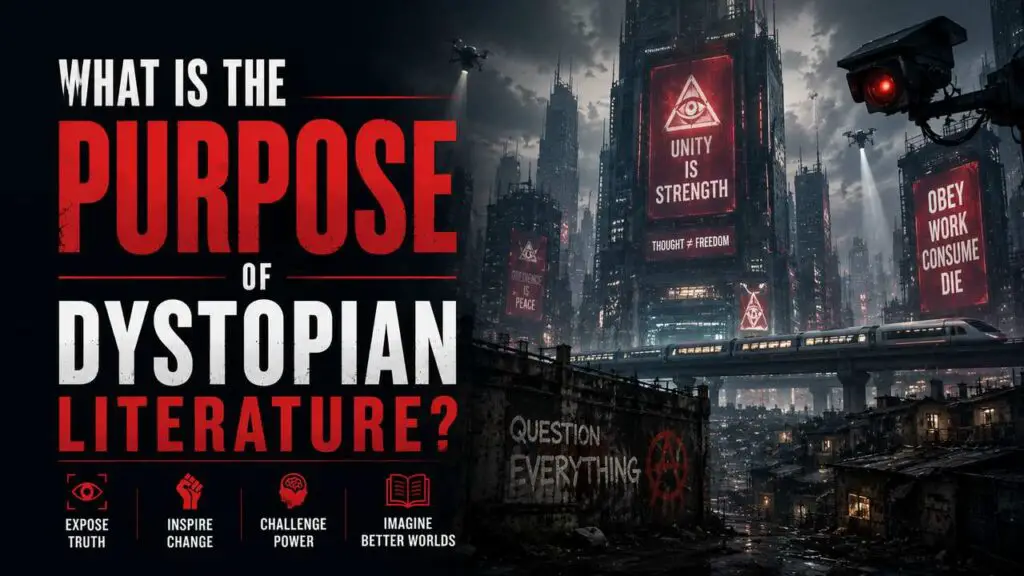
Dystopian literature gives readers a disturbing picture of what society could become when power, fear, technology, inequality, or control go too far. These stories often take place in dark imagined worlds, but their real purpose is not simply to frighten readers. They help us think more deeply about the present.
A dystopian novel may show a government that watches every citizen, a society where people have no freedom, or a future where human values have been replaced by cold systems. These worlds may seem extreme, but they often grow out of real concerns. That is what makes dystopian literature so powerful.
At its best, dystopian literature asks difficult questions. What happens when people give up freedom for safety? What happens when technology controls human life? What happens when truth is manipulated? What happens when ordinary people stop questioning authority?
By exploring these questions through fiction, dystopian literature helps readers understand the dangers hidden inside society and human nature.
What is Dystopian Literature?
Dystopian literature is a type of fiction that presents an imagined society where life is deeply flawed, oppressive, or frightening. It is the opposite of utopian literature, which imagines an ideal or perfect society.
In a dystopian story, the world may appear organized on the surface. There may be strict laws, advanced technology, or promises of peace and equality. But beneath that surface, people often suffer from control, fear, injustice, poverty, surveillance, or loss of individuality.
Dystopian literature usually focuses on what happens when a society tries to create order by destroying freedom. The government, corporation, ruling class, or social system may claim to be helping people, but it often uses power to silence them.
These stories are often set in the future, but they are really about the present. They take current social, political, or technological problems and push them to an extreme. This allows readers to see the possible consequences of choices that may already be happening in the real world.
Dystopian literature is not just about dark futures. It is about warning, reflection, resistance, and the human desire for freedom.
Key Elements of Dystopian Literature
Dystopian literature often includes several common elements that help create its disturbing world.
One major element is oppressive control. This control may come from a government, corporation, religious authority, social system, or artificial intelligence. The people in the story may be watched, punished, censored, or forced to obey strict rules.
Another key element is the loss of individual freedom. Characters in dystopian stories are often told what to think, where to work, how to live, and even whom to love. Personal choice becomes dangerous because it threatens the power of the system.
Surveillance is also common in dystopian fiction. People may be monitored through cameras, technology, informants, or social pressure. This creates a world where privacy disappears and fear becomes normal.
Propaganda is another important feature. Dystopian societies often control information. They rewrite history, manipulate language, spread lies, and punish independent thought. Truth becomes whatever the powerful say it is.
Dystopian literature also often includes social inequality. Some groups may have wealth, comfort, and power, while others live in poverty, fear, or forced labor. These divisions reveal the cruelty of the system.
Finally, dystopian stories usually include a protagonist who begins to question the world around them. This character may not start as a rebel, but over time they notice the lies, injustice, and suffering around them. Their awakening becomes central to the story.
What Is the Purpose of Dystopian Literature?
The purpose of dystopian literature is to warn, challenge, and awaken readers. These stories do not simply imagine terrible societies for entertainment. They use dark fictional worlds to reveal real dangers and force readers to think about freedom, justice, truth, and power.
Dystopian literature matters because it helps readers see what can happen when harmful ideas are ignored for too long. It turns social fears into stories that are easier to understand, remember, and discuss.
#1. To Warn Readers About Dangerous Futures
One of the main purposes of dystopian literature is to act as a warning. These stories show what could happen if society continues down a harmful path.
A dystopian novel might warn about totalitarian government, environmental destruction, extreme inequality, censorship, technological control, or the loss of privacy. By presenting these dangers in an exaggerated form, the writer makes readers pay attention.
The warning is not always about a distant future. Often, it is about choices being made in the present. Dystopian literature asks readers to notice early signs of danger before they become impossible to stop.
This is why dystopian stories can feel uncomfortable. They show a world that seems fictional but also familiar. That discomfort is part of their purpose. It pushes readers to ask whether certain patterns already exist in their own society.
#2. To Criticize Power and Oppression
Dystopian literature often examines how power can become abusive. It shows what happens when governments, institutions, or ruling groups gain too much control over people’s lives.
In many dystopian stories, those in power claim they are creating peace, safety, order, or progress. But their real goal is often control. They use fear, punishment, propaganda, and surveillance to keep people obedient.
This allows dystopian literature to criticize oppression in a powerful way. Instead of writing a direct political argument, the author creates a fictional world where readers can see oppression in action.
Through this approach, dystopian literature reveals how easily people can lose their rights when power is not questioned. It also shows how systems of control can become normal when people are too afraid, distracted, or comfortable to resist.
#3. To Defend Individual Freedom
Another major purpose of dystopian literature is to defend individual freedom. These stories often show societies where personal choice has been taken away.
Characters may be forced to follow strict rules, accept official beliefs, or live according to the expectations of the system. They may not be allowed to think freely, speak honestly, or form meaningful relationships.
By showing the pain caused by this loss of freedom, dystopian literature reminds readers why individuality matters. It shows that human beings need more than survival. They need dignity, privacy, love, imagination, and the right to make choices.
The struggle of the main character often represents the struggle to remain human in a world that treats people like tools, numbers, or machines. This makes dystopian literature a defense of the human spirit.
#4. To Expose the Dangers of Blind Obedience
Dystopian literature often warns against blind obedience. In these stories, ordinary people may follow harmful rules because they are afraid, conditioned, or convinced that the system is always right.
This is one of the most disturbing parts of dystopian fiction. The oppressive society does not survive only because of powerful leaders. It also survives because ordinary people cooperate with it.
Some characters obey because they fear punishment. Others obey because they have been taught not to question authority. Some even believe the system is good because they have never known anything else.
By showing this, dystopian literature encourages readers to think critically. It reminds us that obedience is not always a virtue. When authority becomes cruel or dishonest, questioning it may become a moral responsibility.
#5. To Explore the Manipulation of Truth
Dystopian literature often focuses on the control of truth. In many dystopian societies, the powerful control books, news, education, history, and language.
When truth is controlled, people lose the ability to understand reality. They may believe lies because they have no access to better information. They may repeat propaganda because independent thought has become dangerous.
This theme is important because truth is necessary for freedom. People cannot make meaningful choices if they are constantly misled. They cannot resist injustice if they cannot name it.
Dystopian literature shows that controlling truth is one of the strongest forms of control. A society does not need to imprison everyone physically if it can control what people believe.
#6. To Question the Cost of Progress
Many dystopian stories question whether all progress is truly good. They often explore advanced technology, scientific development, or social engineering that appears useful at first but becomes harmful.
For example, a society may use technology to make life more efficient, but that same technology may destroy privacy. A government may promise safety, but the cost may be constant surveillance. A system may claim to create equality, but it may erase individuality.
Dystopian literature does not always reject progress. Instead, it asks what kind of progress society is pursuing and who pays the price for it.
This makes dystopian fiction especially relevant in a world shaped by rapid technological change. It encourages readers to ask whether human values are being protected or sacrificed.
#7. To Inspire Resistance and Moral Courage
Although dystopian literature is often dark, it is not always hopeless. Many dystopian stories focus on characters who begin to resist.
This resistance may start quietly. A character may ask a forbidden question, read a banned book, protect another person, remember the past, or refuse to accept a lie. These small acts can become powerful symbols of courage.
The purpose of this resistance is not always to show a complete victory. Sometimes the system remains strong. But the act of resistance still matters because it proves that the human spirit has not been fully conquered.
Dystopian literature reminds readers that courage often begins with awareness. Before people can resist injustice, they must first see it clearly.
Closing Thoughts
Dystopian literature serves a serious purpose. It warns readers about dangerous futures, criticizes oppressive power, defends freedom, and exposes the fragile nature of truth.
These stories may be fictional, but their concerns are real. They show what can happen when people stop questioning authority, when technology becomes a tool of control, when truth is manipulated, and when human dignity is ignored.
The power of dystopian literature comes from its ability to disturb readers in a meaningful way. It does not simply ask us to imagine a terrible world. It asks us to look at our own world more carefully.
In the end, dystopian literature is not only about fear. It is about awareness. It reminds us that the future is shaped by the choices people make today.