
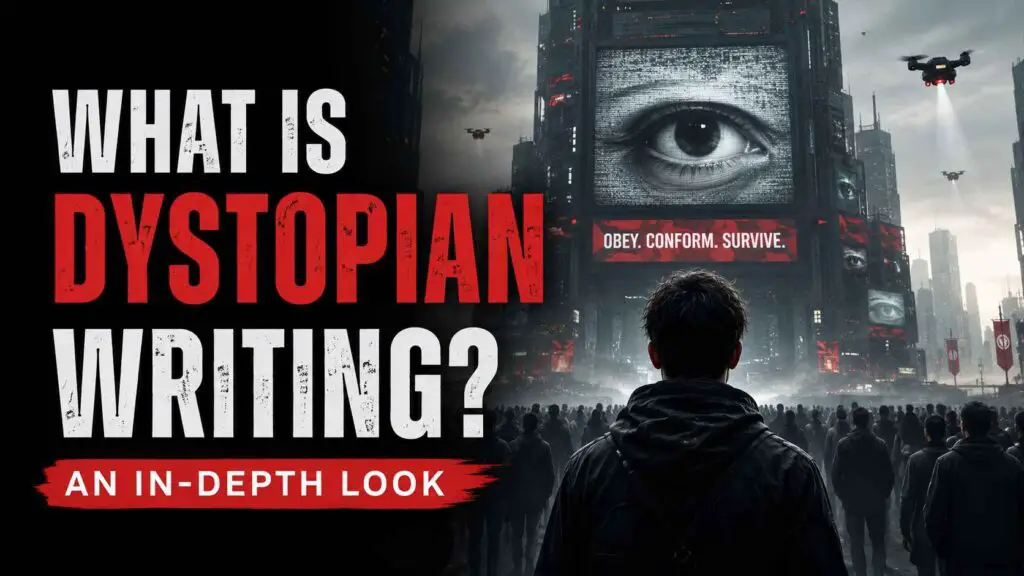
Dystopian writing is a genre of literature that explores societies marked by suffering, oppression, and widespread injustice. These stories often imagine worlds where governments exert excessive control, technology is misused, or social systems have broken down. Readers are drawn to dystopian fiction because it combines compelling storytelling with thought-provoking commentary about real-world issues. Themes such as surveillance, censorship, inequality, and resistance frequently appear throughout the genre. By presenting exaggerated versions of contemporary concerns, dystopian writing encourages readers to examine their own societies more critically. Understanding this genre helps reveal why it remains one of the most influential forms of modern literature.
What Is Dystopian Writing?
Dystopian writing is a form of fiction that portrays an imagined society characterized by extreme suffering, oppression, or dysfunction. If someone asks, “what is dystopian writing,” the simplest answer is that it depicts a world where conditions have gone terribly wrong for most people.
Unlike a utopia, which presents an ideal society where citizens live in harmony and prosperity, a dystopia shows the opposite. The society may appear orderly on the surface, but beneath that appearance lies injustice, corruption, or authoritarian control. Citizens often have limited freedoms and little power to change their circumstances.
Dystopian writing uses these fictional worlds to explore real concerns about politics, technology, social structures, and human behavior. Authors create flawed societies to highlight potential dangers and encourage readers to think critically about the direction of their own world.
These stories often serve as warnings. Rather than predicting the future, they exaggerate existing trends to demonstrate where certain decisions or behaviors could lead. Through this approach, dystopian writing entertains readers while also prompting deeper reflection on important social and ethical issues.
The Origins of Dystopian Writing
Early Influences
The roots of dystopian writing can be traced to discussions about ideal and imperfect societies that have existed for centuries. Philosophers, political thinkers, and writers frequently imagined alternative worlds as a way to examine social structures and human behavior.
Ancient texts often described societies that reflected moral lessons or political concerns. Later, writers began creating fictional societies specifically to critique real-world institutions. Works that explored ideal communities naturally led to questions about what could happen when those ideals failed or became corrupted.
During the Renaissance and Enlightenment periods, authors increasingly used fictional settings to comment on government policies, social inequality, and human nature. By placing their critiques in imagined worlds, they could explore controversial ideas more freely.
These early experiments laid the groundwork for modern dystopian literature. They established the concept of using fictional societies not merely as entertainment but as tools for examining the strengths and weaknesses of real civilizations.
The Rise of Modern Dystopian Literature
Dystopian literature gained significant momentum during the nineteenth and twentieth centuries. Rapid industrialization transformed economies and societies, creating both optimism and anxiety about the future. Technological advancements improved living conditions in many ways, but they also raised concerns about control, dehumanization, and inequality.
The devastation caused by world wars, totalitarian governments, and political revolutions further influenced writers. Many authors witnessed firsthand how propaganda, censorship, and centralized authority could affect entire populations.
As a result, dystopian fiction became a powerful literary tool for exploring these concerns. Writers imagined societies where existing problems had intensified to dangerous extremes. Their stories warned readers about the potential consequences of unchecked power and blind faith in progress.
The genre flourished throughout the twentieth century and remains popular today. Modern dystopian works continue to address contemporary issues such as artificial intelligence, environmental degradation, digital surveillance, and growing social divisions.
Key Characteristics of Dystopian Writing
Oppressive Governments
One of the most recognizable features of dystopian fiction is the presence of an authoritarian government. Leaders often maintain power through fear, force, and strict regulation of citizens’ lives.
In many dystopian societies, governments control where people live, what they can say, what information they can access, and even how they think. Individual rights are often sacrificed in the name of security, stability, or social harmony.
Citizens may face severe punishment for questioning authority or expressing dissenting opinions. Elections, if they exist at all, are often meaningless, and political opposition is usually suppressed.
By depicting oppressive governments, dystopian writers explore the dangers of concentrated power and remind readers of the importance of freedom, accountability, and democratic institutions.
Surveillance and Control
Many dystopian societies rely on extensive surveillance systems to monitor their populations. Citizens may be watched through cameras, digital tracking devices, facial recognition systems, or networks of informants.
The purpose of surveillance is not merely to gather information but to influence behavior. When people know they are constantly being observed, they often censor themselves and avoid actions that could attract attention.
This atmosphere of perpetual monitoring creates fear and discourages independent thought. Citizens may become reluctant to trust one another because anyone could be reporting suspicious behavior.
Through these scenarios, dystopian fiction examines the tension between security and privacy and raises important questions about how much monitoring a society should tolerate.
Social Inequality
Dystopian worlds often feature stark divisions between different social classes. Wealth, opportunities, education, and political influence are frequently concentrated in the hands of a small elite.
Meanwhile, the majority of citizens may struggle with poverty, limited opportunities, poor living conditions, or restricted access to resources. These inequalities are often maintained through laws, propaganda, or institutional barriers.
The contrast between privileged and disadvantaged groups highlights issues of fairness and justice. Characters living in these societies frequently confront systems designed to keep them powerless.
By exaggerating existing social divisions, dystopian writers encourage readers to consider the consequences of growing inequality in the real world.
Propaganda and Censorship
Information is often tightly controlled in dystopian settings. Governments and powerful institutions manipulate news, rewrite history, and suppress viewpoints that challenge official narratives.
Citizens may only have access to approved information sources, making it difficult to distinguish truth from falsehood. Books, media, and educational materials are often censored to support the interests of those in power.
Propaganda plays a crucial role in maintaining control. By shaping public perception, authorities can convince people that oppressive policies are necessary or beneficial.
These portrayals emphasize the importance of free expression, independent journalism, and access to accurate information in maintaining a healthy society.
Loss of Individuality
Citizens in dystopian societies are frequently pressured to conform. Personal expression, creativity, and independent thought may be discouraged, restricted, or punished.
People are often expected to adopt approved beliefs, behaviors, and lifestyles. Those who stand out or challenge social norms may face exclusion, punishment, or reeducation.
This suppression of individuality creates societies where diversity of thought is limited and innovation becomes difficult. Characters who resist conformity often become central figures in dystopian narratives.
The theme highlights the value of personal identity and the importance of protecting the freedom to think, speak, and live independently.
Environmental or Technological Crisis
Many dystopian stories are set in worlds damaged by environmental disasters or technological misuse. Climate change, pollution, resource depletion, and ecological collapse are common causes of societal decline.
Other stories focus on technology that has become harmful rather than beneficial. Artificial intelligence, genetic engineering, advanced surveillance systems, and automated decision-making may be used in ways that threaten human freedom.
These crises often serve as the backdrop for larger social and political problems. They demonstrate how poor decisions, unchecked innovation, or environmental neglect can reshape entire civilizations.
Through these scenarios, dystopian writing encourages readers to think carefully about humanity’s relationship with technology and the natural world.
Common Themes in Dystopian Writing
Freedom Versus Control
The conflict between freedom and control is one of the most important themes in dystopian literature. Governments and institutions often seek to regulate every aspect of life, while individuals struggle to maintain autonomy.
In many dystopian societies, control is justified as necessary for safety, stability, or efficiency. Citizens may be told that strict rules protect them from chaos or danger, even when those rules severely limit personal freedoms. This creates a constant tension between what is presented as the greater good and the individual’s right to self-determination.
This tension drives many dystopian plots and highlights the value of personal liberty. Readers are encouraged to consider how much control should be given to authorities and what freedoms are worth protecting. By exploring these questions, dystopian writing invites reflection on the balance between order and independence in real-world societies.
The Abuse of Power
Dystopian stories frequently examine how power can corrupt individuals and institutions. Leaders may begin with noble intentions but eventually prioritize their own interests over the well-being of citizens.
As power becomes concentrated, systems of accountability often weaken or disappear entirely. Without checks and balances, those in authority may manipulate laws, silence opposition, and exploit resources for personal gain. This unchecked power can lead to widespread injustice and the normalization of harmful practices.
The abuse of power often leads to oppression, inequality, and widespread suffering. By exploring these dynamics, dystopian writers warn against unchecked authority and emphasize the importance of accountability. These stories remind readers that even well-intentioned systems can become dangerous if power is not carefully monitored and limited.
Resistance and Rebellion
Many protagonists challenge the systems that oppress them. Their acts of resistance may begin as small gestures but often grow into broader movements for change.
Resistance can take many forms, including secret communication, acts of defiance, or organized rebellion. Characters may risk their safety to expose truth, protect others, or disrupt unjust systems. These actions often inspire others, gradually building momentum against oppressive forces.
These stories demonstrate the courage required to confront injustice and show how ordinary individuals can influence larger social forces. They also highlight the risks involved in standing up to authority, emphasizing that meaningful change often requires sacrifice and perseverance.
Technology as a Threat
Technology is often portrayed as a double-edged sword in dystopian fiction. While it can improve lives, it can also be used to monitor, manipulate, or control populations.
In many dystopian worlds, advanced technologies are used to track citizens, predict behavior, or enforce compliance. Artificial intelligence, data collection, and automated systems may replace human judgment, reducing individuals to data points within a larger system.
Writers explore the possibility that technological advancements may create new forms of dependence or oppression if ethical considerations are ignored. These stories encourage readers to think critically about how technology is developed and used, and to consider the long-term consequences of innovation without oversight.
Human Nature Under Pressure
Dystopian settings place characters in extreme circumstances that reveal both the best and worst aspects of human nature.
Under pressure, individuals may be forced to make difficult choices that test their morals and values. Some may act selfishly in pursuit of survival, while others demonstrate compassion, courage, and resilience even in the face of danger.
These contrasting responses provide insight into how people behave under stress. Dystopian stories often explore whether humanity’s core traits are shaped more by environment or by inherent character, offering a deeper understanding of human behavior in challenging situations.
Hope in Dark Circumstances
Despite their bleak settings, many dystopian stories contain elements of hope. Characters often discover strength, friendship, love, and purpose even in the most oppressive environments.
Hope may appear in small moments, such as acts of kindness, shared resistance, or the preservation of truth. These moments remind both characters and readers that humanity can endure even under harsh conditions.
Hope serves as a reminder that positive change remains possible, even when circumstances appear overwhelming. It reinforces the idea that even in the darkest situations, individuals have the power to inspire change and work toward a better future.
Famous Examples of Dystopian Writing
Nineteen Eighty-Four
George Orwell’s Nineteen Eighty-Four is one of the most influential dystopian novels ever written. It portrays a society governed by constant surveillance, propaganda, and thought control.
The novel introduced concepts that continue to shape discussions about privacy, government monitoring, and political manipulation. Its depiction of a regime that controls both information and reality remains highly relevant.
Brave New World
Aldous Huxley’s Brave New World presents a society where stability is maintained through technological control, genetic engineering, and manufactured happiness.
Rather than ruling through fear alone, the society controls citizens through pleasure and conditioning. The novel explores important questions about individuality, freedom, and the true meaning of happiness.
The Handmaid’s Tale
Margaret Atwood’s The Handmaid’s Tale depicts a theocratic regime that severely restricts women’s rights and freedoms.
The novel examines issues of gender, power, religious extremism, and social control. Its themes have sparked significant discussion about civil liberties and human rights.
The Hunger Games
Suzanne Collins’s The Hunger Games introduces readers to a society marked by inequality, political oppression, and public spectacle.
The series follows a young protagonist who becomes a symbol of resistance against an unjust government. Its popularity helped bring dystopian fiction to a wider audience and demonstrated the genre’s appeal to younger readers.
Conclusion
Dystopian writing is a powerful literary genre that explores societies defined by oppression, inequality, and systemic failure. Through imagined worlds and compelling narratives, it examines important questions about freedom, power, technology, and human nature.
The genre’s key characteristics include authoritarian governments, surveillance, social inequality, censorship, and the suppression of individuality. These elements allow authors to critique real-world issues while engaging readers with dramatic and memorable stories.
Its recurring themes of resistance, hope, and the struggle for freedom continue to resonate with readers across generations. These themes remind audiences that even in difficult circumstances, individuals have the capacity to challenge injustice and pursue change.
As long as societies continue to face challenges and uncertainties, dystopian writing will remain relevant. By imagining possible futures, these stories encourage readers to reflect on the present and consider how today’s decisions may shape tomorrow’s world.