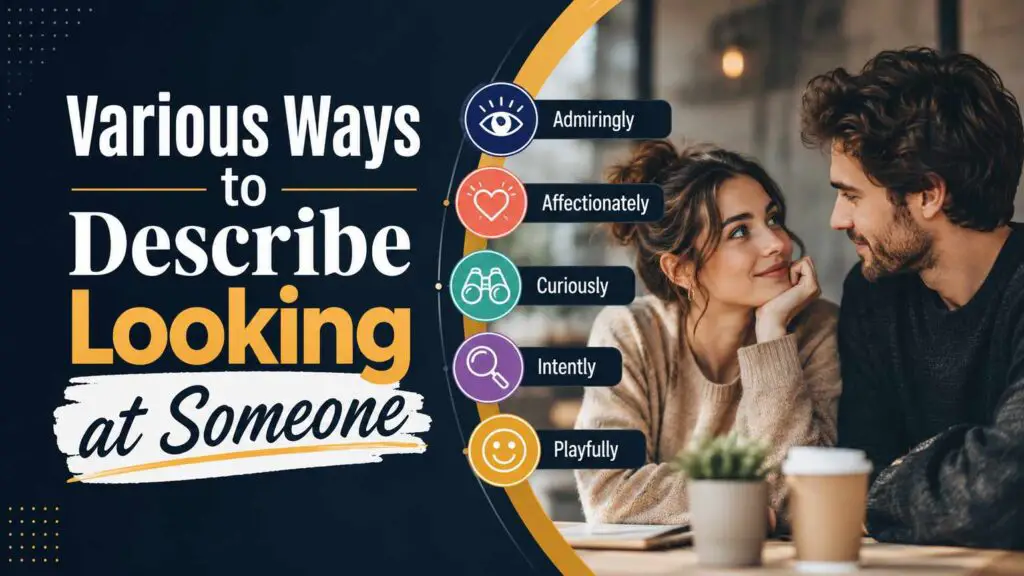
English holds an entire arsenal for the act of looking — glance, stare, gaze, glare, peer, study, scan, watch — and each word is a different event: a glance steals, a stare trespasses, a gaze settles in, a glare charges. Most drafts spend the whole arsenal on one worn verb, “looked,” leaving the reader to guess whether the character’s eyes lingered for half a second or half a minute, in love or in warning. Choosing the right species of look is fast, free characterization. Below are various ways to describe looking at someone, organized by kind, each with examples you can study and adapt.
Various Ways to Describe Looking at Someone
#1. The Glance — Looking’s Smallest Coin
A glance is brief by definition — a flick of attention that hopes to go unbilled — and it suits curiosity, nerves, and checking: the watch glance, the door glance, the is-she-still-there glance. Its power is deniability; a glance can always claim it was nothing, which is why repeated ones confess so much.
He glanced at her twice during the reading — quick, bookkeeping flicks — and would have sworn under oath it was zero.
Her glance went to the door each time it opened, a small reflex she’d have hated to know was visible from every table in the café.
One glance passed between the sisters at the word “investment” — a fifth of a second, carrying the entire family history of Uncle Ray.
#2. The Stare — Attention Past Politeness
A stare is a look that has overstayed — fixed, unblinking, past the social meter’s limit — and it reads as rudeness, shock, menace, or hunger depending on the face around it. Stares are trespasses; the stared-at person feels them physically, and “being stared at” is an event worth writing from both ends.
The man at the end of the bar stared with the patience of furniture, and she moved her chair by degrees until her back was to him, and felt the stare relocate to her shoulder blades.
The children stared at the astronaut with their whole bodies, mouths open, blinking suspended as an unnecessary expense.
He stared at his brother across the casket — not grief yet, just the long unblinking arithmetic of the impossible.
#3. The Gaze — Looking That Has Moved In
A gaze is sustained and soft-edged — attention that has settled on someone and unpacked — and it belongs to love, wonder, and deep thought rather than challenge. Where the stare pins, the gaze rests; reserve it for characters whose looking has stopped being observation and become residence.
His gaze followed her through the party the way a window follows light — no demand in it, just orientation.
She gazed at the sleeping baby with the unhurried attention people otherwise give only to fires and the sea.
The old man’s gaze rested on the orchard a long while — on it, and through it, to some year standing behind it.
#4. The Glare — a Look With a Charge in It
A glare is anger delivered optically — narrowed, hot, aimed — and it works as dialogue: characters glare instead of shouting in churches, meetings, and cars full of children. Calibrate its wattage; the mild marital glare and the courtroom glare are different weapons from the same holster.
She couldn’t say it in front of the vicar, so she sent it optically — a glare with his full name in it, including the middle name — and he received every syllable.
The defendant glared at the witness with a heat the jury felt sideways, two rows away, like an open oven door.
Mom’s glare in the rearview mirror had a range of three rows and required no words, and the wrestling in the back seat concluded mid-hold.
#5. The Study — Looking as Analysis
To study someone is to look with a project — the tailor measuring by eye, the detective reading a suspect, the mother assessing a child’s “I’m fine” — and the verb implies method and duration. Studied looking suits professionals and worriers; write what the study is checking for, and the look gains a plot.
The tailor studied him for four seconds and knew the suit size, the sloped shoulder, and — from the collar’s wear — which side he carried the bag on.
Her mother studied her across the teacups, running the old diagnostics — eyes, hands, the speed of the smile — and poured a second cup, which meant the results were in.
The scout studied the pitcher the way an appraiser studies a canvas: the signature was fine; he was checking the brushwork.
#6. The Scan and the Sweep — Looking for, Not At
Scanning is search — eyes sweeping a crowd for one face, a room for exits, a horizon for sails — and the verb carries urgency and system. The scan’s drama is its ending: the moment sweeping attention snags and locks is one of fiction’s reliable beats, whether the payoff is love, threat, or absence.
She scanned the arrivals crowd twice, methodically, left to right and back — and on the third pass the scan snagged, and her suitcase simply stayed where she dropped it.
His eyes swept the reception in one professional pass — exits, hands, sight lines — and then he became a man enjoying a party.
The lifeguard’s gaze never rested and never hurried, a lighthouse in swim trunks, sweeping the same water all summer for the one moment it would matter.
#7. The Peer and the Squint — Effortful Looking
Peering is looking against difficulty — through fog, dim light, bad eyes, or disbelief — and it bends the whole body into the attempt: neck forward, eyes narrowed, glasses raised. The effort characterizes; peering says the looker cares enough to strain, and what’s peered at gains importance by costing labor.
She peered through the rain-streaked windshield at the figure on the porch, wipers dealing her the view in one-second installments.
He pushed the reading glasses up and peered at the photograph, then held it at arm’s length, then close — an old man negotiating distance with a face he’d once known by heart.
The border guard squinted from the passport to her face and back, twice, performing the comparison like a man matching paint.
#8. The Watch — Looking Across Time
Watching is looking with duration and duty in it — the parent at the playground, the nurse at the monitor, the rival from across the street — and it implies the watcher will keep looking after the sentence ends. To watch someone is to have a stake in them; the verb quietly assigns responsibility or obsession.
She watched her son from the kitchen window all the way to the bus, as she had for nine years, a surveillance made entirely of love and entirely unpaid.
He watched the new hire the way senior men watch — sideways, at intervals, over the rims of other tasks — and by Thursday he had a verdict.
The dog watched the door from two o’clock onward, a patience with ears, and was proven right at six-fifteen daily.
#9. The Once-Over and the Up-and-Down — Looking as Judgment
The evaluative look travels — head to shoes and back, pricing as it goes — and it’s felt by its target as assessment: admiring, dismissive, or predatory by context. The once-over is social judgment made visible; who dares deliver one to whom maps the room’s power in a single vertical sweep.
The maître d’ gave his shoes and jacket one vertical read, arrived at a number, and the number determined the table.
Her future mother-in-law’s once-over was slow and thorough as customs, and she stood for it with her chin up, declaring nothing.
The foreman looked the new kid up and down — boots, hands, boots again — and hired him on the second look at the boots.
#10. Match the Word to the Moment — the Lexicon Rule
The catalog only pays if each word is placed truly — a glance at a funeral, a gaze in a boardroom, and a glare at a baby are all miscastings — and the flat “looked” still has its place for looks that don’t matter. Spend the specific verbs on the looks that carry freight, and let the reader feel the difference in duration and heat each time.
The draft used “looked” forty times; the revision kept eleven, promoted six to glances, three to stares, and one — the one at the airport — to a gaze, and the airport scene became the book’s cover quote.
She did not glare at the intern — glaring was for equals — she glanced at him, once, and the brevity was the demotion.
Choose by duration and temperature, the note said: how long the eyes stay, and what they’re set to — every looking word is just those two dials with a name.
Closing Thoughts
All the looking words reduce to two dials — duration and temperature — and every entry above is a preset: the glance short and deniable, the stare long and rude, the gaze long and warm, the glare short and hot, the study long and cool. Write with the presets deliberately and your characters’ eyes will do half the dialogue’s work at none of its cost. And keep the plain “looked” in the drawer for the looks that genuinely don’t matter — because when every look is special, none is, and the gaze at the airport needs the forty ordinary looks around it to land.