
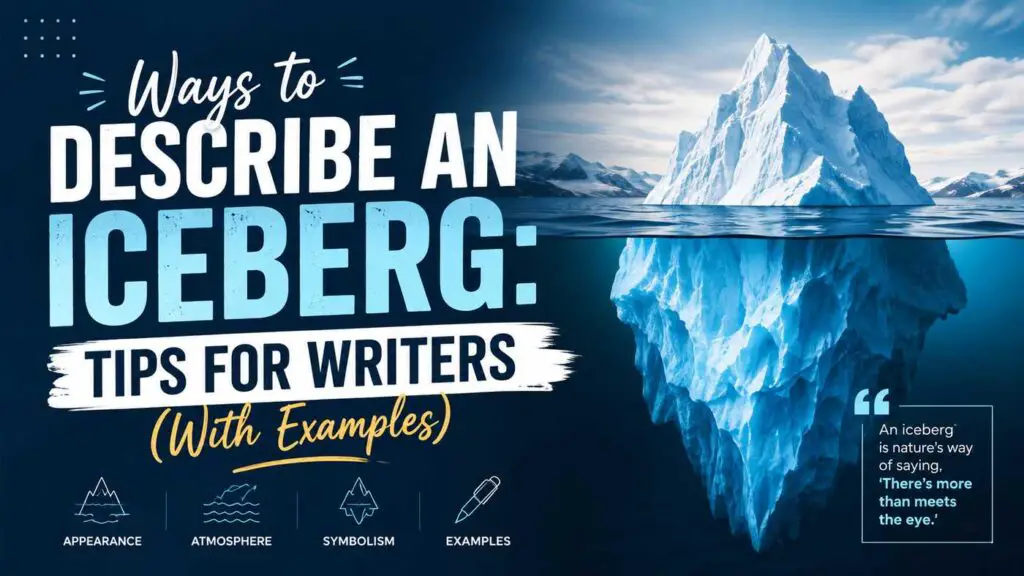
An iceberg is a mountain that travels — a piece of a glacier out on its own, blue-hearted, nine-tenths hidden, older than every ship that steers around it. Writers reach for icebergs in polar fiction, sea stories, climate narratives, and (thanks to one famous night in 1912) disaster scenes, yet most descriptions stop at “massive wall of ice,” which misses everything strange about them: the colors, the sounds, the danger below the waterline, the fact that they melt, roll, and die. Below are the ways to describe an iceberg, with tips and examples for writers you can study and adapt.
Ways to Describe an Iceberg: Tips for Writers (With Examples)
#1. Get the Colors Right — Ice Isn’t White
Dense, ancient, air-free ice runs blue — from pale glass to a deep, lit-from-within cobalt in the cracks — while snow-covered surfaces blaze white and meltwater pools turquoise. Writing the blues accurately is the fastest way to signal you’ve actually looked at one; the color astonishes every first-time witness.
The berg was white only at its edges; its crevasses burned a deep glacial blue, as if the thing carried its own cold light source somewhere inside.
Nobody had warned her about the blue — a blue with no sky in it, older and colder, the color of pressure itself.
At sunset the berg took the light like a screen — rose, then violet, then a blue that belonged entirely to itself again once the sun gave up.
#2. Work the Hidden Nine-Tenths
The iceberg’s most famous fact is its best dramatic tool — the mass below the waterline, glimpsed as a pale green ghost-shape spreading under a hull — and the underwater bulk is where the real danger and the real awe live. What shows is the introduction; what doesn’t is the plot.
From the rail the berg looked modest, almost polite — and then the water around it resolved, and the pale green enormity underneath ran out and down further than the light did.
The captain steered by what he couldn’t see, giving the visible ice a berth that looked like cowardice to passengers and like arithmetic to anyone who’d read a hull report.
Under the kayak the white shelf kept going — a submerged country with its own dim daylight — and she paddled over it holding her breath like a trespasser.
#3. Give It Sound — Icebergs Are Loud
Ice talks — cracks like rifle shots as stresses release, groans and pops of ancient air escaping, the roar of calving, meltwater trickling in a thousand seams — and the soundtrack surprises readers who expect silence. A berg heard through fog before it’s seen is suspense the Arctic provides free.
The berg announced itself through the fog with a crack like artillery, then a long grinding sigh — ice rearranging its opinion of itself somewhere out in the white.
Up close it fizzed — the hiss of ten-thousand-year-old air leaving the melting ice in bubbles, the berg exhaling its entire archive one pop at a time.
All night the anchored crew listened to it work — groans, cracks, the occasional slide and splash — a neighbor renovating at terrible hours.
#4. Convey Scale Against Ships and Shores
Iceberg size needs a ruler — the ship it dwarfs, the harbor it blocks, the town that comes out to photograph it — and human reference converts tonnage into experience. The berg’s indifference to the comparison is part of the description: it isn’t big next to the ship; the ship is small next to it.
They steamed alongside for twenty minutes and the berg was still going — a white coastline with no country attached — and the ship, which had felt large in port, downgraded itself.
The berg grounded in the bay in June and became municipal — photographed from every porch, given a nickname, consulted like a mountain — until August took it apart.
Against it, the fishing boat read like a toy on a windowsill beneath a wardrobe.
#5. Write the Danger — Rolls, Calving, and the Cold Sea
Icebergs kill in specific ways — calving chunks that swamp boats, sudden rolls as melt shifts their balance, the waves both send out, and the underlying rule that nearness is gambling. Experienced characters keep distance and watch for the lean; the berg’s instability is the scene’s loaded gun.
“She’s leaning,” the guide said, already turning the boat, and ninety seconds later the tower they’d been photographing lay down into the sea with a boom they felt in their chests.
The berg rolled in the night — they heard it, a city block turning over in bed — and at dawn its drowned side was up, slick and dark and strange as a surfaced whale.
The old skipper’s rule had no exceptions: admire it at a distance you’d be embarrassed to explain, because the water was four minutes of survivable and the ice made its decisions without minutes.
#6. Honor Its Age and Origin
An iceberg is fossil weather — snow that fell before the pyramids, compressed to ice, carried to the sea in a glacier’s slow procession and finally set loose — and its deep time gives any scene gravity. The air bubbles popping out of it are an ancient atmosphere, breathable news from another epoch.
The ice in her glass — chipped from a beached growler by the cook, a tourist ritual — cracked and released air that had last been breathed by nothing at all, ten thousand years before the ship’s flag had a country.
It had left the glacier before his grandfather was born, the guide said, and would be gone before the summer was — a long life and a short retirement.
Somewhere in its layers was the snow of forgotten winters, stacked like unread correspondence, and the sea was finally opening all of it at once.
#7. Let It Melt — the Iceberg as Mortal
Bergs are dying from the moment they calve — streaming meltwater, shedding growlers, shrinking through grotesque and beautiful shapes toward nothing — and their mortality is the modern iceberg’s emotional register, freighted now with climate meaning. A berg tracked across a season is an elegy with coordinates.
By August the town’s berg had melted from cathedral to schooner to swan, and the harbormaster photographed it daily like a relative in decline.
Meltwater ran off it in bright threads all afternoon, the berg quietly paying itself out into the sea that would have it.
Her grandfather had navigated by bergs that came every June like schedule keepers; she had brought her daughter to see one, singular, the way you visit something to say goodbye.
#8. Use the Metaphor Knowingly — or Dodge It
“Tip of the iceberg” and Titanic shorthand are so embedded that any fictional berg drags them along — so either play the resonance deliberately or defuse it with specificity that makes your berg too particular to be a symbol. The worst outcome is accidental cliché: a berg that means “hidden depths” without meaning to.
She knew the metaphor was waiting for her and refused it — this berg wasn’t the tip of anything; it was all of something, and most of it was leaving.
The draft’s berg loomed like fate; the revision’s had a specific overhang, one grounded corner, and a smell — cold stone and brine — and stopped auditioning for symbolism.
Every passenger made the same joke at the rail, and the first officer smiled at each one and privately gave the ice the distance his profession had learned in 1912.
Closing Thoughts
The iceberg is one of the few subjects where the facts outperform invention — blue-hearted, nine-tenths secret, loud as artillery, older than nations, and dying from the day it’s born. A writer’s whole job here is not to decorate but to select: the fizz of ancient air, the lean before the roll, the town photographing its shrinking guest. Get the blue right and readers will trust the rest; get the danger right and they’ll feel the cold arithmetic of the water. And handle the famous metaphor on purpose, because it’s aboard whether you invited it or not — nine-tenths of any iceberg scene is what you decided not to say about hidden depths.