
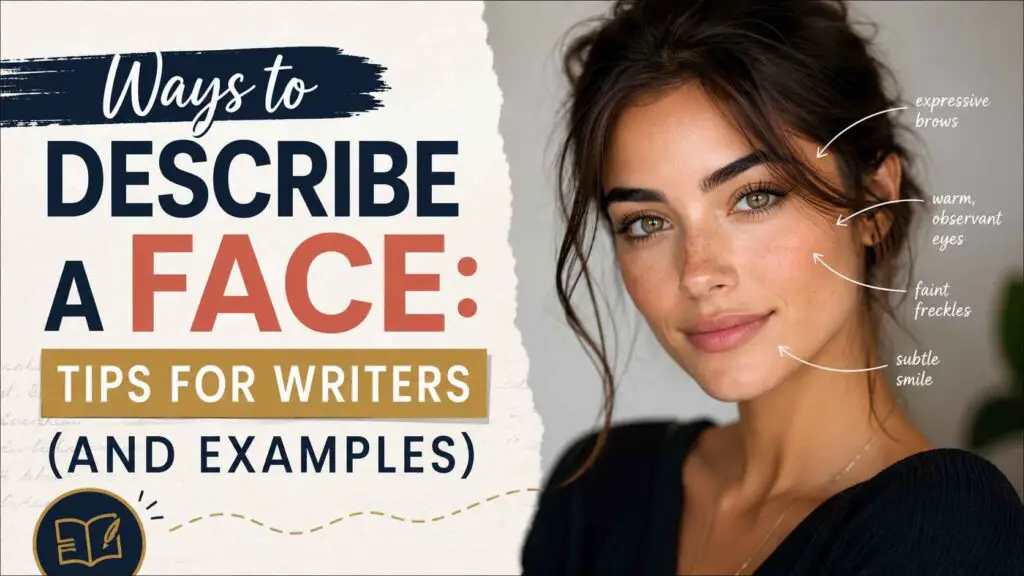
Describing a face is the portrait problem in miniature: you have a few sentences to make a reader see someone they will never see, and the standard solution — hair color, eye color, height, done — produces a police report, not a person. The paradox of face description is that completeness kills it. Readers don’t build faces from inventories; they build them from one or two live details and their own imagination, the same way we remember real faces by a single feature, an expression, a way of turning. The craft is choosing which details do the work of all the rest.
Here’s how to choose them.
Ways to Describe a Face: Tips for Writers (And Examples)
#1. Two Details Beat Ten
Pick the two features a stranger would actually remember and stop there — the reader’s mind renders the rest at higher resolution than you ever could. The skill is selection: the chosen details must be specific enough to exclude most other faces, or they aren’t doing their job.
She had a boxer’s flattened nose on a librarian’s delicate face, and nobody who met her ever asked about the one thing they all remembered.
What you kept of Okonkwo’s face was the gap in his front teeth and the way his eyes arrived a moment before his smile, checking the room’s exits.
Describe her? Pale lashes, and a jaw she carried like an argument she was prepared to have. That was the whole face; that was plenty.
#2. Faces Exist in Motion
A face at rest is a photograph; a face in use is a person. Describe how the features behave — a smile that starts on one side, eyes that leave a conversation early, a laugh that takes the whole face by surprise — and the reader gets both appearance and character in one purchase.
His smile was a two-stage mechanism — the mouth first, polite and immediate, then the eyes a beat later, if you’d earned them.
When she listened — really listened — her whole face leaned into it, like a sunflower doing its job.
You could watch thoughts cross Ray’s face like weather crossing an open county — nothing hidden, everything arriving, one front after another.
#3. Let the Viewer’s Bias Choose
Nobody sees a face neutrally — a rival sees the smugness, a lover sees the tiredness, a child sees the size. Filtering the description through who is looking (and what they want) makes the same face mean different things in different scenes, and characterizes the observer along the way.
To the interview panel he was a strong chin and a good haircut; to his sister in the corridor after, he was all tells — the pressed lips, the childhood flush climbing his neck.
She had reached the age where waiters saw nothing at all, and the age, simultaneously, where her granddaughter could not stop studying her face like a map of somewhere they were both from.
The mugshot showed a hard case; the wedding photo, same year, same face, showed a boy holding still for luck. Both were accurate. Neither was true.
#4. Resemblance Is Description Plus History
Describing a face through family — her mother’s mouth, his grandfather’s ears, the family nose arriving in a new generation — delivers appearance and backstory in one stroke. Resemblance also carries emotion: seeing a dead father look out of a living son’s face is description doing grief’s work.
The boy had his grandmother’s mouth, which unsettled the whole family at Christmas — that particular pursed patience, dead eleven years, buttering toast again.
She was her father from the eyebrows up and her mother from the cheekbones down, and when she was angry the two halves finally agreed on something.
Strangers said the sisters were identical. The sisters knew better: Lena’s face asked questions, Vera’s face graded the answers.
#5. Light and Context Re-Describe
The same face changes by lamp, dawn, fluorescent office, and firelight — and by circumstance: exhaustion, joy, fear, and illness all recast the features. Re-describing a known face under new conditions is how you keep a main character visible across a whole book without repeating the introduction.
Under the ward’s fluorescents her face went documentary — every year on record, no cinematography — and he loved it stubbornly in that light too.
Firelight redistributed his face: softened the scar, deepened the eye sockets, promoted the cheekbones — the same man, edited for evening.
Fear simplified her face, took away everything ornamental, and what remained — planes, eyes, purpose — was the face her passport had been trying to photograph for years.
#6. Memorable Isn’t Beautiful
Beauty is the least descriptive thing you can say about a face — it’s a rating, not a picture. Interesting faces are asymmetric, lived-in, off-pattern: too-wide mouths, mismatched profiles, a handsomeness that’s almost an error. Write the deviation from standard, not the score.
She wasn’t beautiful in any way a catalog could use — the mouth too wide, the eyes set a fraction deep — but hers was the face the room kept checking back to, the way you reread the one interesting sentence.
His face missed handsome by one feature, and everyone disagreed about which one, which was somehow the appeal.
The baby had a boxer-promoter’s face — jowly, shrewd, faintly cigared — and the whole family privately conceded she would grow into power.
#7. The Face Doing Its Job
Professions and habits train faces — the customer-service smile that never reaches cargo altitude, the poker player’s flat courtesy, the teacher’s warning look refined over decades. Describing a face’s occupational equipment tells the reader what this person does all day and what it has cost.
Twenty years of nursing had given her a face that could receive any news at all — a level, kind readiness that patients trusted and her daughters found impossible to fight with.
The maître d’ wore professional delight like a clip-on tie, and the real face underneath did inventory.
Judge Okafor’s face had two settings, patience and more patience, and attorneys who mistook the second for approval did so exactly once.
#8. First Impressions Get Revised
Real acquaintance rewrites faces — the plain face that becomes beloved and therefore beautiful, the striking one that goes ordinary once the charm is spent. Describing a face twice, before and after knowing, measures the relationship without a word of summary, and readers feel the revision as intimacy.
The first week she’d have called his face unremarkable. By June she could not find the unremarkable version anywhere — it had been replaced, feature by feature, by his.
Handsome lasted about a month. After that she could see the impatience living in the good bones, a tenant the architecture had been hiding.
He met his own face in shop windows all his life as a mild disappointment — until the twins learned it, lit up at it, demanded it at every doorway, and made it, late in the day, a face worth wearing.
#9. Burn the Police Blotter
The cliché here is the inventory paragraph: “She had long brown hair, blue eyes, high cheekbones, and full lips” — data that vanishes on contact, plus the mirror scene invented to deliver it. The repair: cut the stats, keep one live detail, and never let a character inspect themselves for the reader’s benefit.
Blotter version: brown hair, green eyes, freckles. Living version: a redhead gone sensible brown out of professional necessity, with the freckles holding out against the office like natives of a sunnier government.
Nobody in the story ever said he was tall with gray eyes; the reader learned it when he ducked the beam in the boathouse and when Ana, at the funeral, could not stop meeting the wrong gray gaze in a sea of brown ones.
She passed the hallway mirror without consulting it — the book had better uses for her — and her face reached the reader the honest way: through what it did to other faces when it entered a room.
Closing Thoughts
Run the recall test on your last character introduction: close the file, wait an hour, and try to draw the face from memory — or better, ask a friend who read it to describe the character back to you. If what returns is a list (“brown hair… eyes?”), the description was data and it’s already gone. If what returns is an image — the flattened nose, the two-stage smile, the jaw carried like an argument — you chose the right details. Faces survive in single strokes, in fiction exactly as in life. Write the stroke a stranger would testify to, and delete the rest.