
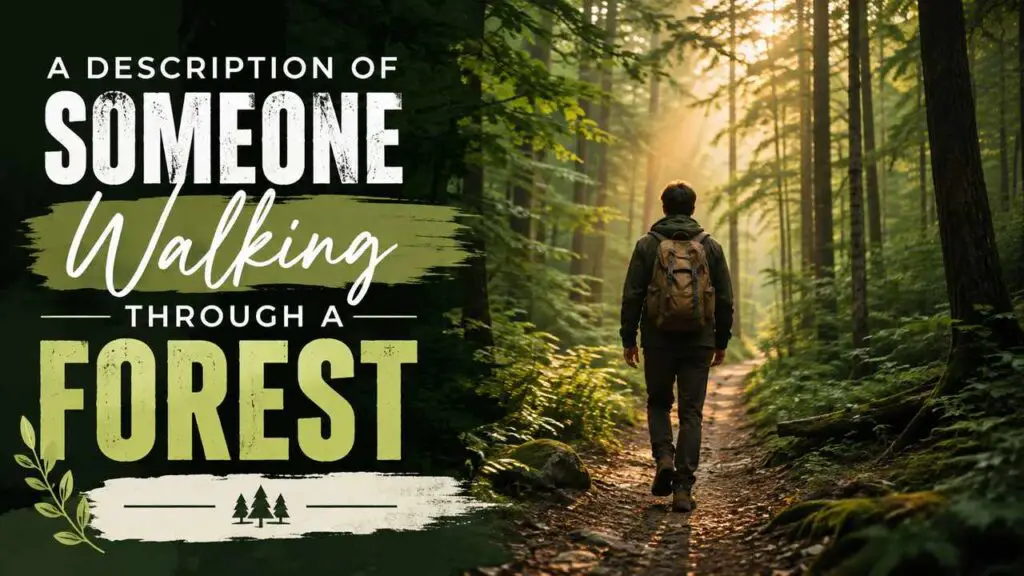
Describing a forest and describing someone walking through one are different assignments — the first is a place, the second is a scene in motion, with a body negotiating ground, a mind running its parallel track, and a wood revealing itself at three miles an hour. The walking version is what stories actually need: characters cross forests on the way to plot, and the crossing is where mood, memory, and foreshadowing get done. The failure mode is scenery narration with legs; the craft is keeping the walker — feet, breath, thoughts, and fears — at the center of every sentence.
Here’s how to write the walk itself.
A Description of Someone Walking Through a Forest
#1. Start With the Feet
The walk is felt from the ground up — roots read through boot soles, the path’s soft and firm patches, the different sounds of needle floor and beech litter. Writing the footwork keeps the scene in a body, and the ground’s changes narrate the forest’s changes without a single vista.
Her boots learned the path as she went — the mattress hush of needles, the crackle where the beeches took over, the root that crossed at ankle height and had clearly claimed shins before.
He walked the streambed stones with his arms out like a tightrope act, and the forest’s whole crossing narrowed, for two minutes, to the honest question of the next wet rock.
The mud archived everyone before her — boot prints, a dog’s stitching, one deer’s neat diacritics — and she added her own signature to the page as she went.
#2. Let the Pace Set the Prose
An amble, a hike, and a flight through trees are three different scenes — and the sentence rhythm should match the stride. Long unhurried sentences for the wanderer; efficient clauses for the hiker; short breathless fragments for the runner. The reader’s pulse follows the punctuation.
She wandered rather than walked, stopping for whatever asked — a feather, a fungus shelf, a shaft of light worth standing in — the path less a route than a suggestion she kept declining.
He kept hiking pace: steady, breath and boots in rhythm, the kilometers going under him in installments, the forest sliding past at the speed of a man with somewhere to be by dark.
Branches. Face. Duck. The path gone. Roots grabbing. Breath ragged. Behind her — still — the sound that was not the wind.
#3. The Senses Arrive in Walking Order
A walker meets the forest sequentially — the cool at the treeline, resin on a warm rise, a stream heard long before seen. Deliver sensations in the order the trail delivers them and the description gains a built-in itinerary; the reader walks the sequence with the character.
The stream announced itself ten minutes early — a hush growing under the birdsong — and the path bent toward the sound the way paths always have, water being the oldest argument for a left turn.
On the warm south rise the pines gave up their resin smell, and for fifty meters the walk was all turpentine and heat; then the trail dropped into the hollow and the air went cellar-cool and mushroomy — the forest’s climates crossed on foot, one per bend.
First light through trunks, then coins of it on the path, then one full shaft where the fallen oak had opened a skylight — the walk collecting the morning in pieces.
#4. Run the Mind’s Parallel Track
Walking loosens thinking — the argument replayed, the decision circling, memory surfacing at an old landmark — and the forest walk is fiction’s favorite thinking chamber. Alternate outer path and inner path; where the two converge (a thought resolved at the wood’s far edge) is the scene’s real destination.
She took the quarrel into the wood the way you take a stone from your shoe eventually — walked it, turned it, walked it — and somewhere past the second bridge it had become smaller, older, and mostly her own fault, which the trees had known all along.
At the lightning oak his father surfaced, as he did at every walk’s this point — the whistle, the penknife, the lesson about widow-makers — a man met reliably at one bend of a path, twenty years dead everywhere else.
He entered the wood undecided and came out at the far stile decided — nothing in between but trees, breath, and three miles — the forest having done what it does to questions, which is walk them until they soften.
#5. The Path Negotiates; the Walker Answers
The trail is a character — forking without signage, fading in bracken, offering deer paths as counterfeits, funneling the walker where the land wants. Write the small navigational dramas: each fork chosen, each faint stretch trusted, is the walk’s plot in miniature.
The path forked without comment — both branches equally trodden, equally confident — and she stood a moment at the wood’s small unmarked decision before taking the one that went up, on no grounds at all.
What he’d been following thinned, hesitated, and revealed itself as a deer path — a trail with different priorities — and the wood stood around him suddenly authorless, every direction equally unendorsed.
The trail squeezed between the crag and the fallen spruce, and everyone who had ever walked this wood had passed through that same two-foot gap — the forest’s turnstile, polishing boots for a century.
#6. Company Changes the Walk
Who walks matters — single file forcing talk over shoulders, the dog running its joyful perimeter, the child collecting sticks, silences that walking makes companionable. The same trail is a different scene per cast; write the choreography of walking together.
The path was single file, so the conversation went over her shoulder in pieces, and the hard thing he had to say waited, as hard things do, for the wide stretch by the river where they could finally walk abreast.
The dog ran the walk in triplicate — ahead, back to report, ahead again — sewing the family to the path with long joyful stitches.
They walked the last mile in silence, and it was the good kind — two people letting the wood do the talking — a quiet that would have been awkward anywhere without trees.
#7. Mark the Walk’s Phases
A forest walk has acts — the bright entry, the deep middle where the entrance is forgotten, the subtle turn (light failing, energy flagging, mood shifting), and the emergence. Structure the walk in phases and even an uneventful crossing carries a narrative arc.
There was a point — she felt it pass — where the walk stopped being from the car park and became toward the far side: the wood’s middle, where both edges are rumors and the trees run the government.
The turn came quietly: the coins of light going amber, the birds changing shift, his legs sending up their first invoices — the walk’s afternoon arriving in the wood an hour before the sky’s.
The trees thinned, the light widened, and the field arrived like applause — the walk ending as walks do, with the walker slightly different and the wood exactly the same.
#8. Retire the Sunlight-Dappled Stroll
“She strolled through the sun-dappled forest, taking in the sights and sounds of nature” — the kit that walks nowhere: dappled doing all the light’s work, “sights and sounds” doing none. The repair is the walker’s rule: every sentence must contain the body or the mind of the person walking. Scenery with no one in it is the other article; this one has feet.
Kit version: she strolled through the dappled woods. Walker’s version: she clocked the mile by her boots’ rhythm and her breath’s, hood down to hear better, hands cold, mind six miles ahead at the hospital and returning, every few minutes, to the path’s roots like a tongue to a loose tooth.
He did not take in the sights and sounds; the wood administered them — a jay’s alarm that spiked his pulse, resin on the warm rise, the crack of his own step on a dead branch that stopped him cold, listening, counting.
Nothing dappled: the light hit the path in moving coins she walked through — bright, dark, bright — her own hands flickering lit and unlit before her like frames of a film about her hands.
Closing Thoughts
One revision test covers this whole article: go through your forest-walk scene and check every sentence for the walker — their feet, breath, pace, thought, or fear. Sentences that are pure scenery belong to a different kind of description; here, each one should move a body or a mind at least a step. Then read the scene aloud at the walk’s own pace and listen for the rhythm matching the stride. A forest walk on the page succeeds when the reader arrives at the far stile slightly out of breath and slightly changed — exactly like the character, exactly like every real walk worth taking.