Allusion lets a writer say more than the words on the page actually state, borrowing meaning from something the reader already knows — a story, a figure, an event — and folding it quietly into a new context. Done well, it rewards an attentive reader with an extra layer of resonance without ever slowing the narrative down to explain itself. Different types of allusion draw on different shared knowledge, from scripture to pop culture, and each carries its own tone and effect. Below are the major types of allusion writers use, and how each one deepens a story, with examples you can study and adapt.
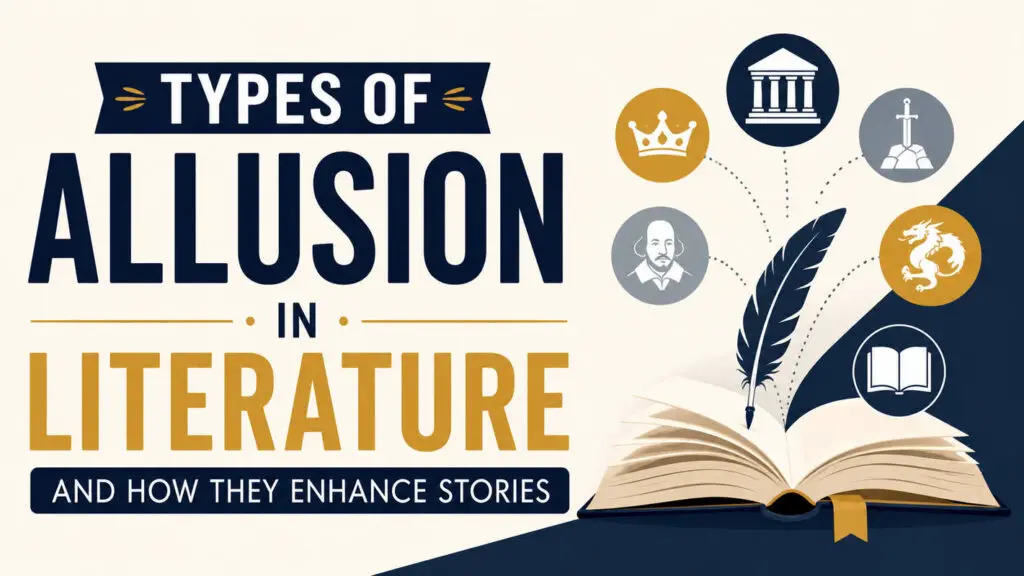
Types of Allusion in Literature and How They Enhance Stories
#1. Biblical Allusion
Referencing scripture, biblical figures, or religious imagery taps into centuries of shared cultural weight, often lending a story a sense of moral gravity or inevitability. Even in secular fiction, biblical allusion can frame a character’s choice as a fall, a betrayal, or a sacrifice without the narrator ever using those exact words.
He carried the guilt the way Cain must have — not as a single weight, but as something that followed him into every room.
She’d been the one to open the letter, and now she understood, a little too well, how Pandora must have felt afterward.
He washed his hands twice at the sink, an old habit he refused to examine too closely.
#2. Mythological Allusion
Drawing on Greek, Roman, Norse, or other mythologies gives writers a shorthand for grand, archetypal patterns — hubris, temptation, transformation — that readers recognize instinctively. A single mythological reference can elevate an ordinary conflict into something that feels timeless.
He’d flown too close to the deal from the start, and everyone in the office had quietly started taking bets on when the wings would melt.
She kept looking back at the life she’d left, even though some part of her already knew what that always cost.
His temper had a way of turning perfectly reasonable people to stone, one clipped sentence at a time.
#3. Historical Allusion
Referencing real events, figures, or eras situates a story within a larger continuum of human experience, often using history’s echoes to comment on the present. Historical allusion can lend urgency to a plot by suggesting that current events rhyme with past ones.
The line outside the bank stretched around the block, the kind of image she’d only ever seen before in photographs from her grandmother’s stories.
He gave the order without hesitation, the way men in his position always seemed to when the history books weren’t watching yet.
The speech borrowed its cadence, if not its words, from every leader who’d ever needed a frightened crowd to feel briefly less afraid.
#4. Literary Allusion
Referencing other works of literature — their characters, plots, or famous lines — invites readers into a kind of conversation between texts, deepening a story for anyone who catches the reference while still functioning for those who don’t. This type of allusion often signals genre, tone, or thematic intent early in a narrative.
She half expected a white rabbit to dash past, the day had already gone that strange.
He’d been chasing the same green light for years now, though he’d stopped admitting it was a light at all.
The old house had its own Miss Havisham energy, clocks stopped at an hour no one living could explain.
#5. Allusion to Pop Culture
Referencing films, music, television, or celebrities grounds a story firmly in a specific cultural moment and can create instant, informal intimacy with a contemporary reader. Pop culture allusion works fast, but it also dates quickly, so writers use it deliberately to fix a story in a particular time.
He hummed the theme song under his breath without realizing it, the way people his age always did when they were nervous.
She said it in her best late-night-host voice, the joke landing exactly the way she’d hoped it would with this crowd.
The whole office had the same ringtone that summer, a fact that felt significant only in hindsight.
#6. Allusion to Fairy Tales and Folklore
Referencing fairy tales and folk stories lets writers tap into deeply familiar narrative shapes — the wicked stepmother, the poisoned apple, the wolf at the door — often to subvert or complicate them. This type of allusion can add irony when a story deliberately fails to follow the expected fairy-tale ending.
She’d been waiting for a glass slipper to fall into her lap for so long that she’d forgotten most people just buy their own shoes.
He kept expecting the woods to open into a house made of something sweeter than what he actually found.
There was no wolf at the door, in the end — just a landlord, and a lease that had run out months ago.
#7. Allusion to Art and Music
Referencing paintings, composers, or specific pieces of music can characterize a person quickly through what they choose to reference, while also setting a visual or emotional tone for a scene. This type of allusion often works best when tied closely to a character’s taste or background.
The light through the blinds fell across her face in stripes, almost deliberately, like something out of a painting neither of them could name.
He played the same four bars over and over, chasing a resolution the composer had clearly never intended him to find.
The whole apartment had a kind of still-life quality to it, everything arranged and nothing actually touched.
#8. Political Allusion
Referencing political figures, movements, or ideologies can layer commentary into a story without the narrative stopping to editorialize directly. This type of allusion is especially useful for satire, where a fictional stand-in lets a writer critique real events from a safe narrative distance.
The mayor’s promises had the same shelf life as every campaign season before it, forgotten by the first frost.
He gave speeches full of walls that were never actually about walls, and everyone in the room understood exactly which one he meant.
The committee’s decision came down along lines so predictable that no one bothered pretending to be surprised.
#9. Self-Allusion and Intertextual Reference
Referencing a writer’s own earlier work — a recurring image, a character’s name, a familiar line — rewards long-time readers and can build a sense of a larger, connected universe across otherwise separate stories. This type of allusion often functions as a quiet signature, recognizable mainly to a writer’s most attentive audience.
The house on the corner looked, to anyone who’d read her earlier novels, suspiciously like the one that kept burning down in all of them.
He introduced himself with the same line he’d given a different character in a different book entirely, a joke only a handful of readers would ever catch.
The dog’s name was the same one that kept appearing across three unrelated stories, never explained, never acknowledged.
Closing Thoughts
Allusion works because it lets a story borrow meaning it hasn’t had to build from scratch, whether that meaning comes from scripture, myth, history, or a writer’s own earlier pages. Used with restraint and matched carefully to tone, allusion rewards attentive readers with resonance while still holding together for those who miss the reference entirely — which is exactly what makes it one of fiction’s most efficient tools.