
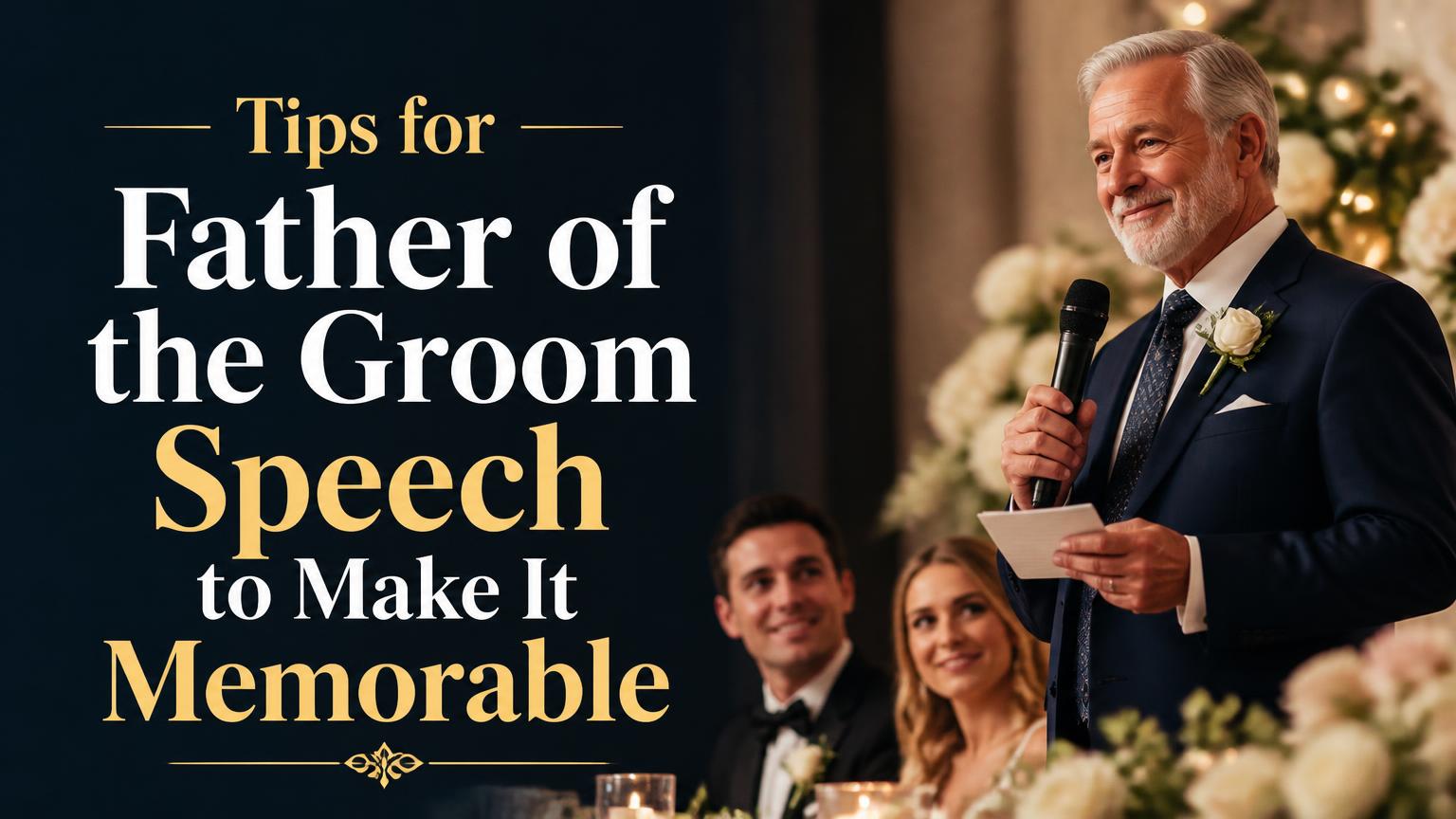
If you have been asked to give a father of the groom speech, your role is more than introducing yourself or listing your son’s achievements. You are helping welcome guests, honor the couple, and offer a personal perspective on the man your son has become. The most memorable speeches are usually warm, specific, and concise rather than elaborate. The tips below will help you choose meaningful material, acknowledge both families, use humor carefully, and deliver a wedding speech that sounds genuinely like you.
Tips for a Father of the Groom Speech
A memorable father of the groom speech usually combines three elements: a sincere welcome, a personal glimpse of the groom, and generous attention to the couple’s future together. You do not need to tell your son’s entire life story. Choose a few details that reveal his character and connect naturally to the occasion.
Wedding customs vary between families, cultures, religions, and venues, so confirm the expected format with the couple or wedding coordinator. In many celebrations, the speech lasts roughly three to five minutes, but the schedule may call for something shorter. Aim to leave the audience with affection for the couple, not with the feeling that the speech has delayed the evening.
Clarify Your Role Before You Draft
Before writing, ask what the couple wants your speech to accomplish. You may be expected to welcome guests, thank people who helped with the wedding, speak about your son, acknowledge his partner, or raise a toast. Sometimes another family member will already cover certain subjects, such as formal thank-yous or family history.
Knowing the wider program prevents repetition and helps you choose the right emphasis. Your speech should support the couple’s celebration rather than compete with it. If the couple has requested a particular tone, length, cultural tradition, or subject to avoid, treat those wishes as part of your responsibility as a speaker.
Choose One Message to Carry Through the Speech
Select one central idea before collecting stories. It might be that your son has always shown quiet determination, that he brings people together, or that his relationship has helped him become even more fully himself. A clear message gives the speech shape and makes it easier to decide which memories belong.
Once you have chosen the message, select two or three supporting moments rather than trying to mention everything. For example, a story about your son helping someone during a difficult time may say more about his character than a long list of accomplishments. Return briefly to your central idea near the end so the speech feels unified.
Open With Welcome and Gratitude
Begin by acknowledging the people who have gathered to celebrate the marriage. A simple welcome can include thanks to relatives, friends, guests who traveled, and anyone whose work made the day possible. Keep this section sincere and brief; it should open the door to the personal part of the speech, not become a roll call.
You might say, “Thank you all for being here to celebrate [Son’s Name] and [Partner’s Name]. Seeing so many people they love in one room is a wonderful reminder of how many lives they have brought together.” Adapt the wording to your voice and the formality of the wedding. Avoid thanking guests for attending as though you are delivering an official announcement unless that suits the event.
Tell a Story That Reveals Your Son
Choose a story with a beginning, a small turning point, and a clear connection to your son’s character. The event does not need to be dramatic. A childhood habit, a difficult decision, a family responsibility, or an ordinary moment that showed patience or loyalty can be powerful when described specifically.
Give the audience enough context to follow the story, then explain why it matters. Do not assume everyone understands the significance of a family nickname or private reference. A useful test is to ask, “What does this story help guests see about him?” If the answer is unclear, choose another memory or add a sentence that makes the connection explicit.
Welcome Your Son’s Partner and Both Families
The speech should celebrate the relationship, not treat the partner as a guest who has joined your son’s story. Speak directly about what you appreciate in [Partner’s Name], using observations that are genuine and respectful. You might mention the way they support one another, make people feel included, or approach life as a team.
If appropriate, acknowledge the partner’s family and express pleasure at the families becoming connected. Do not make assumptions about family closeness, surnames, gender roles, or traditions. A gracious welcome can be as simple as thanking the partner’s family for sharing in the day and saying that you look forward to the relationship continuing beyond the wedding.
Use Humor That Serves the Couple
Gentle humor can make a wedding speech sound relaxed, but the joke should invite the audience into the celebration rather than place the groom or his partner on display. Good humor often comes from a harmless family pattern, your own limitations, or an affectionate observation that the couple would be comfortable hearing repeated in public.
Avoid stories involving intoxication, former relationships, sexual behavior, serious conflict, private medical matters, or anything the couple has not approved. Do not use humor to criticize the partner, compare families, or suggest that marriage has taken your son away from you. If you are uncertain whether a joke is kind, necessary, and safe for the audience, leave it out.
Build a Toast-Worthy Ending
The closing should move from memory to the couple’s shared future. Offer a sincere wish rather than a collection of vague compliments. You might express hope that they continue to give each other patience, laughter, steadiness, or room to grow. The best wishes are usually connected to something you have already shown in the speech.
End clearly so guests know when to respond. For example: “To [Son’s Name] and [Partner’s Name], may your life together be filled with the same kindness and good humor you have shown the people around you. Please raise your glasses to the happy couple.” Check whether the venue follows a particular toast tradition, and use the couple’s preferred names and pronouns.
Edit for the Ear and Rehearse Aloud
A speech that looks polished on the page may be difficult to deliver. Read it aloud several times and listen for long sentences, repeated ideas, formal phrases, and transitions that feel unnatural. Replace written expressions with the words you would actually use in conversation. Mark pauses after emotional points and before the toast.
Time yourself while speaking at a calm, conversational pace. If the speech is too long, remove extra background before removing the story’s meaning. Prepare large-print notes or cue cards with short prompts rather than dense paragraphs. Rehearse enough to know the route through the speech, but do not memorize every word if that would make your delivery stiff.
Common Mistakes to Avoid in a Father of the Groom Speech
A father of the groom speech can become difficult when the speaker feels pressure to be especially funny, profound, or comprehensive. The safest standard is simple: everything you say should contribute to the couple’s happiness and help the audience understand why this marriage matters to you. A speech does not need a dramatic revelation to be memorable.
Think carefully about the people in the room. A wedding audience may include children, older relatives, colleagues, close friends, and guests from different backgrounds. Material that seems harmless in a private family gathering may feel uncomfortable in a formal celebration. When in doubt, choose warmth, specificity, and restraint.
Making the Speech Mostly About Yourself
Your perspective matters because you are the groom’s father, but the wedding is not an occasion to recount your own life or make a long speech about parenting. A brief personal reflection can provide context; an extended account of your sacrifices, career, opinions, or family history can pull attention away from the couple.
Use yourself as a guide into the subject rather than as the subject itself. Instead of describing every stage of raising your son, select one moment that shows who he is now. Then connect that quality to his relationship with his partner. This keeps the speech personal while maintaining the correct focus.
Using Embarrassment as Entertainment
Some speakers assume a wedding audience wants revealing childhood stories or embarrassing details. In reality, a story can receive laughter and still leave the couple wishing it had not been told. Public embarrassment is especially risky when the partner’s family, work colleagues, or people from different generations are present.
Before including a potentially awkward story, ask the couple for permission. Consider whether the story protects their dignity, whether the humor depends on private information, and whether you would be comfortable hearing it told about you. If the anecdote is funny only because someone is exposed or humiliated, it does not belong in the speech.
Treating the Partner as an Afterthought
A speech that praises the groom for several minutes and then adds, “And of course, [Partner’s Name] is wonderful too,” can sound dismissive even when that is not the intention. The partner deserves more than a final mention because the occasion celebrates their relationship and marriage.
Include the partner naturally rather than forcing a separate paragraph of compliments. Describe a quality you have observed, explain how the couple brings out the best in each other, or welcome the partner into the family in language that feels authentic. Specific appreciation is more convincing than exaggerated praise.
Letting the Speech Run Too Long
Long speeches often contain good material, but the strongest moments lose their effect when surrounded by too much explanation. Repetition is common: the speaker tells several versions of how proud he is, offers multiple childhood stories that make the same point, and thanks the same people more than once.
Ask someone you trust to identify the sections that feel most engaging and the parts that could be shortened. Keep the story with the clearest detail, the most relevant message, and the strongest connection to the couple. A concise speech often feels more confident and gives the wedding program room to continue smoothly.
Depending on Alcohol or Improvisation
A drink may seem to reduce nerves, but relying on alcohol can affect timing, volume, judgment, and emotional control. It is wiser to rehearse, eat beforehand if appropriate, keep water nearby, and decide in advance how much you want to drink before speaking. You should be able to deliver the speech clearly without depending on anything that alters your concentration.
Improvising may also cause you to lose the ending or repeat yourself. You do not need a full manuscript if you prefer speaking from notes, but prepare a clear outline with the opening, story points, partner acknowledgment, and toast. If emotion interrupts you, pause, breathe, look at your notes, and continue when ready. Taking a moment is more composed than rushing.
Closing Thoughts
The best father of the groom speech is not the one with the cleverest joke or the most impressive vocabulary. It is the one that sounds sincere, respects the couple, and gives guests a meaningful glimpse of the groom and his relationship. Choose a few authentic details, welcome your son’s partner generously, keep the message focused, and rehearse aloud. With thoughtful preparation, your words can become a warm and lasting part of the wedding day.