
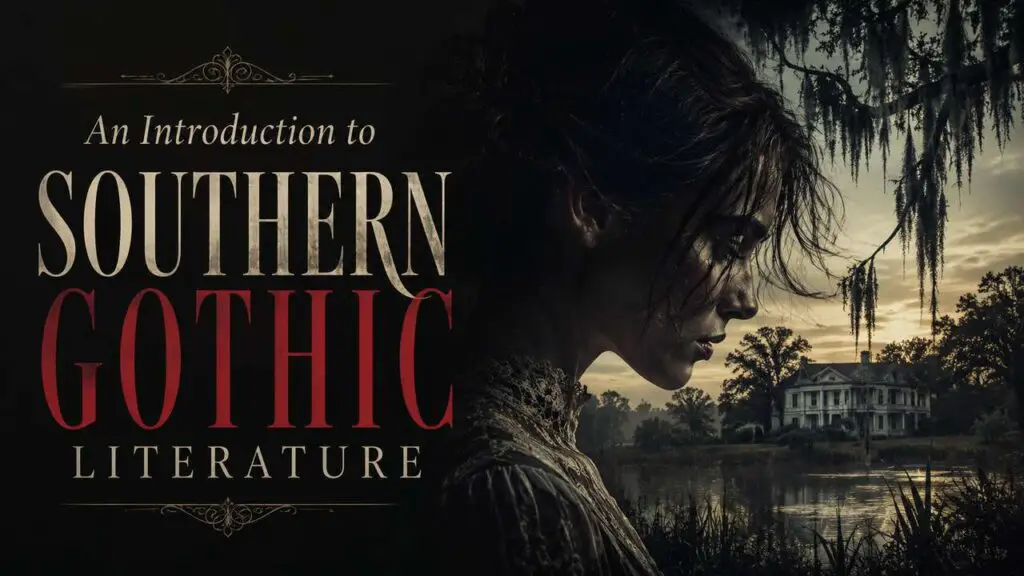
Southern Gothic literature is one of the most distinctive traditions in American fiction. It blends dark settings, troubled characters, moral tension, and the haunting history of the American South. Unlike ordinary Gothic stories, which often rely on castles, ghosts, and supernatural terror, Southern Gothic literature finds horror in families, towns, churches, racial injustice, poverty, and social decay. It shows that the past is never fully gone. It lingers in old houses, damaged relationships, buried secrets, and broken communities. This article introduces the meaning, origins, characteristics, themes, authors, and major works of Southern Gothic literature.
What Is Southern Gothic Literature?
Southern Gothic literature is a subgenre of Gothic fiction set in the American South. It uses disturbing characters, decaying settings, violence, irony, and moral conflict to explore the darker side of Southern life and history.
The genre often focuses on people who are isolated, damaged, eccentric, or trapped by the past. These characters may seem strange or grotesque, but they are rarely included only for shock. They often reveal deeper truths about society, family, religion, race, class, and human weakness.
Southern Gothic literature differs from traditional Gothic literature in important ways. Traditional Gothic fiction often features medieval castles, haunted mansions, mysterious villains, and supernatural events. Southern Gothic fiction may include mystery or horror, but its fear usually comes from human behavior and social reality. The haunted castle becomes the decaying plantation. The ghost becomes the memory of slavery, violence, guilt, or family trauma.
This is why Southern Gothic literature remains important in American literature. It forces readers to confront uncomfortable truths. It does not present the South as romantic, simple, or innocent. Instead, it shows a region marked by beauty and brutality, faith and hypocrisy, tradition and decay.
The Origins of Southern Gothic Literature
The roots of Southern Gothic literature lie in the history of the American South. The region was shaped by slavery, the Civil War, Reconstruction, racial segregation, poverty, religion, and rigid social traditions. These historical forces created a cultural landscape filled with tension.
After the Civil War, the South faced economic ruin and social upheaval. Old plantations declined. Former social structures were challenged. Many white Southerners clung to myths of a noble past, while Black Southerners continued to face oppression and violence. This conflict between memory and reality became central to Southern Gothic writing.
Religion also played a major role. Christianity, especially Protestant Christianity, deeply influenced Southern culture. Southern Gothic writers often explored sin, judgment, guilt, redemption, and hypocrisy. Their stories show people who speak the language of faith but fail to live with mercy, justice, or honesty.
The genre began to take shape in the late 19th and early 20th centuries. Writers used Gothic elements to examine Southern society more honestly. Instead of presenting the South as charming or heroic, they revealed its hidden wounds. By the time authors like William Faulkner and Flannery O’Connor became central figures, Southern Gothic literature had become one of the most powerful ways to understand the region’s moral and historical complexity.
Key Characteristics of Southern Gothic Literature
Southern Gothic literature has several defining features. These elements often appear together, creating stories that feel strange, unsettling, symbolic, and emotionally intense.
Grotesque Characters
Grotesque characters are one of the most recognizable features of Southern Gothic literature. A grotesque character may be physically unusual, emotionally damaged, morally corrupt, socially isolated, or psychologically disturbed.
However, the grotesque is not simply about ugliness or deformity. In Southern Gothic fiction, grotesque characters often expose truths that polite society tries to hide. They may reveal hypocrisy, cruelty, loneliness, prejudice, or spiritual emptiness.
For example, a character who seems strange or disturbing may actually be the only person who sees the world clearly. Another character may appear respectable but be morally rotten underneath. This contrast is part of what makes Southern Gothic literature so powerful.
Decaying Settings
Southern Gothic stories often take place in decaying settings. These may include ruined plantations, broken-down houses, dusty towns, isolated farms, old churches, or neglected family estates.
These settings are rarely just background details. They often symbolize larger social and moral decline. A collapsing mansion may represent the collapse of an old family. A dying town may reflect economic decay. A ruined plantation may point to the destructive legacy of slavery.
The physical environment in Southern Gothic literature often feels heavy with history. Buildings, roads, graveyards, and landscapes seem to remember what the characters would rather forget.
Themes of Isolation and Alienation
Many Southern Gothic characters are outsiders. They may be rejected because of race, class, disability, sexuality, poverty, personality, or family background. They often live on the edge of society, unable to fully belong.
This isolation can be emotional, social, or spiritual. Characters may feel trapped in their families, towns, marriages, or religious communities. They may long for connection but be unable to find it.
Alienation is important because Southern Gothic literature often explores the conflict between the individual and society. The community may appear orderly on the surface, but underneath it may be cruel, judgmental, or deeply broken.
Violence and Dark Humor
Southern Gothic literature often includes violence. This violence may be physical, emotional, racial, domestic, or psychological. It can appear suddenly and shock the reader.
Yet the genre also uses dark humor. This humor is often ironic, bitter, or absurd. It allows writers to expose uncomfortable truths without making the story feel like a simple moral lecture.
The combination of violence and humor creates a disturbing effect. Readers may laugh and feel unsettled at the same time. This tension is one reason Southern Gothic literature is so memorable.
Religious and Moral Tensions
Religion is another major feature of Southern Gothic literature. Many stories include preachers, churches, sinners, prophets, fanatics, and people struggling with guilt or redemption.
Southern Gothic writers often show the difference between true faith and public religion. A character may appear pious but act cruelly. Another may reject religion but still wrestle with moral questions. Sin, grace, judgment, and hypocrisy appear again and again.
These stories rarely offer easy answers. Instead, they explore the conflict between belief and behavior, good and evil, guilt and forgiveness.
Major Themes in Southern Gothic Literature
Southern Gothic literature is not only about strange characters and dark settings. Its deeper power comes from the serious themes it explores.
The Legacy of Slavery
One of the most important themes in Southern Gothic literature is the legacy of slavery. The American South was built around slavery, and the effects of that system continued long after its legal end.
Southern Gothic stories often show how the past remains present. Racial violence, family secrets, social inequality, and historical guilt shape the lives of characters. The genre does not allow readers to treat slavery as a closed chapter. It shows how history continues to haunt communities and individuals.
This theme gives Southern Gothic literature much of its moral force. It asks readers to face what has been denied, hidden, or romanticized.
Social Decay and Decline
Southern Gothic literature often focuses on decline. Families lose status. Houses fall apart. Towns become poor and stagnant. Old traditions no longer provide meaning.
This decay is not only economic. It is also moral and cultural. Characters may cling to pride, reputation, or family history even when those things are empty. The past becomes a burden rather than a source of strength.
The theme of decline helps Southern Gothic writers challenge myths about Southern honor, gentility, and tradition. Beneath the surface, they reveal fear, violence, shame, and weakness.
Identity and Belonging
Many Southern Gothic stories explore identity. Characters struggle to understand who they are in relation to family, history, race, religion, and community.
Some characters are trapped by expectations. Others are excluded because they do not fit social norms. Many feel divided between who they are and who society demands they become.
This theme is especially important because Southern culture has often placed strong emphasis on family, reputation, place, and tradition. Southern Gothic literature shows what happens when those forces become oppressive.
Good Versus Evil
Southern Gothic literature often explores good and evil, but not in a simple way. Characters are rarely purely innocent or purely wicked. They are complex, conflicted, and morally ambiguous.
A respectable person may commit terrible acts. A sinful person may show moments of grace. A foolish character may speak the truth. A violent event may reveal hidden corruption.
This moral complexity makes the genre serious and unsettling. It suggests that evil is not always outside the community. Sometimes it lives inside families, churches, traditions, and ordinary people.
Notable Southern Gothic Authors
Several major writers helped define Southern Gothic literature. Each brought a different style and focus to the genre.
William Faulkner
William Faulkner is one of the most important figures in Southern Gothic literature. His fiction often explores family decline, racial history, memory, guilt, and the burden of the past.
Faulkner created the fictional Yoknapatawpha County, a Southern setting filled with old families, racial tensions, decaying estates, and damaged characters. His works often use complex narration and experimental structure.
Major works associated with Faulkner include The Sound and the Fury, As I Lay Dying, Absalom, Absalom!, and “A Rose for Emily.”
Flannery O’Connor
Flannery O’Connor is famous for her use of grotesque characters, religious symbolism, violence, and shocking moments of grace. Her stories often focus on pride, sin, judgment, and spiritual blindness.
O’Connor’s characters are often flawed, arrogant, or morally confused. Through strange and violent events, they are forced to confront truths about themselves.
Her major works include Wise Blood, “A Good Man Is Hard to Find,” “Good Country People,” and “The Life You Save May Be Your Own.”
Carson McCullers
Carson McCullers is known for her sensitive portrayal of loneliness, alienation, and emotional longing. Her characters often feel isolated from society and misunderstood by those around them.
Her fiction is less violent than some Southern Gothic writing, but it is deeply concerned with outsiders and emotional pain. She explores what it means to desire love, connection, and recognition in a world that often denies them.
Her major works include The Heart Is a Lonely Hunter, Reflections in a Golden Eye, and The Member of the Wedding.
Tennessee Williams
Tennessee Williams brought Southern Gothic elements into drama. His plays often feature decaying families, fragile characters, sexual tension, illusion, memory, and social decline.
Williams often presents characters who are trapped between desire and reality. They cling to dreams, manners, or fantasies while the world around them changes.
His major works include A Streetcar Named Desire, Cat on a Hot Tin Roof, and The Glass Menagerie.
Truman Capote
Truman Capote also contributed to Southern Gothic literature, especially through his early fiction. His writing often blends lyrical prose with emotional darkness, strange characters, and psychological tension.
Capote’s Other Voices, Other Rooms is often associated with Southern Gothic themes. His later work In Cold Blood is not purely Southern Gothic, but it shares the genre’s interest in violence, psychology, and the darkness beneath ordinary life.
Famous Examples of Southern Gothic Literature
Southern Gothic literature includes novels, short stories, and plays. The following works are among the most important examples.
A Rose for Emily
“A Rose for Emily” by William Faulkner is one of the classic Southern Gothic short stories. It tells the story of Emily Grierson, an isolated woman from a once-prominent Southern family.
The story includes many Southern Gothic elements: a decaying house, family decline, social isolation, secrecy, death, and a shocking final revelation. Emily herself becomes a symbol of a dying Southern past that refuses to disappear.
The Sound and the Fury
The Sound and the Fury is another major work by William Faulkner. The novel follows the decline of the Compson family, once a respected Southern family now marked by failure, obsession, and loss.
The novel explores memory, family decay, race, time, and moral collapse. Its fragmented structure reflects the broken inner lives of its characters.
Wise Blood
Wise Blood by Flannery O’Connor is a powerful example of religious Southern Gothic fiction. The novel follows Hazel Motes, a man who tries to reject Christianity but remains obsessed with religious questions.
The novel includes grotesque characters, dark humor, spiritual conflict, and disturbing events. It explores the impossibility of escaping questions of sin, belief, and redemption.
The Heart Is a Lonely Hunter
The Heart Is a Lonely Hunter by Carson McCullers focuses on loneliness and the desire for connection. Its characters are isolated in different ways and project their hopes onto a deaf man named John Singer.
The novel reflects Southern Gothic concerns with alienation, social marginalization, and emotional suffering. It shows how people can live near one another and still remain deeply alone.
A Streetcar Named Desire
A Streetcar Named Desire by Tennessee Williams is one of the most famous Southern Gothic plays. It tells the story of Blanche DuBois, a fading Southern woman who comes to live with her sister Stella and brother-in-law Stanley.
The play explores decay, illusion, desire, violence, class conflict, and psychological breakdown. Blanche represents an old Southern world that is fragile, damaged, and unable to survive in modern reality.
Conclusion
Southern Gothic literature is a dark, complex, and powerful tradition in American writing. It uses grotesque characters, decaying settings, violence, dark humor, religious conflict, and moral tension to explore the hidden wounds of the American South.
At its heart, southern gothic literature is about what people and societies try to bury. It examines slavery, racism, family secrets, religious hypocrisy, social decline, loneliness, and guilt. Its stories are often disturbing, but they are disturbing for a reason. They reveal truths that polite society avoids.
For readers, Southern Gothic literature offers more than suspense or horror. It offers a deeper understanding of history, morality, identity, and human nature. That is why the genre continues to matter today.