
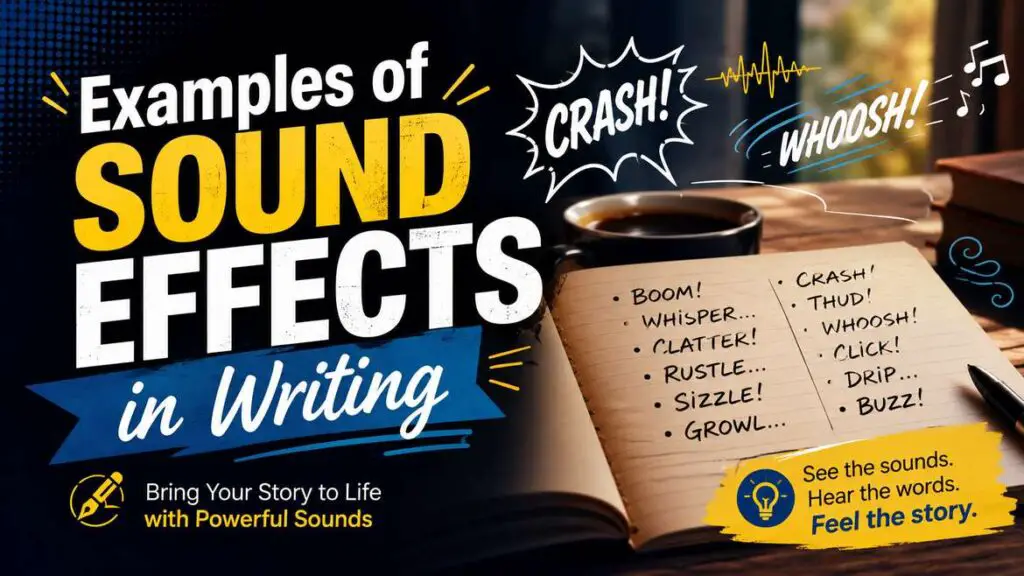
Writers spend so much time thinking about what a story looks like on the page that they sometimes forget it also has a soundtrack. Every scene you write can hum, crash, whisper, or roar if you choose your words with the ear in mind rather than just the eye. Sound effects in prose aren’t limited to comic-book “BOOM” and “CRASH” — they’re a whole toolkit of techniques that let readers hear a world instead of just seeing it described. Below is a breakdown of the core techniques you can use to bring sound to life on the page.
Sound Effects in Writing
#1. Onomatopoeia
Onomatopoeia is the most direct way to inject sound into your writing — it’s the use of words that phonetically imitate the noise they describe. Words like buzz, sizzle, clang, and whoosh don’t just tell the reader a sound happened; they perform it. This technique works best when used sparingly, since a page littered with sound-words can feel cartoonish rather than immersive. Used well, though, a single onomatopoeic word can land with more impact than a full sentence of description.
The kettle hissed and spat on the stove, then let out a shrill, rising whistle that cut through the silent kitchen.
Somewhere below the deck, metal clanged against metal, and a dull thud followed a beat later.
The balloon popped with a sharp crack, and the crowd gasped in unison.
#2. Alliteration for Rhythm and Impact
Alliteration — the repetition of consonant sounds at the start of nearby words — gives a sentence a percussive, musical quality. It can mimic the rhythm of the very sound being described, whether that’s the steady beat of footsteps or the clatter of machinery. Beyond mimicry, alliteration also makes prose more memorable and quotable, since repeated sounds naturally catch the ear and stick in the reader’s mind.
The drummers pounded a pulsing, primal pattern that pressed against the walls of the packed hall.
Waves washed and whipped against the weathered wooden dock, over and over, without end.
Hooves hammered the hard-packed highway, a thundering herd of horses racing the storm.
#3. Sibilance for Softness or Menace
Sibilance is the repetition of “s,” “sh,” and “z” sounds, and it’s a favorite tool for creating a hushed, slippery, or unsettling atmosphere. Because sibilant sounds are quiet and drawn-out, they’re perfect for scenes involving whispers, wind, water, or creeping danger. The technique lets the sentence itself sound the way the scene feels, without ever naming the emotion directly.
She slipped silently past the sleeping guards, her soft steps swallowed by the hiss of wind through the grass.
The snake’s slow, sinuous slither sent a shiver through the grass as it searched for its next meal.
Steam hissed softly from the seams of the ship, a slow exhale escaping into the salt-heavy air.
#4. Plosives for Sharpness and Violence
Plosive consonants — hard sounds like “b,” “p,” “t,” “d,” “k,” and “g” — burst out of the mouth quickly, making them ideal for conveying sudden, sharp, or violent action. Stacking plosives in a sentence gives it a staccato, punchy rhythm that mirrors impact, collision, or aggression. This is the opposite tool to sibilance: where sibilance slows a scene down, plosives speed it up and make it hit harder.
The door burst open, and boots pounded down the corridor, kicking up dust with every heavy, battering step.
The boxer’s gloves battered the bag in a brutal, driving beat, knuckle and canvas colliding again and again.
Thunder cracked, and a bolt of light split the black sky, striking the tower with a deafening blast.
#5. Auditory Verbs and Precise Sound Vocabulary
Rather than relying on generic words like “sound” or “noise,” strong writers reach for precise auditory verbs — creak, rattle, thud, screech, murmur — that carry built-in texture and tone. A precise verb does double duty: it tells the reader what happened and how it felt to hear it, without needing an extra adjective. Building a varied vocabulary of sound-specific verbs is one of the fastest ways to sharpen any piece of descriptive writing.
The old floorboards creaked and groaned beneath his weight, each step announcing him before he ever reached the door.
Chains rattled against the hull as the anchor dropped, and gulls shrieked overhead, circling the harbor.
The radio crackled and hissed between stations before a voice finally broke through, faint and muffled.
#6. Rhythm and Sentence Length as Sound
Sound in writing isn’t only about individual words — it’s also about the shape and pace of a sentence. Short, clipped sentences create a staccato, tense rhythm, like gunfire or a racing heartbeat, while long, flowing sentences can mimic a steady hum, a rolling wave, or an unbroken drone. Matching your sentence structure to the sound you’re describing lets the prose become the noise rather than just report on it.
The engine roared. Then coughed. Then died. Silence rushed in to fill the space it left behind, heavy and absolute.
Run. Don’t look back. Just run. Her heartbeat pounded a frantic, uneven rhythm in her ears.
The river moved on and on, an unbroken murmur beneath the trees, indifferent to the hours it carried away.
#7. Contrast Through Silence
Paradoxically, one of the most powerful sound effects a writer can use is the deliberate absence of sound. Describing a sudden silence — especially right after noise — makes readers acutely aware of what’s missing, often heightening tension far more than any noise could. Silence works best as a contrast tool: it needs a “before” of sound to set against it, so the quiet lands with real weight.
The gunfire stopped as abruptly as it began, and for a moment the only sound was the ringing left behind in her ears.
The band cut off mid-note, and the entire hall fell into a silence so complete she could hear her own pulse.
For years the factory had roared day and night. Now it stood empty, and the silence felt louder than the machines ever had.
#8. Layered Soundscapes
Advanced sound-writing doesn’t rely on a single technique in isolation — it layers several sounds together to build a full sensory environment, the way a film sound designer mixes dialogue, ambient noise, and effects into one track. A layered soundscape gives a scene depth and believability, letting the reader feel fully present in a space rather than just being told where they are.
Somewhere a dog barked, a car alarm wailed two streets over, and beneath it all the city hummed its low, constant drone, indifferent to the chaos above it.
Crickets chirped in the tall grass, an owl called from the treeline, and far off a screen door slapped shut against its frame.
Waves crashed against the rocks, gulls screeched overhead, and somewhere a rope creaked against a mast, the whole harbor breathing in one restless rhythm.
Closing Thoughts
Sound is one of the most underused tools in a writer’s kit, yet it’s one of the easiest to strengthen once you know what to listen for. Onomatopoeia, alliteration, sibilance, and plosives give you control over the texture of a sentence, while precise verbs, rhythm, silence, and layered soundscapes let you shape an entire scene’s atmosphere. The next time you revise a piece of writing, try reading it aloud — you’ll often hear exactly where the silence needs breaking, and where the noise needs to stop.