
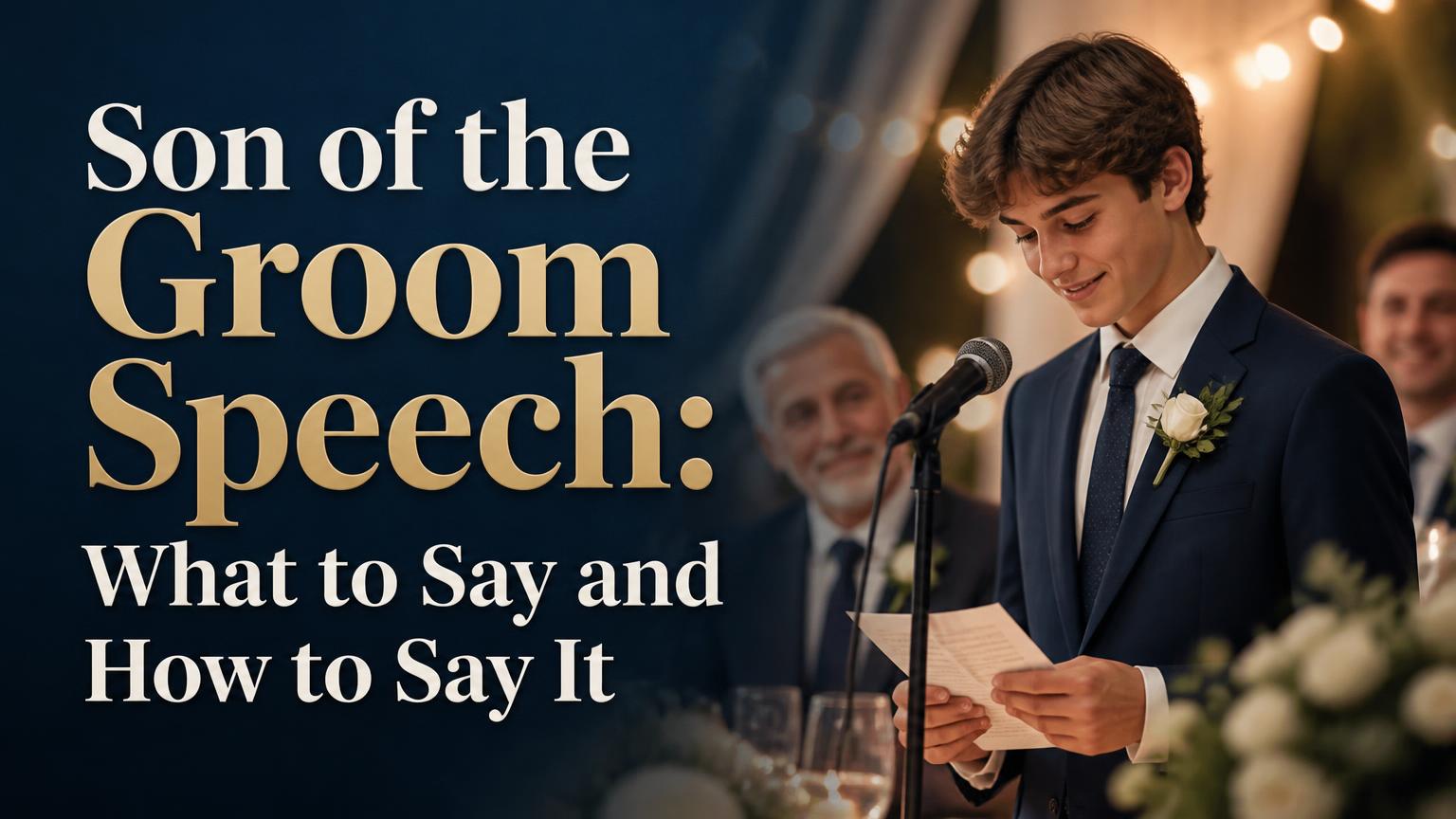
A son of the groom may be speaking as an adult child, a teenager, or even a young boy, but the purpose is the same: honor his father, welcome the person he is marrying, and help the guests understand why this day matters. The strongest speech is personal without becoming private, warm without taking over the celebration, and brief enough to leave the couple and their future at the center. The guidance below explains what to include, what to avoid, and how to deliver the words naturally.
Preparing a Son of the Groom Speech: What to Say and How to Say It
A successful son of the groom speech usually combines six elements: a gracious welcome, your relationship with your father, one meaningful memory, a few sincere words about his partner, recognition of the couple's future, and a clear toast. You do not need to tell your father's entire life story or explain every family detail. Choose one central message, such as “My father has found a relationship that brings him joy,” and let every part of the speech support it.
Your relationship may be close, complicated, newly restored, or naturally reserved. Do not force yourself to sound more emotional than you feel. A thoughtful, honest speech can be deeply moving without making claims that do not fit your experience. If the wedding joins families, acknowledge that possibility carefully, using language that feels true rather than assuming everyone sees the occasion in exactly the same way.
Step 1. Define Your Place in the Wedding
Before writing, decide what you want your presence to contribute. You are not expected to act as your father's spokesperson, summarize the entire relationship, or compete with the best man or maid of honor. Your distinctive role is to offer the perspective of a son who has watched his father reach this important moment.
Write down two or three sentences that describe your purpose. For example: “I want guests to see how much happiness this relationship has brought Dad,” or “I want to welcome [Partner's Name] while sharing one quality I have always admired in my father.” This decision will keep the speech focused and prevent unrelated stories from taking over.
Step 2. Open With a Warm Welcome
Begin by acknowledging the couple and welcoming the guests. A simple opening is often more effective than a dramatic announcement. You might thank everyone for being present, congratulate the newly married couple, and briefly identify yourself if some guests do not know you.
Your opening should establish a generous tone from the first sentence. You could say, “Good evening, everyone. I am [Name], the groom's son, and I am grateful to be here to celebrate Dad and [Partner's Name].” If you are nervous, write the first two or three sentences exactly as you intend to speak them. A prepared opening makes it easier to settle into the rest of the speech.
Step 3. Choose One Memory That Reveals Your Father
The best story is not necessarily the funniest or most impressive. Choose a memory that shows something true about your father: his patience, loyalty, curiosity, humor, steadiness, generosity, or willingness to begin again. A small, specific moment often says more than a long list of achievements.
Give the story enough context for guests to follow it, then explain why you remember it. Avoid private details that would embarrass your father or leave other guests confused. If the memory involves a difficult period, present it with care and do not use the wedding speech to settle an old argument. The story should illuminate your message, not require the audience to judge the family history.
Step 4. Speak Directly About His Partner
A son of the groom speech should make room for the person his father is marrying. Mention a quality you have observed or a way the relationship has affected your father. You might say that he seems more relaxed, adventurous, hopeful, or fully himself. If you have had limited time with the partner, honesty is better than exaggerated intimacy.
You can also offer a sincere welcome without pretending the relationship has always been effortless. “I have enjoyed getting to know you, and I am happy to see the joy you bring to my father” is warm and believable. If appropriate, address the partner by name and speak directly to them for a few sentences. This helps the speech feel like a welcome rather than merely a tribute to your father.
Step 5. Acknowledge the Couple’s Future
After reflecting on the past, turn toward the marriage itself. Say what you hope the couple will carry into their life together: friendship, patience, laughter, honesty, curiosity, or the ability to support one another through ordinary days as well as major events.
Keep this section personal rather than turning it into a list of universal marriage rules. You might refer to the way they listen to each other, make room for one another's interests, or bring calm and energy into the same home. If children, stepchildren, or wider family members are part of the household, include them only if the couple would welcome that recognition.
Step 6. Set the Right Tone and Length
Most wedding speeches work best when they are concise enough to hold attention and substantial enough to feel personal. A son of the groom speech of about three to five minutes often provides room for a memory and a meaningful welcome, although the couple's schedule and the reception traditions should guide the final length.
Your tone should match the relationship and the room. Gentle humor can work when it comes from affection and does not embarrass anyone. Avoid jokes about former partners, family conflict, money, age, divorce, drinking, or private behavior. If the speech feels emotionally complicated, choose calm sincerity over exaggerated celebration. You are allowed to be warm without sounding theatrical.
Step 7. End With a Clear Toast
Do not let the speech fade into an uncertain final sentence. Signal the ending by turning directly to the couple and inviting the guests to raise their glasses. A clear close might be: “Dad and [Partner's Name], may your life together be full of patience, good conversation, and reasons to laugh. Please raise your glasses to the happy couple.”
The final toast should honor both people, not only your father. Use their names, congratulate them again, and choose a wish that sounds like something you genuinely mean. If the event does not include a formal toast, you can simply finish with a direct expression of love, gratitude, or good wishes and follow the instructions of the person coordinating the reception.
Delivering a Son of the Groom Speech With Confidence
Good delivery does not require a professional speaking voice. It requires preparation, readable notes, and enough pauses for your meaning to reach the room. Wedding receptions can be noisy, emotional, and tightly scheduled, so practical planning matters as much as polished wording.
Ask the couple or the event coordinator about the expected speaking time, microphone, order of speeches, and toast custom. Wedding traditions differ by family, culture, religion, and venue. Treat common practices as helpful expectations rather than unbreakable rules, and let the couple's wishes take priority.
Keep the Speech Within the Agreed Time
Ask how long you have before finalizing the speech. If the couple requests two minutes, do not prepare five; if you are given a longer slot, still avoid repeating the same thought. Read the speech aloud while timing it, including natural pauses and the moments when guests may laugh.
A shorter speech can be more powerful because it leaves the audience with a clear impression. If you need to reduce the length, remove a second anecdote, extra background, or a string of similar compliments before cutting the meaningful memory or the welcome to the couple.
Write for the Whole Room
You may be speaking from a deeply personal relationship with your father, but the audience includes the couple's friends, relatives, colleagues, and possibly people meeting one another for the first time. Give listeners enough context to understand who appears in your story and why the moment matters.
Avoid references such as “the summer we all know about” or “what happened at the lake,” unless everyone in the room can follow them. A brief explanation turns a private memory into a shared celebration. Remember that the speech should help guests feel included, not test their knowledge of the family.
Use Notes That Are Easy to Read
Print the speech in a large, comfortable font with generous spacing, or use sturdy cue cards. Mark places to pause, look up, or breathe. Full notes are perfectly acceptable, particularly when the occasion is emotional; memorizing every sentence is not a requirement for sounding sincere.
Keep a backup copy on your phone or with someone you trust, but do not rely on a screen that may dim or distract you. Number pages or cards so they cannot be shuffled out of order. Before speaking, check whether the microphone stand, lectern, or lighting makes your notes difficult to see.
Practice the Emotional Parts Aloud
Reading silently will not show you where the words feel awkward or where emotion may interrupt your pace. Practice aloud at least several times, first alone and then in front of one calm listener if possible. Mark the sentences most likely to affect you and decide where you can pause without losing your place.
If you become emotional during the speech, stop, breathe, look at your notes, and continue when ready. A brief pause is not a failure. You can also keep a simple sentence available, such as “This is an important day for our family, so please give me a moment.” You do not need to apologize repeatedly or hide every feeling.
Confirm the Room and Wedding Customs
Find out whether the reception will use a microphone, whether guests will be seated or standing, and whether the toast is expected to include a particular phrase or beverage. Some celebrations are formal, while others are relaxed; some families observe religious or cultural traditions that shape the order and style of speeches.
Do not assume that every wedding includes clinking glasses, a raised toast, or a particular form of address. Follow the couple's instructions and ask a member of the wedding party if you are uncertain. This small amount of preparation prevents an awkward ending and shows respect for the event the couple has planned.
Common Mistakes in a Son of the Groom Speech
A speech from the groom's son can carry special emotional weight, but that does not mean it should contain every feeling or family story connected to the wedding. The most effective remarks are selective. They give the audience a clear way to understand the speaker's relationship with his father while welcoming the couple into the next part of their lives.
Before you finalize the speech, read it from the perspective of someone who knows neither family well. If the listener could understand the tone, follow the story, and identify the central message, the speech is probably working. If not, simplify the background and make the couple more visible in the final version.
Making the Speech Entirely About Your Father
Your relationship with your father is the reason you have a distinctive perspective, but the occasion celebrates a marriage. A speech that praises the groom for several minutes without acknowledging his partner may feel incomplete or unintentionally exclusive.
Keep the father-son relationship as the emotional foundation, then connect it to the couple. Explain what you appreciate about your father and how you have seen him grow, find happiness, or build a meaningful relationship. Make sure the person he is marrying receives a genuine welcome rather than a brief mention at the end.
Using Embarrassing or Overly Private Stories
A story can be funny to the family and uncomfortable for everyone else, including the person being celebrated. Avoid anecdotes involving intimate relationships, health matters, private arguments, financial problems, intoxication, or behavior your father would not want repeated in a room full of guests.
When considering a story, ask whether your father would be comfortable hearing it from a microphone in front of the new spouse's relatives and friends. If there is doubt, choose another memory. Warm humor can come from an endearing habit, a familiar family tradition, or a harmless difference between your personalities.
Comparing the Marriage With the Past
Even if the family has experienced divorce, bereavement, estrangement, or other complicated history, a wedding speech is rarely the right setting to compare the current relationship with a previous one. Remarks such as “this time it will work” or “you finally got it right” can create discomfort and distract from the couple's happiness.
You can recognize a new beginning without referring to old relationships at all. Focus on what you see now: the couple's companionship, respect, humor, or ability to support one another. If past family circumstances must be acknowledged, use restrained, respectful language and avoid making the audience responsible for your unresolved feelings.
Speaking for Every Family Member
As the groom's son, you can speak from your own experience, but you should not claim to represent every child, relative, or friend unless they have specifically asked you to do so. Statements such as “we all feel exactly the same” may unintentionally exclude people whose relationships or emotions are different.
Use phrases that accurately identify your perspective: “I have always admired,” “I have noticed,” or “I am grateful.” If you want to include a message from siblings or other relatives, confirm their words beforehand and keep the attribution clear. Personal honesty is stronger than an artificial impression of unanimous feeling.
Ending Without a Toast or Clear Good Wish
Some speakers prepare a moving middle section and then stop abruptly because they are unsure how to finish. Guests may not know whether to applaud, raise their glasses, or wait for another thought. A deliberate ending gives the speech shape and gives the couple a final message to carry with them.
Write your last two or three sentences before you write the rest of the speech. Include both names, offer a specific wish for their marriage, and state what you want the guests to do if a toast is expected. Practice the ending as carefully as the opening so your voice does not trail away when you are nearly finished.
Closing Thoughts
A son of the groom speech does not need to be elaborate to be memorable. It needs to sound true to the speaker, respectful of the couple, and appropriate for the people gathered to celebrate them. Choose one meaningful memory, welcome the groom's partner sincerely, keep private matters private, and end with a direct good wish or toast. With clear notes and a few spoken rehearsals, you can deliver a heartfelt message without trying to sound like anyone other than yourself.