
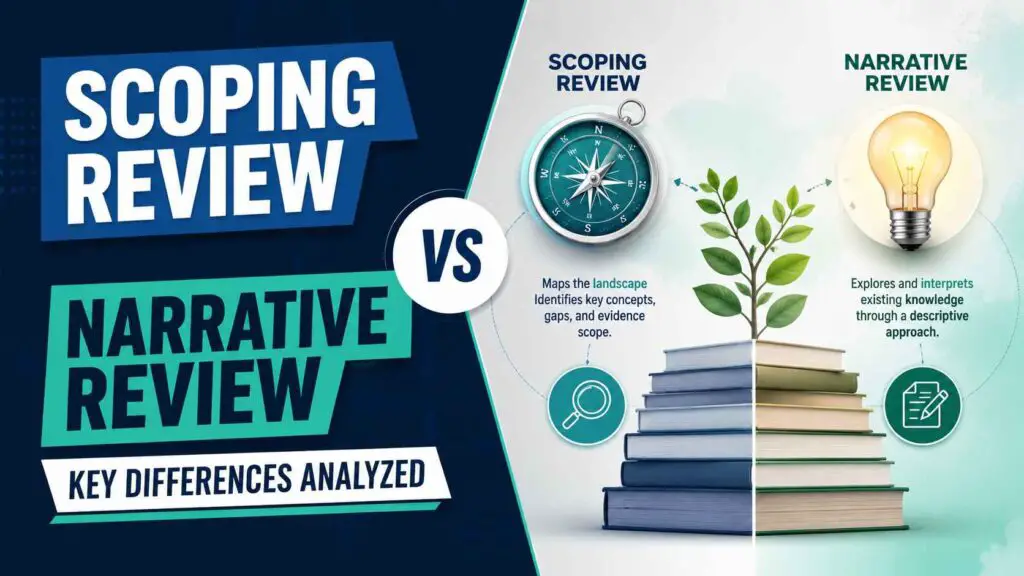
Scoping reviews and narrative reviews both help readers understand existing research. However, they serve different purposes. They ask different questions, use different methods, and produce different kinds of answers.
At first glance, they may seem similar. Both summarize literature. Both help researchers, students, and professionals make sense of a topic. Yet the difference matters. A scoping review maps the available evidence in a structured way. A narrative review explains, interprets, and discusses a topic in a broader and often more flexible manner.
Therefore, choosing between a scoping review and a narrative review depends on the goal. If the aim is to identify what research exists, where gaps remain, and how a field is developing, a scoping review is usually the better choice. However, if the aim is to tell the story of a topic, explain key ideas, or provide expert interpretation, a narrative review may be more suitable.
Definitions
Scoping Review
A scoping review is a structured review that maps the existing literature on a topic. It does not usually try to answer one narrow research question. Instead, it explores the size, range, and nature of available evidence.
Researchers often use scoping reviews when a topic is broad, complex, or still developing. For example, they may want to know what studies exist, what methods researchers have used, which populations have been studied, and where evidence gaps remain.
A scoping review follows a clear process. It usually includes a defined search strategy, inclusion and exclusion criteria, systematic screening, and organized reporting. As a result, it offers transparency and helps readers understand how the evidence was gathered.
Narrative Review
A narrative review is a broad, descriptive summary of literature on a topic. It often explains major themes, theories, debates, findings, and developments in a field.
Unlike a scoping review, a narrative review is usually less rigid in method. The author may select important studies, interpret trends, compare viewpoints, and build an argument around the topic. Because of this, narrative reviews often read more like expert essays than formal evidence maps.
Narrative reviews are useful when the goal is to provide background, explain concepts, or discuss a topic from a thoughtful and interpretive angle. However, because the method is often less systematic, the review may reflect the author’s judgment more strongly.
Scoping Review vs Narrative Review
#1. Purpose
Scoping Review
A scoping review aims to map the available evidence. It shows what has been studied, how much research exists, and where the gaps are. It is especially useful when a field is broad or unclear.
Narrative Review
A narrative review aims to explain and interpret a topic. It may summarize major ideas, compare perspectives, and present a broad understanding of the subject.
#2. Research Question
Scoping Review
A scoping review usually starts with a broad research question. For example, it may ask, “What evidence exists on this topic?” or “How has this concept been studied?”
Narrative Review
A narrative review may use a broad question, but it does not always state it formally. The question may be more conceptual, argumentative, or explanatory.
#3. Methodology
Scoping Review
A scoping review uses a structured and transparent method. Researchers normally define search terms, databases, screening rules, and selection criteria before reviewing the literature.
Narrative Review
A narrative review uses a more flexible method. The author may choose sources based on relevance, importance, or expert judgment. Therefore, the process is often less reproducible.
#4. Search Strategy
Scoping Review
A scoping review usually has a detailed search strategy. It may search multiple databases and document the exact search terms used.
Narrative Review
A narrative review may not describe the search strategy in detail. In some cases, the author simply discusses key studies and major themes.
#5. Selection of Studies
Scoping Review
A scoping review uses clear inclusion and exclusion criteria. This helps readers understand why certain studies were included or left out.
Narrative Review
A narrative review may include studies because they are influential, relevant, or useful to the discussion. However, the selection process may not always be clearly explained.
#6. Level of Structure
Scoping Review
A scoping review is highly organized. It often includes tables, charts, categories, and summaries that map the evidence.
Narrative Review
A narrative review is usually more essay-like. It may move through themes, historical developments, theories, or debates in a flowing structure.
#7. Use of Evidence
Scoping Review
A scoping review focuses on the breadth of evidence. It does not always judge the quality of each study in depth. Instead, it shows what research exists.
Narrative Review
A narrative review focuses more on meaning and interpretation. The author may explain why certain findings matter and how they connect to larger ideas.
#8. Objectivity
Scoping Review
A scoping review aims to reduce bias through a transparent process. Because the method is clearly described, readers can evaluate how the review was conducted.
Narrative Review
A narrative review can be more subjective. The author’s expertise, perspective, and interpretation often shape the review strongly.
#9. Best Use Case
Scoping Review
A scoping review works best when researchers want to explore a broad field, clarify concepts, identify gaps, or prepare for future research.
Narrative Review
A narrative review works best when writers want to explain a topic, provide background, discuss theories, or present an expert overview.
#10. Final Output
Scoping Review
A scoping review usually produces a map of the literature. It may show research trends, study types, populations, methods, and gaps.
Narrative Review
A narrative review usually produces a readable discussion of a topic. It helps readers understand key ideas, debates, and conclusions.
Closing Thoughts
Scoping reviews and narrative reviews both play valuable roles in research. However, they are not the same.
A scoping review is more structured, systematic, and evidence-mapping focused. It helps researchers understand what is known, what is missing, and how a field is organized. In contrast, a narrative review is more flexible, interpretive, and discussion-focused. It helps readers understand the meaning, background, and development of a topic.
Therefore, the best choice depends on the purpose. Use a scoping review when the goal is to map evidence clearly. Use a narrative review when the goal is to explain, interpret, and discuss a subject in depth.
In the end, both review types can be useful. The key is to choose the one that matches the research question, audience, and desired outcome.