
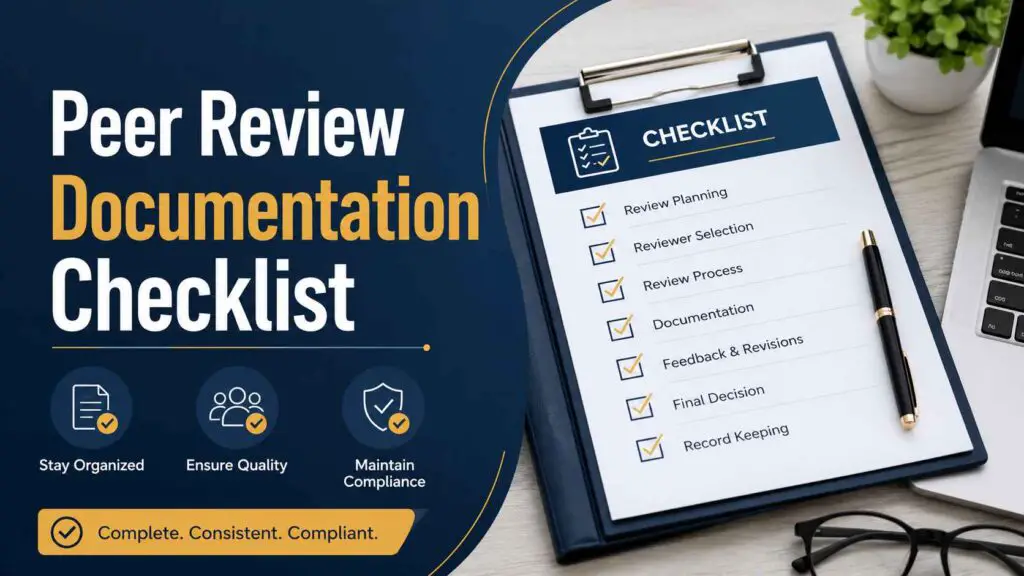
Peer review documentation is not just a formality. It protects the quality, fairness, and credibility of the review process. When documentation is clear, reviewers know what to look for, editors can make better decisions, and authors receive useful feedback.
However, weak documentation can create confusion. It may lead to missed criteria, vague comments, inconsistent decisions, or unnecessary delays. That is why a strong peer review documentation checklist matters.
A good checklist gives structure to the entire process. It helps reviewers stay focused, record important observations, and support their conclusions with evidence. More importantly, it makes the review process easier to audit, improve, and trust.
Peer Review Documentation Checklist
Manuscript and Submission Details
- Record the manuscript title accurately.
- Note the submission ID or reference number.
- Include the author name or anonymized author code, depending on the review model.
- Confirm the journal, department, course, or organization receiving the review.
- Record the date the review was assigned.
- Record the date the review was completed.
- Identify the type of submission being reviewed, such as research paper, case study, article, report, or proposal.
Reviewer Information
- Record the reviewer’s name if the process is not anonymous.
- Confirm the reviewer’s role or area of expertise.
- Declare any conflict of interest.
- Confirm that the reviewer accepted the assignment.
- Note whether the review is single-blind, double-blind, open, or internal.
- Confirm that the reviewer followed confidentiality rules.
Scope and Review Criteria
- List the main criteria used for review.
- Confirm that the work fits the required topic or subject area.
- Check whether the submission meets the purpose of the review.
- Note whether the methodology, argument, or approach is appropriate.
- Confirm that the reviewer assessed originality.
- Confirm that the reviewer assessed relevance.
- Confirm that the reviewer assessed clarity and structure.
Content Quality
- Check whether the main argument is clear.
- Confirm that the work has a strong introduction.
- Review whether the claims are supported by evidence.
- Check whether important terms are defined.
- Note any unsupported statements.
- Identify gaps in logic or explanation.
- Assess whether the conclusion follows from the evidence.
- Check whether the content adds value to the field or discussion.
Methodology and Evidence
- Confirm that the research method is explained clearly.
- Check whether the method suits the research question.
- Review the quality of the data or sources.
- Note any missing details in the methodology.
- Check whether limitations are acknowledged.
- Assess whether the analysis is fair and reasonable.
- Confirm that evidence is interpreted accurately.
Writing, Structure, and Formatting
- Check whether the writing is clear and readable.
- Review the organization of sections.
- Confirm that headings are useful and logical.
- Note grammar, spelling, or punctuation issues.
- Check whether the tone is appropriate.
- Confirm that formatting follows the required guidelines.
- Review tables, figures, and appendices for clarity.
- Check whether citations and references follow the required style.
Ethical and Compliance Issues
- Check for possible plagiarism.
- Confirm that human or animal research approvals are included if required.
- Note whether consent procedures are described.
- Check for data privacy concerns.
- Identify any biased, harmful, or inappropriate language.
- Confirm that funding or sponsorship is disclosed.
- Note whether competing interests are declared.
Reviewer Comments
- Provide clear comments for the author.
- Separate major concerns from minor concerns.
- Give specific examples instead of vague criticism.
- Explain why each major issue matters.
- Suggest practical improvements.
- Keep the feedback respectful and professional.
- Avoid personal comments about the author.
- Make sure comments match the final recommendation.
Decision Recommendation
- Select the correct recommendation category.
- State whether the work should be accepted, revised, rejected, or reviewed again.
- Explain the reason for the recommendation.
- Confirm that the recommendation is supported by the review notes.
- Note whether revisions are minor or major.
- List the most important changes required before approval.
- Indicate whether another round of review is needed.
Final Documentation Review
- Check that all required fields are complete.
- Confirm that the review is dated.
- Review the comments for clarity and professionalism.
- Remove any confidential notes from the author-facing section.
- Make sure internal comments are placed in the correct section.
- Confirm that the review follows the organization’s policy.
- Submit the documentation through the correct system or channel.
- Save a copy if required by policy.
Closing Thoughts
A peer review documentation checklist helps turn a complex review process into a clear and reliable system. It gives reviewers a practical guide, reduces missed steps, and creates a stronger record of the decision-making process.
In addition, good documentation improves trust. Authors can understand the feedback. Editors can defend decisions. Organizations can maintain quality standards.
Ultimately, peer review works best when it is careful, fair, and well documented. A checklist does not replace expert judgment, but it supports it. It keeps the review focused, consistent, and useful from start to finish.