
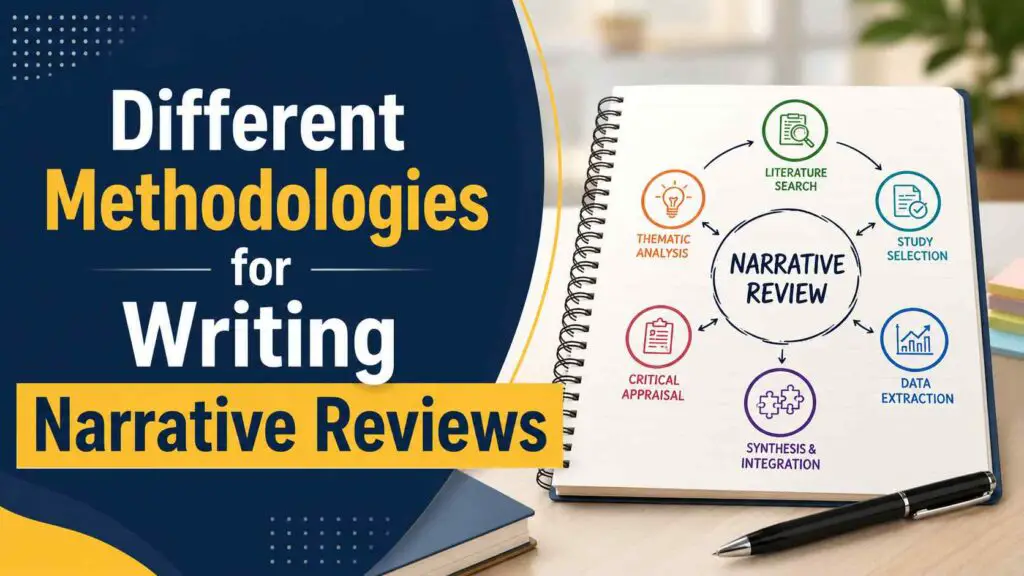
Narrative reviews play an important role in academic writing, research communication, and professional practice. They help readers understand a topic by bringing together ideas, findings, debates, and gaps from existing literature. Unlike systematic reviews, narrative reviews do not always follow a rigid protocol. Instead, they allow the writer to interpret, organize, and explain the literature in a meaningful way.
However, that flexibility can also create confusion. A narrative review can become too broad, too descriptive, or too unfocused if the writer does not choose a clear methodology. Therefore, the best narrative reviews still need structure. They need a thoughtful approach to selecting sources, organizing evidence, and presenting arguments.
Different methodologies can help writers produce stronger narrative reviews. Each method offers a different way to explore the literature, depending on the goal of the review, the nature of the topic, and the needs of the audience.
Different Methodologies for Writing Narrative Reviews
#1. Thematic Narrative Review
A thematic narrative review organizes the literature around major themes. Instead of discussing studies one by one, the writer identifies recurring ideas, patterns, or debates across the literature.
For example, a narrative review on online learning might include themes such as student engagement, teacher presence, assessment methods, and technology access. Each theme becomes a section of the review.
This method works well when the topic is broad and contains many connected ideas. It allows the writer to show how different studies speak to the same issue from different angles. As a result, the review feels organized and easy to follow.
However, the writer must avoid simply grouping studies without analysis. A strong thematic review explains how each theme developed, where researchers agree, and where important disagreements remain.
#2. Chronological Narrative Review
A chronological narrative review presents the literature according to time. It shows how research on a topic has developed across years, decades, or major historical periods.
This method is useful when the topic has changed significantly over time. For instance, a review on artificial intelligence in education could begin with early computer-assisted learning, move into adaptive learning platforms, and then discuss generative AI tools.
The strength of this approach is that it helps readers understand development and progression. It shows how earlier ideas influenced later research. It also highlights turning points, such as new theories, technologies, or social changes.
Still, the writer must do more than list events in order. The review should explain why changes happened and how the field evolved.
#3. Conceptual Narrative Review
A conceptual narrative review focuses on key concepts, definitions, and theoretical ideas. It asks how scholars have understood a topic and how those understandings differ.
This method works well for complex or abstract topics. For example, a review on “resilience” might explore how the concept is defined in psychology, education, healthcare, and social work.
The writer compares definitions, explains conceptual disagreements, and clarifies how the term has been used in different contexts. Therefore, this method is especially helpful when a field uses the same concept in inconsistent ways.
A strong conceptual review gives readers clarity. It does not merely summarize research findings. Instead, it helps readers understand the meaning and boundaries of an idea.
#4. Critical Narrative Review
A critical narrative review evaluates the strengths, weaknesses, and assumptions within the literature. The goal is not only to summarize what has been written but also to challenge it.
This method asks important questions. What perspectives dominate the field? Which voices are missing? Are there methodological weaknesses? Do researchers rely on outdated assumptions?
For example, a critical review of leadership studies might examine whether the literature focuses too heavily on corporate settings while ignoring community, nonprofit, or religious leadership.
This approach is powerful because it moves beyond description. It helps the writer build an argument. However, the criticism must be fair, balanced, and supported by evidence.
#5. Integrative Narrative Review
An integrative narrative review brings together literature from different disciplines, theories, or research traditions. It connects ideas that may not usually appear together.
This method is useful when a topic crosses boundaries. For example, a review on burnout could include research from psychology, healthcare, education, business, and sociology.
The writer’s task is to show how these different bodies of literature relate to one another. In addition, the review may identify shared insights, contradictions, and opportunities for future research.
An integrative approach can produce a rich and original review. However, it requires careful organization because the literature may come from very different fields.
#6. Problem-Based Narrative Review
A problem-based narrative review begins with a specific problem and then reviews the literature that helps explain or address it.
For example, a review might focus on the problem of low student motivation in online classes. The writer would then explore studies on motivation theory, course design, teacher interaction, feedback, and digital learning environments.
This method works well when the review has a practical purpose. It helps readers understand not just what the literature says, but how it relates to a real-world issue.
The review should clearly define the problem at the beginning. Then, each section should connect back to that problem. This keeps the article focused and useful.
#7. Theory-Based Narrative Review
A theory-based narrative review organizes the literature around one or more theoretical frameworks. The writer uses theory as the main lens for interpreting the research.
For instance, a review on adult learning might use transformative learning theory, experiential learning theory, or self-directed learning theory. Each theory helps explain different aspects of the topic.
This method is especially useful in academic fields where theory plays a central role. It allows the writer to show how research supports, extends, challenges, or applies a theory.
However, the writer must explain the theory clearly. Readers should understand why that theory matters and how it shapes the review.
#8. Methodological Narrative Review
A methodological narrative review focuses on how researchers have studied a topic. Instead of emphasizing findings alone, it examines research designs, methods, samples, tools, and limitations.
For example, a review on workplace stress might compare qualitative interviews, surveys, longitudinal studies, and experimental designs. The writer may discuss which methods dominate the field and which methods remain underused.
This approach is valuable when the goal is to evaluate the quality of existing research. It can also reveal gaps in how a topic has been investigated.
A strong methodological review helps future researchers choose better methods. It also shows readers whether current conclusions rest on strong or weak evidence.
#9. Gap-Focused Narrative Review
A gap-focused narrative review identifies what is missing from the literature. The writer reviews existing research with the specific aim of showing where further study is needed.
This method is common in research proposals, dissertations, and academic articles. It helps justify a new study by showing that existing work has not fully answered a question.
For example, a review might show that many studies discuss digital literacy among university students, but few examine digital literacy among older adults in rural communities.
The key is to move from summary to argument. The writer must clearly explain why the gap matters and how future research could address it.
#10. Contextual Narrative Review
A contextual narrative review focuses on how a topic is shaped by a particular setting, population, culture, institution, or historical background.
For example, a review on mental health support might focus specifically on schools, refugee communities, workplaces, or religious organizations. The literature is selected and interpreted through that context.
This method is useful because research findings do not always apply equally across settings. A practice that works in one context may not work in another.
Therefore, a contextual review helps readers understand the conditions that shape a topic. It adds depth and relevance by grounding the literature in real circumstances.
Closing Thoughts
Writing a strong narrative review requires more than collecting sources and summarizing them. It requires a clear methodology. The chosen approach shapes how the writer selects literature, organizes ideas, and develops the argument.
A thematic review highlights major patterns. A chronological review shows development over time. A conceptual review clarifies meaning. A critical review evaluates assumptions. Meanwhile, integrative, problem-based, theory-based, methodological, gap-focused, and contextual reviews each offer their own strengths.
The best methodology depends on the purpose of the review. Therefore, writers should choose the approach that best fits their topic, audience, and research goal. When a narrative review has a clear method, it becomes more focused, more persuasive, and more valuable to readers.