
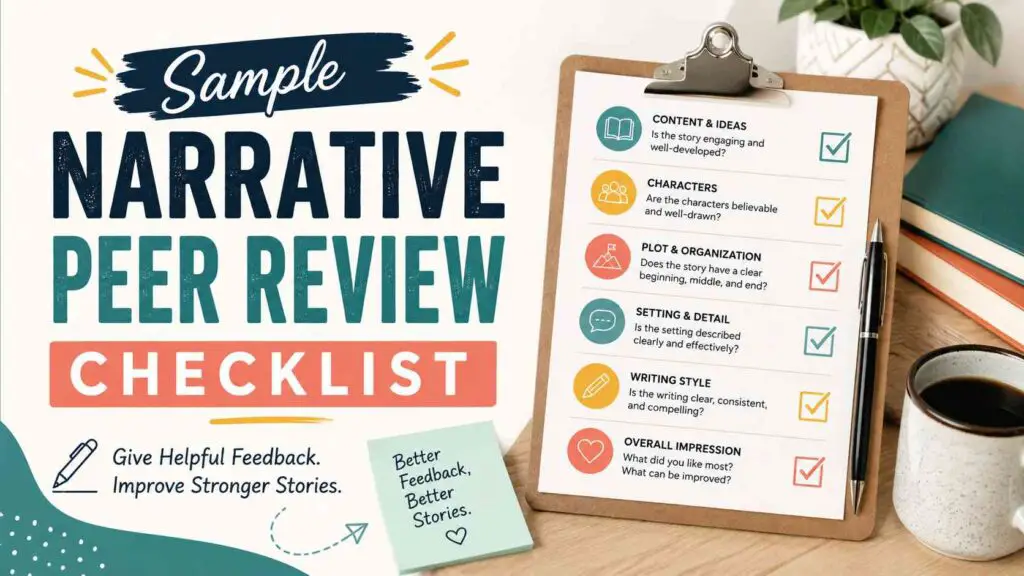
Narrative writing invites readers into a moment, a memory, or an imagined world. However, even a strong story can become clearer, sharper, and more engaging after thoughtful feedback. That is where peer review becomes useful.
A narrative peer review checklist helps writers look beyond grammar and spelling. It guides them to examine the story’s structure, characters, setting, conflict, dialogue, pacing, and emotional impact. More importantly, it gives reviewers a clear way to offer helpful comments instead of vague opinions.
A Narrative Peer Review Checklist
#1. Clear Beginning
Does the story begin in a way that catches attention?
A strong narrative opening should make the reader want to continue. It may begin with action, dialogue, a question, a vivid description, or a surprising moment. The beginning should also introduce the main character, setting, or situation clearly enough for the reader to understand what is happening.
#2. Strong Point of View
Is the point of view consistent throughout the story?
The writer should use first person, third person, or another chosen point of view without confusing shifts. For example, if the story begins with “I,” it should not suddenly move into another character’s private thoughts unless the writer has a clear reason.
#3. Developed Characters
Do the characters feel believable and interesting?
Good narrative writing gives readers enough detail to understand the characters’ personalities, goals, emotions, and choices. The reviewer should check whether the main character changes, learns, struggles, or reveals something meaningful by the end.
#4. Vivid Setting
Can the reader clearly picture where and when the story happens?
The setting should do more than name a place. It should include sensory details such as sights, sounds, smells, textures, or weather. These details help the reader feel present in the story.
#5. Clear Conflict
Does the story include a problem, challenge, or tension?
A narrative needs conflict to keep readers engaged. The conflict may be external, such as an argument, accident, journey, or obstacle. It may also be internal, such as fear, guilt, doubt, or a difficult decision.
#6. Logical Plot
Do the events happen in an order that makes sense?
The story should have a clear sequence of events. Each scene should connect naturally to the next. If the story jumps in time, the writer should use transitions so the reader does not feel lost.
#7. Meaningful Dialogue
Does the dialogue sound natural and serve a purpose?
Dialogue should reveal character, move the plot forward, or increase tension. It should not feel random or unnecessary. Also, the writer should use proper punctuation and make it clear who is speaking.
#8. Descriptive Details
Does the writer show instead of only tell?
Strong narratives use specific details to create emotion and imagery. Instead of writing, “She was nervous,” the writer might show trembling hands, a quiet voice, or quick breathing. These details make the story more powerful.
#9. Smooth Transitions
Does the story move smoothly from one moment to another?
Transitions help readers follow changes in time, place, mood, or action. Words and phrases such as “later that evening,” “after a few minutes,” “meanwhile,” and “by the next morning” can make the story easier to follow.
#10. Strong Pacing
Does the story move at the right speed?
Some scenes need to slow down, especially emotional or important moments. Other scenes can move quickly. The reviewer should check whether any part feels rushed, too long, or unnecessary.
#11. Emotional Impact
Does the story make the reader feel something?
A good narrative should create some kind of emotional response. It may make the reader feel happy, sad, tense, curious, hopeful, or surprised. The reviewer should consider whether the story’s emotions feel genuine and earned.
#12. Clear Theme or Message
Does the story leave the reader with a meaningful idea?
Not every narrative needs an obvious lesson. However, the story should still suggest a deeper meaning. It may show courage, regret, friendship, change, forgiveness, fear, or growth.
#13. Effective Ending
Does the ending feel complete and satisfying?
The ending should resolve the main conflict or show how the character has changed. It does not need to be happy, but it should feel intentional. A weak ending may feel rushed, confusing, or disconnected from the rest of the story.
#14. Correct Grammar and Mechanics
Are grammar, punctuation, capitalization, and spelling mostly correct?
While peer review should focus on big-picture storytelling first, sentence-level errors still matter. Too many mistakes can distract the reader and weaken the story’s impact.
#15. Overall Reader Response
What is the strongest part of the narrative, and what needs improvement?
A helpful reviewer should name at least one strength and one area for revision. For example, the reviewer might praise the dialogue but suggest adding more setting details. This makes the feedback balanced, clear, and useful.
Closing Thoughts
A narrative peer review checklist gives writers a practical way to improve their stories. It helps reviewers focus on the elements that matter most, from the opening scene to the final sentence.
Most importantly, it turns feedback into a constructive process. Instead of simply saying whether a story is “good” or “bad,” reviewers can explain what works, what feels unclear, and what could become stronger.
With the right checklist, every peer review becomes more focused, more respectful, and more helpful.