
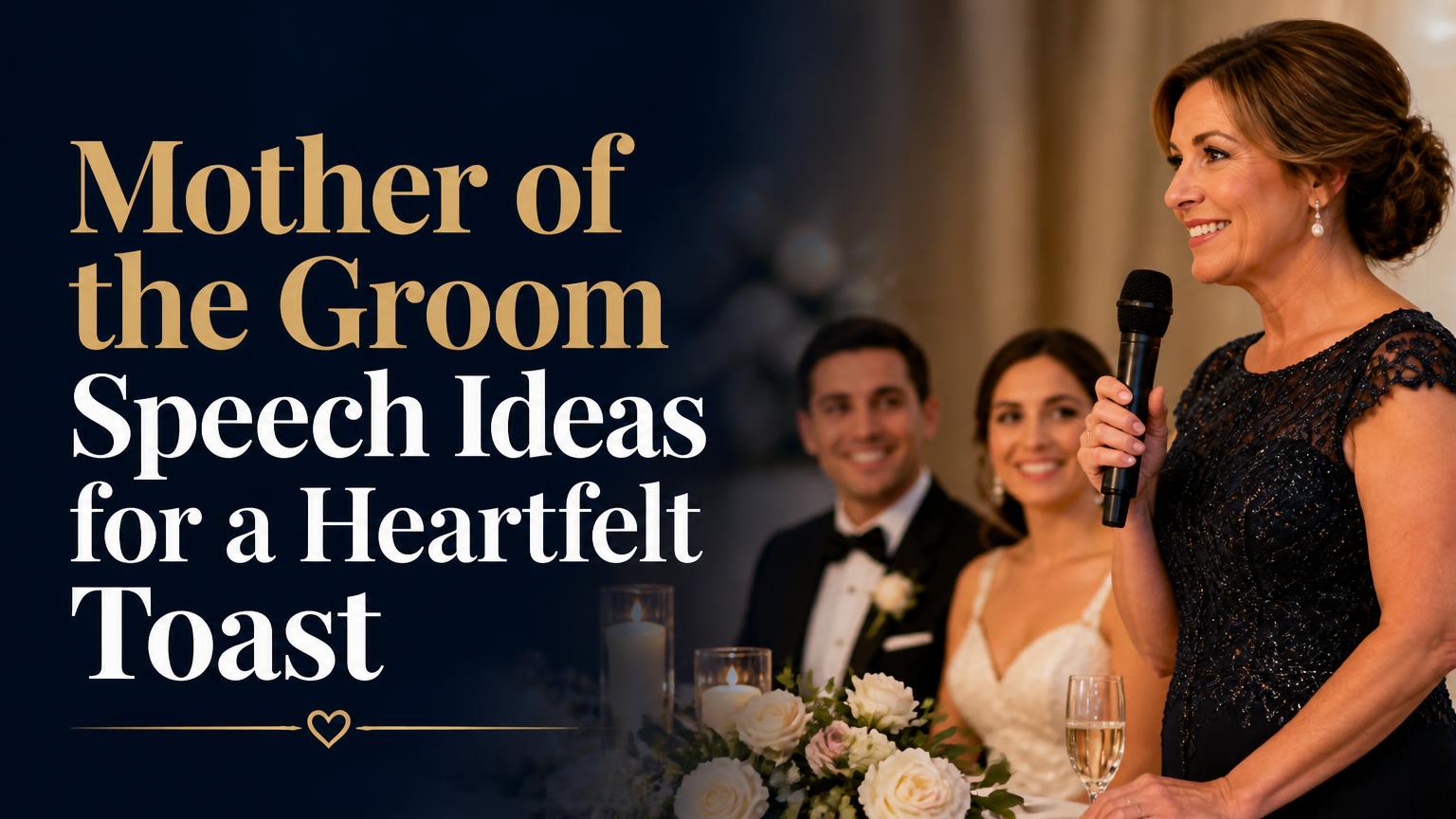
A mother of the groom speech can be warm, personal, and memorable without becoming overly long or sentimental. The best toast reflects your genuine relationship with your son while making the bride or groom’s partner feel welcomed and respected. It should also suit the wedding’s atmosphere, whether the celebration is formal, relaxed, intimate, or joyful and lively. The ideas below will help you choose meaningful material, shape it into a clear speech, and deliver it with confidence.
Mother of the Groom Speech Ideas to Shape a Heartfelt Toast
Your speech does not need to tell your son’s entire life story. Choose one central message, such as how proud you are of the person he has become, how happy you are to welcome his partner, or how meaningful it is to see them begin married life together. A focused speech usually feels more personal than a long list of achievements and memories.
Use details only you can provide, but avoid stories that might embarrass the couple or make one partner feel like an outsider. A small, revealing memory often works better than a dramatic anecdote. Think about moments that show character: your son caring for someone, working through a challenge, showing quiet determination, or becoming especially happy and grounded in this relationship.
Begin With Welcome and Gratitude
Open by welcoming the guests and thanking them for sharing the wedding day. You might acknowledge family members, friends, and anyone who traveled to be present. If another parent or family member is speaking with you, recognize their role naturally rather than turning the opening into a formal list of names.
A simple beginning could be: “Thank you all for being here to celebrate [Son] and [Partner]. As his mother, it is a joy to see so many people who have supported and loved them gathered in one place.” This establishes warmth immediately and gives you a calm, familiar way to begin.
Share a Meaningful Memory of Your Son
Choose a memory that reveals something about your son’s character rather than merely describing what happened. An early childhood story can work well if it connects clearly to the adult he is today. You might recall his determination, kindness, curiosity, loyalty, sense of responsibility, or ability to make people feel included.
For example, instead of recounting a long story about a school event, briefly describe how he stayed beside a nervous friend or worked patiently to solve a difficult problem. Then connect the memory to the present: “That same thoughtfulness is something I see in the way he cares for [Partner].” The connection gives the anecdote purpose.
Explain What You Admire About Their Relationship
A mother of the groom speech becomes more meaningful when it celebrates the couple, not only the groom. Mention what you have noticed about their relationship: perhaps they listen to one another, share a particular sense of humor, encourage each other’s goals, or remain steady during difficult moments.
Keep your observations specific and respectful. Rather than saying only that they are “perfect together,” describe what you have seen. You could say, “I have watched [Partner] bring out [Son]’s generous side, and I have seen [Son] become an even more patient and thoughtful person alongside [Partner].” This honors both people without pretending to know every part of their private life.
Welcome the Bride or Groom Into the Family
If your son is marrying a bride, you may wish to speak directly to her; if he is marrying a groom, speak directly to him. Use the language that fits the couple and their family. A welcome should feel sincere rather than possessive, as though your son is being “given away” or as though the new spouse must earn a place.
You can express gratitude for the love and companionship this person brings into your son’s life. Mention a quality you appreciate or a moment when you felt especially connected. If family relationships are new or still developing, keep the wording honest and gracious: “We are grateful to know you better and delighted that you and [Son] have found such happiness together.”
Offer a Thoughtful Wish for Married Life
A mother’s advice does not need to sound like a lecture. Offer one or two simple wishes based on what you hope the couple will protect in their marriage. You might encourage them to make time for laughter, remain curious about each other, speak honestly, celebrate ordinary days, or remember that marriage is built through many small acts of care.
Avoid presenting your own experience as a universal formula. Phrases such as “What I hope for you is…” or “One thing I have learned is…” sound generous and personal. Keep the advice brief, then return the focus to the couple and the celebration rather than turning the toast into a list of instructions.
End With a Clear and Warm Toast
The ending should signal that the speech is complete. Raise your glass and address both newlyweds by name. You might wish them a life filled with friendship, patience, shared adventures, and lasting affection. A short, confident conclusion is usually stronger than adding one more story after the emotional high point.
For example: “Please raise your glasses to [Partner] and [Son]. May your marriage be full of understanding, laughter, and the quiet happiness of knowing you are on the same team. To a wonderful life together.” The wording can be adapted to your voice, but the essential elements are direct attention to the couple and a definite invitation to toast.
How to Personalize Your Mother of the Groom Speech
A heartfelt speech comes from selecting the right details, not from using elaborate language. Before drafting, write down several memories, qualities, and observations without worrying about order. Then look for a connection among them. Perhaps every note points to your son’s reliability, his compassion, his adventurous spirit, or the way his partner helps him feel fully himself.
It is also useful to consider what the guests may not already know. Many people at the wedding will have their own memories of the couple, so your perspective as the groom’s mother can add something distinctive. You might explain a quality you recognized in your son early in life, describe the first time you understood that his partner was important to him, or reflect on how their relationship has influenced him.
Choose Details That Reveal Character
The strongest details help listeners understand who the groom is. A brief scene is often more effective than a series of adjectives. Instead of writing, “He has always been kind,” describe a moment when he noticed someone needed help, made room for another person, or followed through when support was difficult.
Select details that are suitable for a mixed audience. Wedding guests may include children, older relatives, colleagues, and people meeting one another for the first time. If a story requires extensive explanation or depends on an inside joke, it may not belong in the speech. Choose material that can be understood and appreciated by everyone in the room.
Include the Couple in Balanced Proportion
The speech may begin with your son, but it should gradually make space for his partner and their shared future. A useful balance is to describe your son briefly, explain what you appreciate about the relationship, and finish by addressing both newlyweds. This prevents the toast from sounding like a childhood tribute with the partner added at the end.
Do not compare the couple to other relationships or suggest that one person has “changed” the other in a way that could sound critical. Focus on growth, compatibility, and mutual care. The goal is not to judge the relationship but to celebrate the happiness and commitment you see in it.
Use Humor With Care
Gentle humor can make a mother of the groom speech feel natural, particularly if it reflects an affectionate and recognizable family truth. A light comment about your son’s habit of misplacing keys or his lifelong inability to arrive early may work if it is brief and kind. The joke should invite people to smile, not make the groom defensive.
Avoid embarrassing childhood stories, references to former partners, jokes about divorce, comments about money, and humor aimed at the bride or groom’s appearance, family, or private life. If you are unsure whether a story is amusing or uncomfortable, leave it out. A wedding toast should create warmth, not require the couple to recover from a punchline.
Write for the Actual Audience
Think about the venue, formality, cultural background, and expectations of the couple and their families. A relaxed outdoor wedding may welcome a conversational speech, while a formal evening reception may call for more polished language. Neither style is automatically better; the right choice is the one that sounds appropriate in the room.
Learn whether there are other speeches, blessings, readings, or formal traditions in the program. Your toast should complement the event rather than repeat everything another speaker will say. If the couple has requested certain subjects be avoided, respect that request even if you would normally include them.
End With the Couple’s Future in View
Your final thoughts should move from memory into hope. Rather than repeating everything you have already said, name what you wish for their life together. This might include resilience during challenging seasons, delight in ordinary routines, room for individual dreams, or the continued friendship that brought them to marriage.
A future-focused ending also helps the speech feel like a wedding toast rather than a farewell to your son’s earlier life. You are not losing your place in his story; you are recognizing a new chapter and welcoming the person who will share it with him.
Practical Tips for Writing and Delivering the Toast
The writing process becomes easier when you treat the speech as something meant to be heard. Read each paragraph aloud while drafting. If a sentence feels awkward in your mouth, shorten it. If an idea sounds more complicated than it did on the page, express it in simpler words. Spoken language benefits from clear transitions and enough space for the audience to absorb an emotional moment.
Allow yourself to sound like yourself. A mother of the groom speech does not need to imitate a professional speaker or wedding celebrant. Your natural warmth, pauses, and occasional emotion may make the toast more genuine. Preparation should give you support, not remove the personal quality from your voice.
Keep the Speech Focused
For most wedding receptions, a speech of about three to five minutes is a practical target, though the couple or venue may have different preferences. At an ordinary speaking pace, that is roughly 360 to 700 words, with pauses and laughter affecting the timing. If several people are speaking, a shorter toast may be more considerate.
Choose one main message and let every story support it. If you have five unrelated memories, select the one or two that best reveal your son and his relationship. A focused speech is easier to follow, easier to rehearse, and more likely to leave guests with a clear feeling about the couple.
Prepare Notes You Can Actually Use
Write the full speech first, then reduce it to a readable set of notes if you feel comfortable doing so. Large print, generous spacing, and clear paragraph breaks are more useful than a tiny card filled with text. Mark the names of the couple and the final toast so you do not lose your place at an important moment.
There is no requirement to memorize the speech. Reading from notes is completely acceptable, especially if emotion may make it difficult to remember every line. Look up regularly, particularly when addressing the couple, but do not worry about maintaining constant eye contact. Your notes are there to help you, not to test you.
Rehearse Aloud More Than Once
Practicing silently cannot show you how the words sound or how long the speech takes. Read it aloud at a comfortable pace, then practice standing up with the notes in your hand. Notice any phrases that cause you to stumble, and replace them with language you would naturally say in conversation.
Rehearsal also helps you identify emotional points. You may decide to pause after a meaningful memory, shorten a sentence that makes you too overwhelmed to continue, or move a lighter observation earlier in the speech. Ask a trusted person to listen if you want feedback on clarity, length, or tone.
Plan for Emotion
It is normal to feel emotional while speaking at your son’s wedding. You do not need to eliminate that feeling; you only need a plan for continuing. Take a slow breath, pause, look at your notes, and have a sip of water if your voice catches. The audience will generally understand that the occasion matters to you.
Keep a printed copy of the speech with you even if you intend to speak from memory. Ask someone trustworthy to step in if you need a moment, and avoid apologizing repeatedly for becoming emotional. A brief pause can feel much longer to the speaker than it does to the audience.
Check the Venue and Microphone
Before the reception begins, find out where you will stand and whether you will use a handheld, lapel, or stand-mounted microphone. If it is handheld, keep it close enough to your mouth for your voice to carry, but do not cover the microphone head. Speak toward the room rather than turning completely away while addressing the couple.
If the venue is large or noisy, pause until guests can hear you. Coordinate with the person managing the event so you know when to begin and whether glasses will already be filled for the toast. These small practical details reduce distractions and allow you to concentrate on the words.
Common Mistakes to Avoid in a Mother of the Groom Speech
One common mistake is making the speech entirely about the groom’s childhood. Family memories can be lovely, but the occasion is celebrating a marriage, so the couple should remain at the center. Another mistake is speaking as though the bride or groom joining the family is taking something away from you. Warmly acknowledging your son’s new chapter is more generous than expressing reluctance to share him.
Avoid turning the toast into a private conversation. Inside jokes, unexplained nicknames, and stories that only two people understand may leave the rest of the room disconnected. Similarly, avoid listing every achievement, school, job, or award unless those details directly support your central message. Guests remember sincerity and clarity more than a complete biography.
Be careful with advice that sounds like criticism. Statements about who should manage the household, how the couple should handle money, or when they should have children may be inappropriate, even when offered with good intentions. Keep personal information private, and do not use the microphone to settle old family tensions or make a point to someone who is not present.
Finally, do not wait until the last moment to write the speech. A few rounds of editing will help you remove repetition, adjust the timing, and replace language that does not sound like you. Ask whether each sentence is kind, relevant, and suitable for the audience. If it is not, revise it or leave it out.
Closing Thoughts
The best mother of the groom speech ideas are the ones that help you say something only you can say: what you have seen in your son, what you value in his relationship, and what you hope for the couple’s life together. Choose a few authentic details, keep the focus on both newlyweds, and let your language remain natural. With a clear ending, readable notes, and a little rehearsal, you can offer a heartfelt toast that feels personal without becoming overwhelming.