
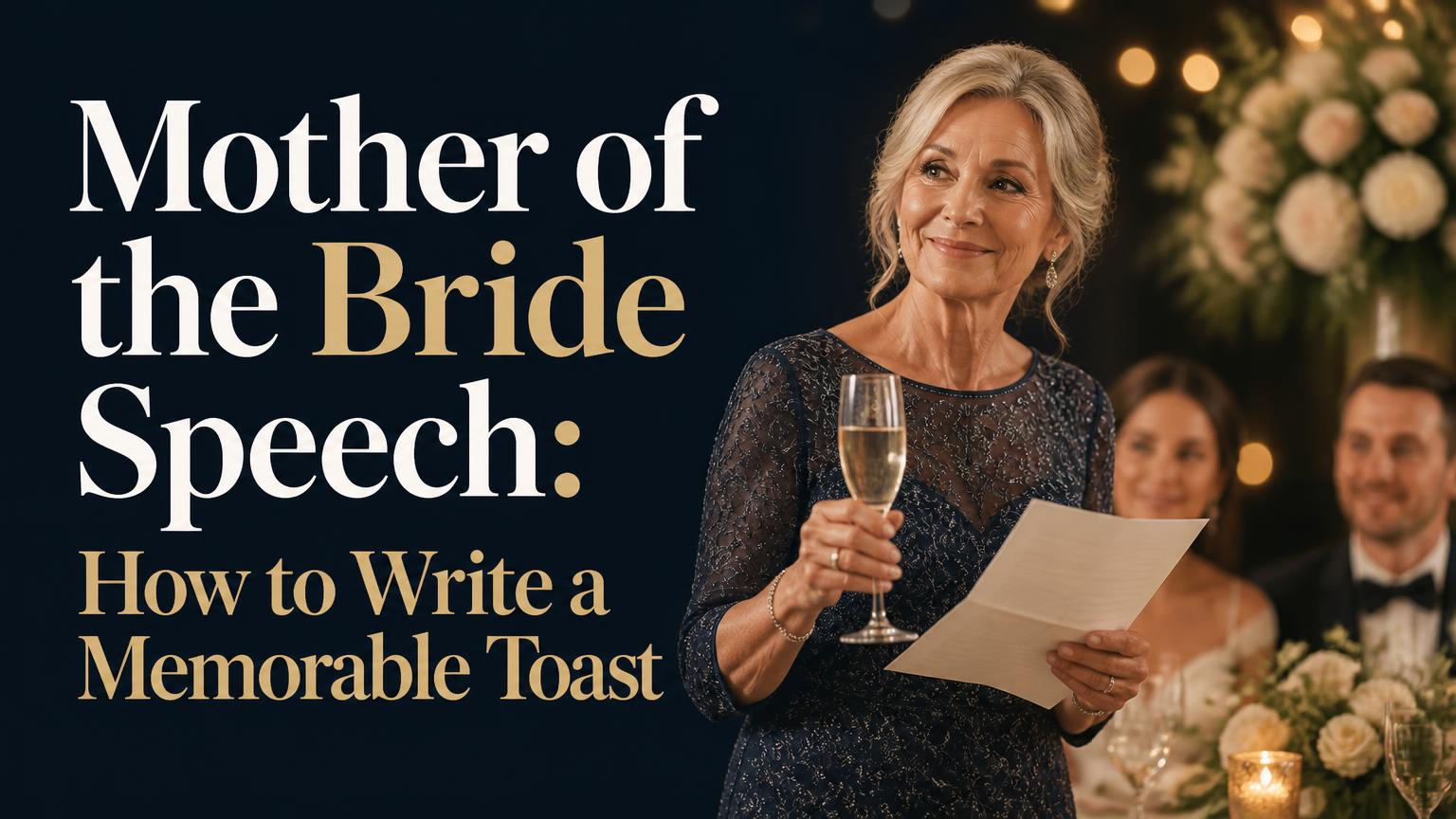
A mother of the bride speech should feel personal, generous, and unmistakably connected to the couple—not like a complete biography of the bride or a list of formal thank-yous. The strongest toast usually combines one or two meaningful memories with a warm welcome to the partner and a hopeful wish for their marriage. Because every family, wedding, and mother-daughter relationship is different, the right speech may be sentimental, lightly humorous, formal, or a thoughtful mixture of all three. The guidance below will help you choose your message, shape your material, and deliver it with confidence.
Mother of the Bride Speech: A Practical Guide to Writing a Memorable Toast
A memorable mother of the bride speech does not require elaborate language or a lifetime of stories. It needs a clear purpose, a few authentic details, and genuine attention to both people being celebrated. Begin by deciding what you most want the couple and their guests to remember: perhaps the bride’s character, the joy of watching her grow, the qualities you admire in her partner, or your hopes for their life together.
A reliable structure is simple: welcome the guests, introduce your central message, share a meaningful memory, acknowledge the partner and both families, and finish with a sincere toast. The following steps will help you develop that structure without making the speech sound stiff or predictable.
Step 1. Clarify Your Role and Purpose
Before writing, consider what your role is at this particular wedding. You may be hosting, welcoming guests on behalf of the family, speaking as the bride’s mother, or simply offering a personal tribute. These roles can overlap, but identifying the main purpose will prevent the speech from wandering.
You do not have to mention every family member, explain the entire wedding program, or represent every emotion in the room. Choose the contribution only you can make. Your perspective might be the experience of watching your daughter become herself, the privilege of welcoming her partner, or the happiness of seeing two families and communities come together.
Step 2. Choose One Central Message
A central message gives the speech direction. Try completing this sentence: “What I most want to say about my daughter and this marriage is…” Your answer might be, “She has always brought determination and warmth to the people around her,” or, “Her partner sees and appreciates the person she truly is.”
Once you have that idea, let it guide the material you select. A speech with one strong theme is easier to follow than one that attempts to cover childhood, school, work, friendships, family history, and every stage of the relationship. You can still include variety, but each story or observation should support the main thought rather than compete with it.
Step 3. Select One or Two Specific Memories
Specific details make a speech sound genuine. Think of a small moment that reveals character rather than choosing a story simply because it is old or amusing. Perhaps your daughter noticed when someone felt left out, persisted through a difficult decision, showed unexpected courage, or made a family gathering more welcoming.
Tell the memory economically. Explain the setting, describe the important action, and then connect it to the person your daughter is today. Avoid turning the speech into a series of private references that only a few guests understand. If the story involves her partner, make sure it reflects well on the couple and does not expose an embarrassing secret, past conflict, or vulnerable detail without permission.
Step 4. Welcome the Partner With Genuine Warmth
The bride’s partner should be an important part of the speech, not an afterthought. Mention a quality you sincerely value, a way the partner supports your daughter, or an observation about how they relate to one another. If you have a shared memory, keep it suitable for the entire audience and make sure the focus remains on the couple.
You do not need to claim that the partner is perfect or pretend that your relationship has always been effortless. Simple, honest language is often more convincing: “I have been grateful to see how thoughtfully [Name] listens to [Bride’s Name]” or “Over time, I have come to admire the steadiness and humor [Name] brings to our family.” A gracious welcome can be meaningful without becoming exaggerated.
Step 5. Build a Clear Spoken Structure
A mother of the bride toast can follow this practical outline:
- Opening: Welcome the guests and acknowledge the joy of the occasion.
- Personal reflection: Share what it means to you to see your daughter on this day.
- Memory or quality: Offer one or two stories that reveal her character.
- The couple: Explain what you appreciate about their relationship and welcome the partner.
- Closing: Offer a wish for their future and invite everyone to raise a glass, if appropriate.
Use transitions that sound natural when spoken. Phrases such as “That quality has stayed with her,” “As she grew older, I began to see,” or “And then [Partner’s Name] became part of her story” can connect sections without announcing a rigid outline. Read the draft aloud to check that each paragraph leads naturally to the next.
Step 6. Choose a Tone That Fits the Wedding
The best tone depends on the couple, the venue, the guest list, and your own relationship with your daughter. A formal evening reception may call for polished, measured language, while a relaxed celebration may welcome more conversational warmth. Either way, aim for sincerity rather than trying to sound like a professional entertainer.
Gentle humor can make a speech lively when it arises from affection and does not require the bride to feel embarrassed. Avoid jokes about drinking, former partners, private disagreements, appearance, sex, money, or family tensions. A brief, kind observation about a familiar habit is safer than a story designed to provoke a large laugh at someone else’s expense.
Step 7. End With a Wish and a Clear Toast
The ending should bring the speech back to the couple. Express what you hope they will carry into married life: patience, curiosity, friendship, laughter, courage, or the ability to keep choosing one another during ordinary days as well as important ones. Keep the wish specific enough to feel personal, but broad enough to suit the couple’s values.
Then make the toast unmistakable. You might say, “May your home always be a place of welcome, your partnership a source of strength, and your life together full of reasons to laugh. To [Bride’s Name] and [Partner’s Name].” If the venue or family custom does not involve raising glasses, end with a spoken blessing, good wish, or expression of love instead.
Mother of the Bride Speech Etiquette and Delivery
Writing the speech is only part of the task. A well-crafted toast can lose its effect if it is too long, difficult to hear, or delivered without regard for the event’s schedule. Wedding customs vary widely, so confirm practical details with the couple or the person coordinating the reception rather than assuming that one traditional order applies everywhere.
The following considerations will help you prepare a speech that is respectful, easy to follow, and comfortable to deliver.
Keep the Speech Within the Agreed Time
There is no universal legal or ceremonial time limit for a mother of the bride speech, but a three- to five-minute toast is a practical range for many receptions. At an ordinary speaking pace of approximately 120 to 140 words per minute, that may mean roughly 400 to 650 words, with pauses and emotion affecting the total time.
Ask the couple or event coordinator how long has been set aside, especially if several people are speaking. A shorter speech is not less meaningful. Editing repeated points, extra background, and second or third anecdotes usually makes the strongest memory more memorable. Time the speech aloud rather than relying only on the word count.
Coordinate With the Couple and Other Speakers
Find out when you will speak, who will come before and after you, whether microphones or lecterns will be available, and whether the couple wants particular people acknowledged. Coordination can prevent several speakers from repeating the same childhood story or thanking the same group in nearly identical language.
You may also want to check whether the couple is comfortable with a particular anecdote, religious reference, family mention, or surprise. A wedding speech is public, and the bride and her partner should not discover at the reception that a private experience has become part of the entertainment. Respecting their boundaries is more important than creating an unexpected reaction.
Prepare Notes That Support You
Use large, readable print or discreet cue cards with generous spacing. Mark the opening, the transition to your main memory, and the final toast so you can find those points quickly if you lose your place. Full sentences are appropriate when exact wording matters, but brief prompts can help the delivery sound more conversational.
Do not write your notes so densely that you must stare down at the page. Highlight names and any words you may find difficult to pronounce. Bring a printed backup even if you plan to use a phone or tablet, since battery, lighting, or notification problems can create unnecessary stress.
Rehearse for Sound and Pace
Read the speech aloud several times, not just silently. Listening to your own words will reveal long sentences, repeated phrases, awkward transitions, and jokes that do not sound as amusing as they looked on the page. Practice looking up at imagined guests at the end of each paragraph and slowing down slightly after an important line.
If a microphone is provided, ask how it will be used. Hold a handheld microphone close enough to your mouth without covering it, and keep your notes at a height that allows you to look up. A calm pace, clear consonants, and brief pauses will help guests follow you better than a forceful or overly theatrical performance.
Plan for Emotion Without Apologizing Excessively
It is natural to become emotional while speaking about your daughter and the wedding. You do not need to eliminate every tremble from your voice. Before the event, identify a sentence where you can pause, breathe, and look down at your notes if needed. Keeping a sip of water nearby may also help.
If you lose your place, stop briefly, take a breath, and continue from the next familiar point. You can say, “This is a very meaningful moment for me,” but you do not need to apologize repeatedly for feeling moved. If speaking feels overwhelming, ask someone to stand with you, share the speech, or deliver it on your behalf. Public speaking is not a test of how much you love your daughter.
Respect Different Family and Cultural Traditions
Not every wedding includes the same roles, rituals, religious language, or family structure. The bride’s mother may be the primary host, one of several parents, part of a blended family, or someone whose relationship with the couple is loving but complicated. Some families expect a formal toast; others prefer short informal remarks or no speeches at all.
Use language that fits the couple’s actual life rather than forcing a traditional script onto it. You do not need to say that the bride is being “given away,” that two families are becoming identical, or that marriage follows one particular path. If faith, cultural tradition, or family history is central to the celebration, include it thoughtfully and in a way the couple has welcomed.
Editing Your Mother of the Bride Speech Before the Wedding
After completing the draft, set it aside briefly and revise it with the audience in mind. Circle every sentence that tells guests something meaningful, reveals a useful detail, welcomes the partner, or advances your central message. Question anything that exists only because it is familiar to you. A story can be precious without belonging in a public toast.
Read the speech to a trusted person who understands the couple and can identify confusing references or unintended embarrassment. Then make a final spoken edit: shorten long sentences, replace formal phrases with words you would naturally say, and remove duplicate compliments. Check the pronunciation of every name and make sure the last paragraph ends with a clear expression of goodwill rather than fading into general remarks.
Closing Thoughts
A memorable mother of the bride speech is built from attention rather than performance. Choose a message that reflects your real relationship with your daughter, include details that help guests see her character, and make room for her partner and their shared future. Keep the speech within the agreed time, protect private information, and rehearse aloud until the words feel familiar. The goal is not flawless delivery; it is to offer the couple a thoughtful, generous moment they will be glad you shared.