
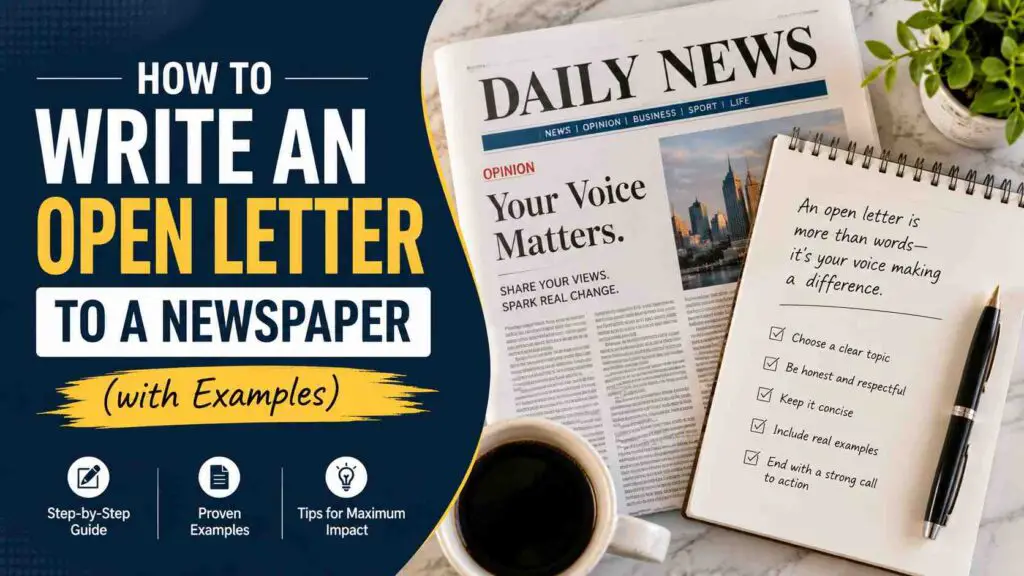
Opening a conversation in public takes courage. A newspaper gives that conversation a serious platform. That is why an open letter to a newspaper can be such a powerful tool.
Unlike a private letter, an open letter is meant for public reading. It may address an editor, a public official, an organization, a community, or society at large. However, it still keeps the direct, personal tone of a letter.
People write open letters to newspapers for many reasons. Some want to raise awareness. Others want to challenge a decision, respond to an event, defend a cause, or invite public discussion. Whatever the purpose, the letter must be clear, focused, respectful, and persuasive.
A strong open letter does not simply complain. Instead, it presents a message that matters. It gives readers a reason to care. More importantly, it encourages action, reflection, or change.
What to Include in an Open Letter to a Newspaper
A Clear Purpose
Every open letter needs a clear reason for existing. Before writing, decide what the letter should achieve.
Do you want to criticize a policy? Support a public cause? Correct misinformation? Appeal to community leaders? Encourage readers to take action?
A clear purpose keeps the letter focused. It also helps the reader understand the main point quickly. Newspapers receive many submissions, so a vague letter may not stand out. However, a focused letter has a much better chance of being read and taken seriously.
A Specific Audience
An open letter may appear in a newspaper, but it should still speak to someone specific. That person or group may be the editor, the mayor, school officials, business leaders, voters, parents, or the wider public.
When you know the audience, your tone becomes stronger. You can choose better examples. You can also shape your argument in a way that speaks directly to the people who need to hear it.
For example, a letter about poor road safety may address the city council. A letter about school funding may address education officials and concerned parents. A letter about local pollution may address both government leaders and residents.
A Strong Opening
The opening should immediately explain the issue. Do not waste space with long background information. Newspapers often have limited room, and readers have limited attention.
Start with the main concern. Then explain why it matters now.
A strong opening may mention a recent event, a public decision, a growing problem, or a personal experience. This gives the letter urgency. It also shows readers why the topic deserves attention.
Relevant Background
An open letter should include enough background to help readers understand the issue. However, it should not become a long history lesson.
Give only the details that support your message. Mention important facts, dates, events, decisions, or experiences. If the issue is local, include specific local details. These details make the letter more credible and relatable.
For example, instead of saying, “Traffic is dangerous,” write, “Three accidents have occurred near the school entrance in the past two months.” Specific information makes the problem harder to ignore.
A Clear Argument
A good open letter has a central argument. It does not jump from one complaint to another. Instead, it builds one main point with supporting reasons.
Your argument should answer a simple question: What do you want readers to understand?
After that, support the point with evidence, examples, or personal experience. Keep each paragraph connected to the main message. As a result, the letter will feel organized and convincing.
A Respectful Tone
Even when the topic is serious, the tone should remain respectful. Anger may grab attention, but uncontrolled anger can weaken the message.
A respectful tone does not mean a weak tone. You can be firm, direct, and passionate without being insulting. Newspapers are more likely to publish letters that contribute to public discussion rather than personal attacks.
Use strong language, but avoid name-calling. Challenge decisions, actions, and ideas. Do not attack people unnecessarily.
A Personal Connection
An open letter becomes more powerful when it includes a personal connection. Readers respond to real experiences. They want to know why the issue matters to someone.
You may explain how the problem affects your family, neighborhood, workplace, school, or community. This human element makes the letter more than an opinion. It turns it into a public concern.
However, keep the personal story brief. Use it to support the larger point, not replace it.
A Call to Action
An open letter should not end without direction. Tell readers what should happen next.
The call to action may ask officials to review a decision, invite residents to attend a meeting, encourage readers to support a cause, or urge a newspaper to investigate an issue further.
Be specific. Instead of writing, “Something must be done,” write, “The council should hold a public meeting before approving the project.” A clear request gives the letter practical force.
A Concise Closing
The closing should leave readers with a final thought. It should reinforce the purpose of the letter and remind readers why the issue matters.
Avoid repeating every point. Instead, end with a strong sentence that feels complete. The best endings are clear, memorable, and purposeful.
How to Write an Open Letter to a Newspaper
#1. Choose One Main Issue
Start by choosing one issue. Do not try to cover too many problems in one letter. A newspaper open letter works best when it focuses on a single concern.
For example, do not write one letter about traffic, school funding, public parks, and local taxes. Each issue deserves its own letter. When you combine too many topics, your message becomes scattered.
Instead, ask yourself: What is the one thing this letter must say?
Once you know the answer, build the entire letter around it. This keeps the writing sharp and persuasive.
#2. Identify the Right Audience
Next, decide who the letter is addressing. Even though the newspaper’s readers will see it, the letter should still have a clear target.
You may write to:
- The editor
- Local government officials
- School leaders
- Business owners
- Community members
- A public organization
- The general public
For example, if you are writing about a local library closure, your audience may include the city council and residents who use the library. If you are writing about a national issue, your audience may be elected officials and concerned citizens.
Once you know the audience, write in a way that speaks directly to them.
#3. Study the Newspaper’s Submission Rules
Before writing, check the newspaper’s guidelines. Many newspapers have rules for letters and opinion submissions.
They may limit word count. They may ask for your name, address, phone number, or email. They may also require original work that has not been published elsewhere.
Following the rules matters. Even a strong letter can be rejected if it is too long or submitted incorrectly.
Therefore, look for the “Letters to the Editor,” “Opinion,” or “Submit a Letter” section on the newspaper’s website. Then follow the instructions carefully.
#4. Write a Direct Opening
Begin with the issue immediately. Do not write a slow introduction. Newspaper readers should understand your concern within the first few sentences.
A strong opening may look like this:
“Residents of Greenfield deserve a clear explanation before the city moves forward with the proposed bus route cuts.”
This sentence tells readers the issue, the audience, and the concern. It also creates urgency.
You can also begin with a recent event:
“Last week’s council vote to reduce evening bus services will affect hundreds of workers who depend on public transport.”
This opening gives the letter a timely reason to exist.
#5. Explain Why the Issue Matters
After the opening, explain why readers should care. Connect the issue to real consequences.
Do not assume everyone already understands the problem. Show them the impact.
For example, if you are writing about poor street lighting, explain how it affects safety. If you are writing about school funding, explain how students and teachers will be affected. If you are writing about healthcare access, explain who will suffer and why.
Use clear examples. The more concrete your explanation is, the stronger the letter becomes.
#6. Support Your Point With Evidence
Now strengthen your message with evidence. This may include facts, statistics, examples, public records, personal experience, or expert statements.
However, do not overload the letter with too many details. Choose the strongest evidence and explain it clearly.
For example:
“According to the district’s own report, class sizes have increased by 20 percent over the past three years.”
This kind of evidence makes your argument more credible. It also shows that your letter is based on more than emotion.
If you include facts, make sure they are accurate. A newspaper may reject a letter if it contains unsupported or misleading claims.
#7. Keep the Tone Firm but Respectful
A newspaper open letter should sound serious and responsible. You can express frustration, disappointment, or concern. However, avoid insults, exaggeration, and personal attacks.
Instead of writing:
“The council clearly does not care about working families.”
Write:
“The council’s decision will place a heavy burden on working families who rely on evening transport.”
The second version is stronger because it focuses on the effect of the decision, not an attack on motives.
A respectful tone helps readers trust you. It also makes officials and editors more likely to take the letter seriously.
#8. Organize the Letter Clearly
Use short paragraphs. Each paragraph should make one point.
A simple structure works well:
- State the issue.
- Explain why it matters.
- Give evidence or examples.
- Address the audience directly.
- End with a clear call to action.
This structure keeps the letter easy to follow. It also helps readers move from concern to understanding to action.
Avoid long, crowded paragraphs. Newspaper writing should be clear and readable.
#9. Add a Clear Call to Action
Before closing, tell readers what you want to happen.
Your call to action should be realistic and specific. For example:
- “The council should delay the vote until residents have been consulted.”
- “The school board should publish a detailed funding plan.”
- “Residents should attend the public meeting on Thursday.”
- “The newspaper should investigate the impact of these closures.”
A strong call to action gives the letter purpose. It turns your opinion into a public request.
#10. End With a Strong Final Statement
The final paragraph should leave readers with a clear message. Do not introduce a new argument at the end. Instead, reinforce your main point.
For example:
“A community cannot thrive when its most vulnerable residents are ignored. This decision deserves public debate before it becomes permanent.”
This ending is brief, serious, and memorable.
Another example:
“The future of our schools should not be decided quietly. Parents, teachers, and students deserve transparency.”
A strong ending gives the letter weight.
#11. Edit for Length and Clarity
After writing the first draft, revise it carefully. Remove unnecessary words. Cut repeated ideas. Make every sentence useful.
Ask these questions:
- Is the main point clear?
- Is the tone respectful?
- Is the letter too long?
- Are the facts accurate?
- Does the call to action make sense?
- Would a busy reader understand the issue quickly?
Read the letter aloud. If a sentence sounds awkward, rewrite it. If a paragraph feels too long, break it up.
Good editing can turn an average letter into a publishable one.
#12. Format and Submit the Letter Properly
Finally, prepare the letter for submission. Include your name and contact details if the newspaper requires them. Some newspapers publish only your name and city, but they may still need your private contact information for verification.
Use a simple subject line if submitting by email. For example:
“Open Letter on Proposed Bus Route Cuts”
Paste the letter into the email body unless the newspaper asks for an attachment. Then submit it through the correct form or email address.
After submission, be patient. Newspapers may edit letters for length, clarity, or style. They may also choose not to publish every submission.
Examples of Open Letters to Newspapers
Concerns About Road Safety Near Schools
Dear Editor,
I am writing to draw attention to the growing safety concerns around the roads surrounding our local elementary school. Every morning and afternoon, hundreds of children cross busy intersections where traffic frequently exceeds the speed limit. Despite repeated requests from parents and teachers, little action has been taken to improve safety measures.
Installing additional crosswalks, reducing speed limits during school hours, and increasing police presence could significantly reduce the risk of accidents. The safety of our children should never be considered optional. I urge local officials to prioritize this issue before a preventable tragedy occurs.
Sincerely,
[Your Name]
Support for Expanding Public Library Services
Dear Editor,
Our public library remains one of the most valuable resources in the community. It provides educational materials, internet access, study spaces, and community programs that benefit residents of all ages. Unfortunately, recent discussions about reducing library funding threaten these important services.
Rather than cutting resources, our community should explore opportunities to expand library programs and operating hours. Libraries contribute to literacy, lifelong learning, and equal access to information. Investing in them is an investment in the future of our town.
I encourage local leaders to protect and strengthen this essential institution.
Respectfully,
[Your Name]
Request for Improved Public Transportation
Dear Editor,
Many residents rely on public transportation to travel to work, school, medical appointments, and other essential destinations. However, recent reductions in bus schedules have created significant hardships for those who depend on these services.
Missed connections, longer waiting times, and overcrowded buses affect workers, students, and elderly residents alike. Reliable transportation is not merely a convenience; it is a necessity for economic and social participation.
I respectfully ask transportation authorities to reconsider these service reductions and engage with community members before making further changes. Accessible transportation benefits everyone.
Sincerely,
[Your Name]
Addressing Local Environmental Concerns
Dear Editor,
The increasing amount of litter and illegal dumping in our parks and public spaces has become a serious concern. These areas are intended to be enjoyed by families, visitors, and future generations, yet many now suffer from neglect and pollution.
Community clean-up events are helpful, but they cannot replace long-term solutions. Increased enforcement of anti-dumping regulations, additional waste disposal facilities, and public awareness campaigns could make a meaningful difference.
Protecting our environment requires a shared commitment from residents, businesses, and local government. I hope this issue receives the attention it deserves.
Respectfully,
[Your Name]
Advocating for Greater Transparency in Local Government
Dear Editor,
Trust in local government depends on transparency and open communication. Unfortunately, many important decisions affecting our community appear to be made with limited public input and insufficient explanation.
Residents deserve timely access to information about proposed projects, spending decisions, and policy changes. Public meetings should be widely advertised, and supporting documents should be easily accessible.
Greater transparency strengthens accountability and encourages public participation. When citizens understand how decisions are made, confidence in local institutions grows.
I urge our elected officials to embrace openness and actively engage with the people they serve.
Sincerely,
[Your Name]
Closing Thoughts
Writing an open letter to a newspaper is a powerful way to enter public conversation. It allows ordinary citizens, community leaders, professionals, and concerned readers to speak on issues that deserve attention.
The best open letters are clear, focused, respectful, and practical. They explain the issue, support the argument, and ask for a specific response. They do not simply express anger. Instead, they invite readers to think, care, and act.
Before writing, choose one issue. Address the right audience. Support your point with evidence. Then end with a clear call to action.
A well-written open letter may not solve the problem overnight. However, it can raise awareness, influence opinion, and push important conversations into the public eye.