
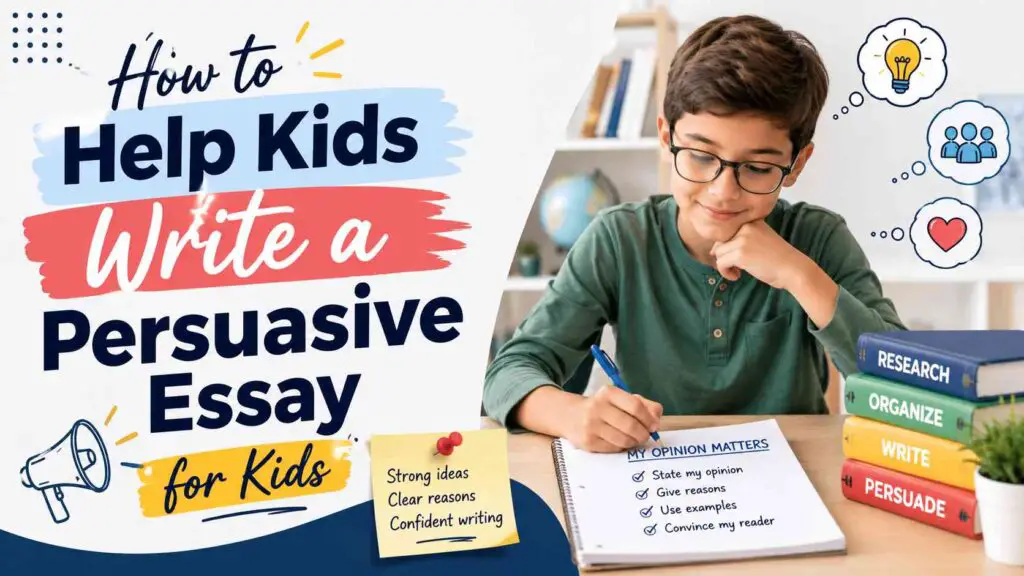
Helping kids write a persuasive essay can feel tricky at first. After all, children often know what they want to say, but they may not know how to organize their ideas, support their opinions, or convince a reader.
That is where a simple structure helps.
A persuasive essay teaches kids how to share an opinion clearly, give strong reasons, use evidence, and end with a confident conclusion. It also helps them think more deeply. Instead of saying, “I like this,” they learn to explain why their opinion makes sense.
A good persuasive essay for kids does not need to be complicated. In fact, the best approach is simple, clear, and practical. Once children understand the basic parts of persuasive writing, they can use the same process again and again.
What Makes an Essay Persuasive?
A persuasive essay tries to convince the reader to agree with an opinion. It does not just state what the writer thinks. It explains the opinion, supports it with reasons, and encourages the reader to think differently.
Here are the key elements that make an essay persuasive.
A Clear Opinion
Every persuasive essay needs a clear opinion.
Kids should be able to answer this question: What do I want the reader to believe?
For example:
- School uniforms are a good idea.
- Kids should have less homework.
- Every classroom should have a pet.
- Recess should be longer.
The opinion should be easy to understand. If the reader cannot tell what the child believes, the essay will not feel persuasive.
Strong Reasons
A persuasive essay needs reasons that support the opinion.
A reason explains why the writer believes something. For example, if a child writes that recess should be longer, they might give these reasons:
- Kids need exercise.
- Breaks help students focus.
- Recess helps children make friends.
Strong reasons make the opinion more convincing. They show the reader that the writer has thought carefully about the topic.
Helpful Evidence
Reasons become stronger when kids add evidence.
Evidence can include examples, facts, personal experiences, or simple observations. For younger children, evidence does not have to be complex. It just needs to support the reason.
For example:
“Longer recess helps kids focus because students often feel tired after sitting for a long time. After a break, they can return to class with more energy.”
This makes the reason clearer and more believable.
Persuasive Words
Persuasive essays use words that guide the reader.
Kids can use phrases like:
- I believe
- One reason is
- For example
- This shows
- Another reason
- Most importantly
- Clearly
These words help the essay flow. They also make the argument easier to follow.
A Strong Conclusion
The conclusion reminds the reader of the main opinion.
It should not introduce a brand-new idea. Instead, it should restate the opinion and leave the reader with a final thought.
For example:
“Clearly, longer recess would help students stay healthy, focused, and happy. That is why schools should give kids more time to play each day.”
A strong conclusion gives the essay a confident ending.
How to Help Kids Write a Persuasive Essay
Teaching persuasive writing works best when you break the process into small steps. Kids need to see that an essay is not one big task. It is a series of simple choices.
#1. Choose a Topic Kids Care About
Start with a topic that matters to the child.
Kids write better when they have a real opinion. So, avoid topics that feel too distant or boring. Instead, choose something connected to school, home, hobbies, books, pets, sports, or daily life.
Good topics might include:
- Should kids get more recess?
- Should homework be optional?
- Should families have a weekly game night?
- Should children be allowed to choose their own bedtime?
- Should every student learn how to cook?
Ask the child, “What do you really think about this?” If they can answer quickly, the topic is probably a good fit.
#2. Help Them Pick One Clear Opinion
Next, help the child turn the topic into a clear opinion.
A topic is broad. An opinion takes a side.
For example, “homework” is only a topic. But “Kids should have less homework” is an opinion.
Encourage the child to write one simple sentence that states what they believe. This sentence can become the main idea of the essay.
For example:
“I believe kids should have less homework because they need more time to rest, play, and spend time with family.”
This gives the essay direction right away.
#3. Brainstorm Three Strong Reasons
After the child has an opinion, help them think of reasons.
A simple persuasive essay usually works well with three reasons. Three is enough to build a strong argument without overwhelming the child.
Use this question:
“Why do you think this is true?”
For example, if the opinion is “Kids should have less homework,” the reasons might be:
- Kids need time to relax.
- Too much homework can cause stress.
- Children need time for family, hobbies, and sleep.
At this stage, do not worry about perfect wording. Just get ideas on paper. Later, the child can choose the strongest reasons.
#4. Add Examples to Each Reason
Now help the child support each reason with an example.
This is where many kids struggle. They may write a reason and stop there. However, persuasive writing needs more detail.
Teach them to ask:
“How can I prove this?”
“What example shows this?”
“When have I seen this happen?”
For example:
Reason: Kids need time to relax.
Example: After a long school day, children may feel tired and need time to play outside, read, or rest before the next day.
This makes the essay feel more complete. It also helps the reader understand the child’s point.
#5. Use a Simple Essay Structure
Kids need a clear structure they can follow.
A persuasive essay can use this basic format:
Introduction: State the topic and opinion.
Body Paragraph 1: Give the first reason and example.
Body Paragraph 2: Give the second reason and example.
Body Paragraph 3: Give the third reason and example.
Conclusion: Restate the opinion and end with a final thought.
This structure gives kids a roadmap. It also reduces frustration because they know exactly what each part should do.
#6. Write a Strong Introduction
The introduction should tell the reader what the essay is about.
For kids, keep it simple. The introduction can include a hook, a little background, and the main opinion.
For example:
“Many kids spend hours at school each day and then come home with more work to do. While homework can help students practice, too much of it can be stressful. I believe kids should have less homework because they need time to rest, enjoy family, and get enough sleep.”
This introduction is clear. It tells the reader the topic and the writer’s opinion.
#7. Build Each Body Paragraph Around One Reason
Each body paragraph should focus on one reason.
This helps kids stay organized. It also keeps the essay from jumping around.
A simple paragraph pattern is:
- State the reason.
- Explain the reason.
- Give an example.
- Connect it back to the opinion.
For example:
“One reason kids should have less homework is that they need time to relax. After sitting in class for many hours, children can feel tired. If they have too much homework, they may not have enough time to play, read, or rest. Less homework would give kids more balance after school.”
This paragraph is easy to follow because it focuses on one idea.
#8. Teach Them to Use Transition Words
Transition words help the essay flow from one idea to the next.
Give kids a small list they can use while writing:
- First
- Next
- Another reason
- Also
- For example
- Because of this
- Most importantly
- In conclusion
These words act like signs for the reader. They show where the argument is going.
For example:
“Another reason kids should have less homework is that they need more time with their families.”
That one phrase helps the reader move smoothly into the next point.
#9. Help Them Write a Confident Conclusion
The conclusion should bring the essay to a strong close.
Teach kids to restate their opinion in a fresh way. Then, they can remind the reader of the main reasons and end with a final sentence.
For example:
“Kids should not have too much homework because they need time to relax, spend time with family, and sleep well. School is important, but children also need balance. With less homework, kids can be healthier, happier, and ready to learn.”
A good conclusion should feel complete. It should leave the reader with a clear final message.
#10. Revise for Clarity and Strength
Writing does not end after the first draft.
Help kids reread their essay and ask simple revision questions:
- Is the opinion clear?
- Does each paragraph have one main reason?
- Are there examples?
- Did I use transition words?
- Does the conclusion feel strong?
Then, encourage them to improve one thing at a time. They might add a better example, fix a weak sentence, or make the opinion clearer.
Revision teaches kids that strong writing is built step by step.
Closing Thoughts
Helping kids write a persuasive essay becomes much easier when they follow a clear process. They need a topic they care about, one strong opinion, clear reasons, helpful examples, and a simple structure.
Most importantly, kids need encouragement.
Persuasive writing teaches more than essay skills. It teaches children how to think, explain, and communicate with confidence. When they learn how to support their opinions with reasons and evidence, they become stronger writers and better thinkers.
With practice, a persuasive essay for kids can become a fun and powerful way for children to express what they believe.