
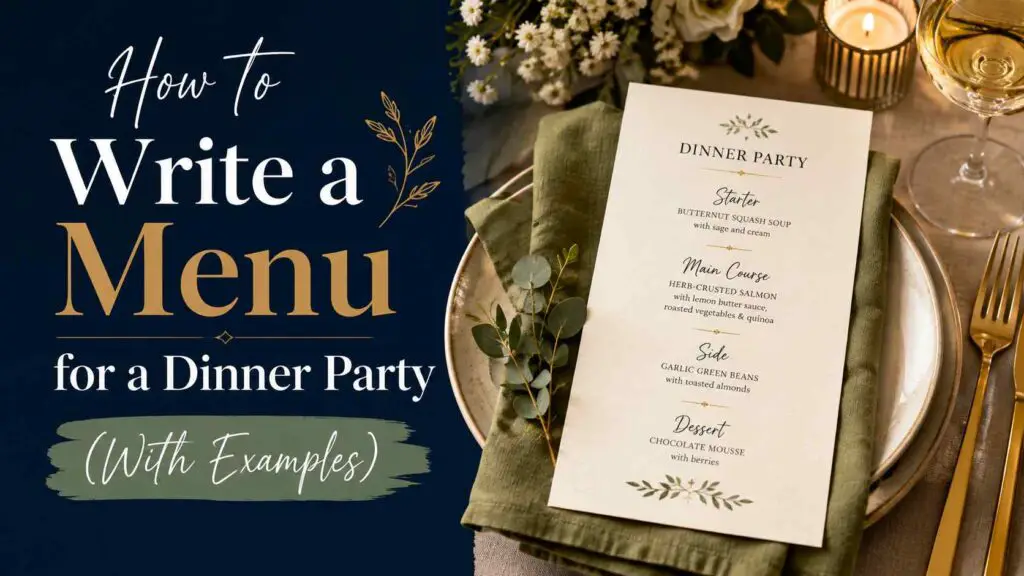
A dinner party menu is a small piece of hospitality writing — the first course your guests consume, before any food arrives. Written well, it builds appetite, sets the evening’s tone, and quietly answers the questions guests won’t ask aloud (how fancy is this, how long will it run, is there something I can eat). Written badly, it oversells with restaurant-speak or undersells with a bare list. The craft sits between those failures: name dishes honestly, describe them briefly, arrange them as an arc, and let the card itself feel like the evening it announces.
Here’s how to write one, course by course.
How to Write a Menu for a Dinner Party (With Examples)
#1. Shape the Arc First
A menu is a narrative — light opening, building middle, indulgent end — and guests read it as a preview of the evening’s pacing. Lay out the courses in order with clear headings so the arc is visible at a glance; the structure itself is reassurance.
To Begin — Chilled cucumber soup with dill and lemon
The Main Event — Slow-roasted lamb shoulder, white beans, gremolata
To Finish — Burnt honey ice cream, shortbread
Nibbles at Seven · Soup at Eight · Something Substantial · Cheese, If You’re Still Standing · Pudding Regardless
Five small courses, one long table: bread & butter — beets & citrus — mushroom broth — duck & plums — chocolate, cream, and no apologies.
#2. Name Dishes Plainly, Then Charm
The dish name should say what’s actually on the plate — main ingredient, method — with charm as garnish, not disguise. “Roast chicken with forty cloves of garlic” beats “Poulet Mystique”; guests trust a menu that tells them what they’re eating.
Roast chicken with forty cloves of garlic — yes, forty; no, you won’t regret it.
Grandma Rosa’s Sunday ragù (three hours, one secret) over fresh pappardelle.
Baked salmon, brown butter, capers — the fish your host caught none of but chose with great personal courage at the market this morning.
#3. One Line of Description, Maximum
Each dish earns at most one short descriptive line — a texture, a temperature, an origin — chosen to trigger appetite, not to inventory the pantry. Menus are read standing up with a drink in hand; brevity is a courtesy and confidence.
Onion tart — slow-cooked to sweetness, pastry like a rumor, served warm.
Short ribs — braised since Thursday. They fall apart; feel free to do the same.
Lemon posset — three ingredients, one of them patience.
#4. Provenance Without the Sermon
A touch of origin — the neighbor’s tomatoes, the market cheese, Dad’s recipe — warms a menu and honors sources, but two mentions is the ceiling before it becomes a lecture. Choose the one or two provenances that carry actual meaning for this table.
Tomato salad — Franco-next-door’s tomatoes, who will be at the table and accepts compliments.
The bread is from the bakery on Cedar Street, because some things should be left to professionals.
Apple cake — my father’s recipe, served the way he served it: too large, and without discussion.
#5. Handle Dietary Notes With Grace
Guests with restrictions scan a menu anxiously; relieve them elegantly — small markers, a gentle footnote, or an alternative named with as much affection as the main dish. The goal is that no one at your table feels like a logistics problem.
Everything on this menu is nut-free; the ragù and the tart have vegetarian twins, made with equal love and slightly more mushrooms.
(v) grows on plants · (gf) never met wheat · ask me anything, I promise I planned for you.
For Priya: your dal is not an afterthought — it took two practice runs and a phone call to your mother.
#6. Match the Voice to the Evening
A menu’s tone previews the party — formal and spare for a celebration dinner, playful for old friends, tender for an anniversary. Decide the evening’s register first and write every line in it; a mismatched menu promises a different party than the one you’re throwing.
Formal: Celebration Dinner for Amara & Daniel — Champagne on arrival · Scallops, brown butter · Beef Wellington · Wedding cake, at last, the one we froze.
Playful: MARCO’S ANNUAL “I SWEAR THE SMOKER WORKS NOW” DINNER — brisket (14 hours, pray for us), slaw, cornbread, and a fire extinguisher on standby.
Tender: Fifty Years, One Table — her soup, his roast, their daughter’s pavlova, and the toast at nine.
#7. Drinks Deserve a Line
A short drinks note — what’s poured with what, and a named non-alcoholic option — completes the menu and spares guests the awkward ask. Write the alcohol-free choice with the same care as the wine; it’s the line that tells certain guests they were expected.
With the lamb: a big friendly Rioja. With dessert: sweet wine or strong coffee. All evening: elderflower pressé with mint, made this afternoon and honestly excellent.
Wine is on the table; the good bottle appears with the cheese, per tradition. Drivers and abstainers: the sour cherry spritz was invented for you and named after you — ask for a Reliable Friend.
One cocktail, made properly, until the shaker’s arm gives out — then wine, water, and whatever the evening decides.
#8. Skip the Symphony of Flavors
“A symphony of flavors,” “drizzled with a delicate medley,” “nestled on a bed of” — restaurant-menu clichés turn a home dinner card into a parody of fine dining. The repair is the plain-words test: describe each dish the way you’d tell a friend across the kitchen counter, and let warmth do what “sumptuous” can’t.
Menu-speak: pan-seared chicken nestled on a bed of seasonal medley. Counter-speak: chicken with crispy skin, whatever looked best at the market, and more butter than I’ll admit.
Not “a symphony of flavors”: soup, then the good part, then cake. Trust me and pace yourselves.
Not “artisanal charcuterie experience”: a big board of things that go with wine. Start anywhere.
Closing Thoughts
Before you print, run the guest test: read your menu as three specific people from your list — the hungriest, the one with the allergy, the shy one who doesn’t drink. Does each find, within ten seconds, the line that says you’re taken care of? Then read it once aloud in your own kitchen voice; any phrase you’d never actually say across the counter gets rewritten until you would. A dinner party menu is a note from a host, not a restaurant’s audition — and the best compliment it can earn is a guest folding it into a pocket to keep.