
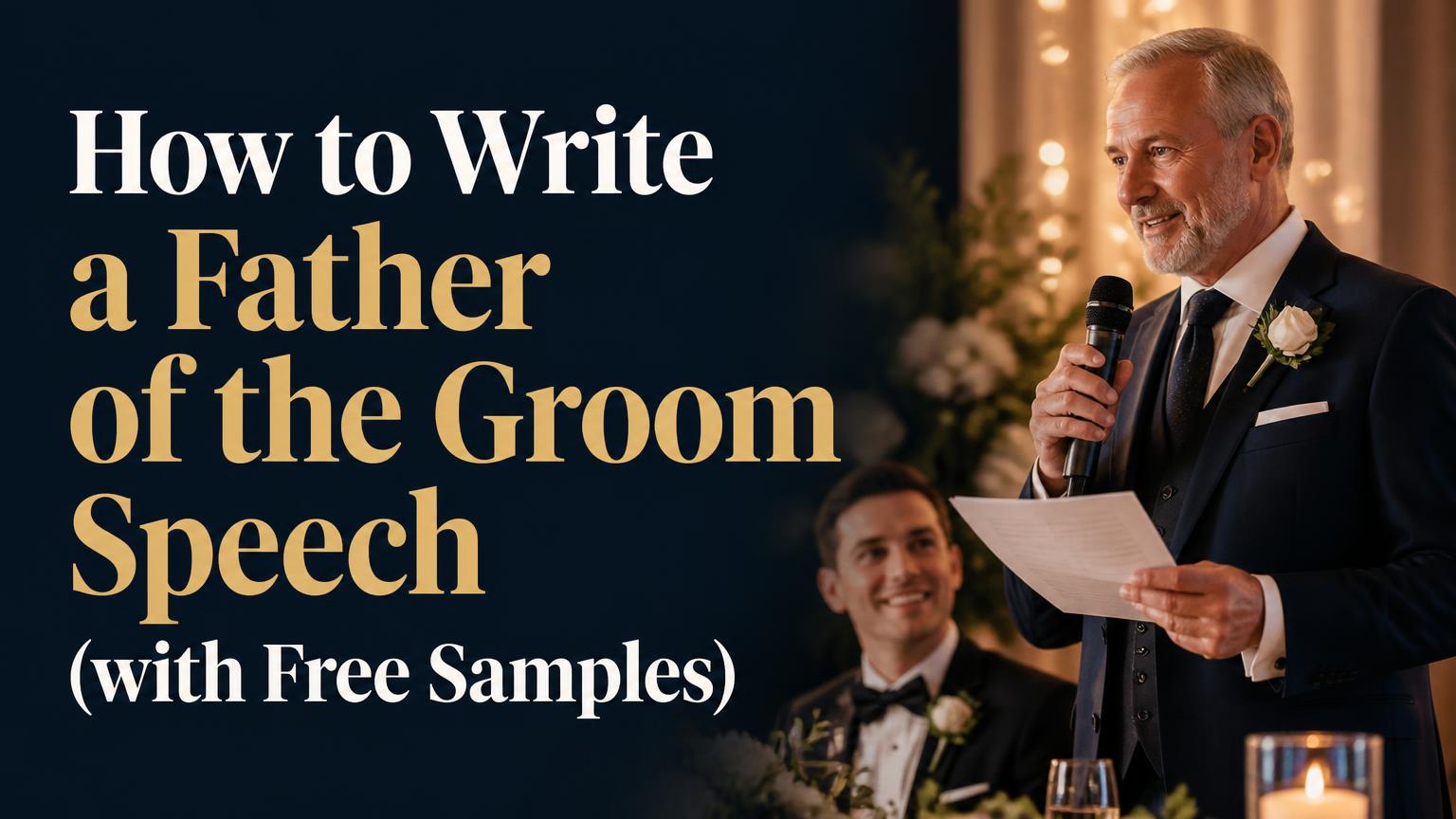
A father of the groom speech should do more than list achievements or offer a formal welcome. It should give guests a warm sense of who the groom is, recognize the person he has chosen, and express genuine hope for the couple’s life together. The strongest speeches are personal without becoming private, affectionate without becoming embarrassing, and polished enough to suit the room while still sounding like the speaker. The guidance below explains how to plan, write, personalize, and deliver the speech, followed by two adaptable free samples.
How to Write a Father of the Groom Speech
Step 1. Define What You Want the Speech to Do
Before writing the first sentence, decide what you want guests to remember. A father of the groom speech usually has several purposes: welcoming the couple, celebrating the groom, acknowledging the bride or groom’s partner, thanking guests, and offering a sincere wish for the future. You do not need to give equal time to every purpose, but each should have a place if it suits the wedding.
Choose one central feeling to guide the speech. You might want it to express gratitude, pride, affection, admiration, or a mixture of these. A clear purpose keeps the speech from becoming a scattered collection of childhood stories, family references, and congratulations. Write that purpose in one sentence, such as: “I want this speech to show how proud I am of the man my son has become and how happy I am to welcome [Partner’s Name] into our family.”
Step 2. Keep the Couple at the Center
Although you are speaking as the groom’s father, the wedding celebrates two people. Mention your son’s qualities and your relationship with him, but connect those thoughts to the partnership he is forming. Explain what you appreciate about [Partner’s Name], what you notice in them together, or how their relationship seems to bring out the best in both of them.
Avoid treating the partner as a guest being formally admitted into the family. A warmer approach is to speak about the relationship with respect and openness. If you do not know the partner well, you can still say something genuine about their kindness, steadiness, sense of humor, or the happiness they bring to your son. Do not invent a story or claim a closeness that has not developed yet.
Step 3. Choose One Clear Theme
A theme gives the speech shape. It might be the groom’s thoughtfulness, his ability to build strong relationships, the way he has grown into adulthood, or the importance of finding someone with whom he can be fully himself. The theme does not need to be announced directly; it can simply guide the examples you choose.
For instance, if your theme is your son’s generosity, select one childhood example and one present-day observation that reveal it. If your theme is growth, contrast an early memory with the mature person standing beside [Partner’s Name] today. One strong theme is usually more memorable than six unrelated compliments. It also makes editing easier when the draft becomes too long.
Step 4. Select Stories That Reveal Character
Choose one or two memories that show something meaningful about the groom rather than merely proving that he had a childhood. A story about helping someone, persisting through difficulty, welcoming others, or taking responsibility will usually serve the occasion better than an embarrassing incident. The audience does not need every detail; it needs the detail that reveals the person behind the story.
A useful test is to ask, “What does this memory show?” If the answer is unclear, leave the story out or explain its significance. Keep private information, past relationships, family disagreements, and jokes that could make the couple uncomfortable away from the microphone. A brief reference to [Specific Memory] can be enough if you add the lesson or quality it represents.
Step 5. Build a Simple Spoken Structure
A practical father of the groom speech can follow this sequence: greet the guests, thank those who helped create the day, introduce your relationship with the groom, share one or two meaningful observations, acknowledge [Partner’s Name] and the couple’s relationship, and finish with a heartfelt wish or toast.
This structure is flexible rather than a rigid formula. You might begin with a reflection instead of a formal greeting, or place the thanks near the end. What matters is that the speech moves naturally. Each paragraph should lead to the next: from who your son was, to who he has become, to the relationship he is building now. If a paragraph does not support that movement, it may not belong.
Step 6. Write a Toast That Includes Everyone
The final toast should be concise, warm, and directed toward both people. Avoid ending with a vague phrase such as “Here’s to happiness” unless you add a more personal wish. You could hope that the couple continues to make room for laughter, listens to each other during difficult seasons, or remains curious about one another throughout married life.
Include [Partner’s Name] by name and raise a glass to the couple together. If the wedding has particular cultural, religious, or family traditions, follow the guidance of the couple or the person coordinating the event. A traditional toast may be expected in one setting and unnecessary in another, so let the occasion determine the formality.
Step 7. Edit, Time, and Rehearse Aloud
Aim for roughly three to five minutes unless the couple or venue has requested a different length. At a natural speaking pace, that is approximately 360 to 700 words, although pauses, laughter, and emotion will affect the timing. A shorter, focused speech is usually more effective than one that tries to cover every stage of the groom’s life.
Read the draft aloud several times. Replace formal phrases you would never say in conversation, shorten long sentences, and mark places where you want to pause. Practice looking up from your notes rather than memorizing every word. Keep a printed copy or large cue cards available, and identify the first and last lines clearly so you can regain your place if emotion or interruption breaks your concentration.
Father of the Groom Speech Samples
The following samples use adaptable details rather than invented family history. Replace the bracketed wording with a genuine memory, observation, or name, and remove anything that does not sound like you. Each sample takes a different approach: the first is reflective and traditional, while the second is more conversational and focused on the couple’s partnership.
#1. A Proud Father’s Reflection on His Son’s Journey
Good evening, everyone. Thank you all for being here to celebrate [Groom’s Name] and [Partner’s Name]. A wedding brings together people from many parts of a couple’s life, and it means a great deal to our family to see so many friends and relatives gathered in one place.
As [Groom’s Name]’s father, I have had the privilege of watching him grow from a boy with his own strong ideas into the man standing here today. I remember [Specific Memory], a moment that showed me something about his character even then. It may have seemed like a small event at the time, but I could see his determination, his thoughtfulness, or perhaps simply his refusal to give up when something mattered to him.
Those qualities have stayed with him. They have developed with age, experience, and the many decisions that shape a life. I am proud of what he has accomplished, but I am even more proud of the way he treats people. He has learned that strength is not only about achieving goals. It is also about being dependable, listening carefully, and standing beside the people you love.
[Partner’s Name], thank you for loving my son and for building this life with him. When I see the two of you together, I see affection, respect, and a genuine sense of partnership. You bring out happiness in each other, and that is one of the greatest gifts a parent could hope to see.
Marriage will bring easy days, demanding days, and many ordinary days that become meaningful because you share them. I hope you continue to speak honestly, forgive generously, and make time for laughter. May you remain each other’s trusted friend as well as each other’s partner.
[Groom’s Name], I have been proud to call you my son at every stage of your life. Today, I am proud to see the man you have become and the future you are creating with [Partner’s Name].
Please raise a glass with me to [Groom’s Name] and [Partner’s Name]. May your home be filled with patience, friendship, laughter, and lasting love. To the happy couple.
#2. A Warm and Conversational Toast to the Happy Couple
Good evening, everyone. I promised myself I would keep this speech brief, partly out of respect for the schedule and partly because [Groom’s Name] knows that whenever I say, “I only have a few things to say,” people should become slightly concerned.
But today deserves a few words. [Groom’s Name], from the time you were young, you have had a strong sense of what matters to you. That has not always made life predictable for the people around you, but it has made you unmistakably yourself. You have worked hard, cared deeply, and learned from the experiences that brought you to this day.
One of the things I value most is seeing the way you and [Partner’s Name] treat each other. You do not simply look happy in photographs, although you certainly do that too. You listen to one another. You make room for each other’s ideas. You share the ordinary responsibilities of life, and you seem to understand that a lasting relationship is built in those ordinary moments as much as in the grand ones.
[Partner’s Name], our family is grateful for the joy and steadiness you bring into [Groom’s Name]’s life. Thank you for choosing him, for encouraging him, and for helping create a relationship in which both of you can continue to grow. We are very happy to celebrate you today.
To my son: marriage does not require you to have every answer. It asks you to keep showing up, especially when the answer is not obvious. Be patient when the day has been difficult, be generous when you disagree, and never underestimate the value of a kind word or a shared laugh.
To both of you, I hope your life together contains exciting adventures, quiet mornings, good friends, and the confidence that you never have to face any season alone.
Please raise your glasses to [Groom’s Name] and [Partner’s Name]. May today be the beginning of a long, happy partnership and a life that feels fully your own. Cheers.
Closing Thoughts
Writing a father of the groom speech becomes easier when you focus on one honest message rather than trying to summarize your son’s entire life. Choose a memory that reveals character, give the couple equal respect, and end with a specific wish for their future. Read the speech aloud until the language sounds like you, then practice enough to feel steady without losing the natural warmth of the occasion. The most memorable words will be sincere, personal, and directed toward the people being celebrated.