
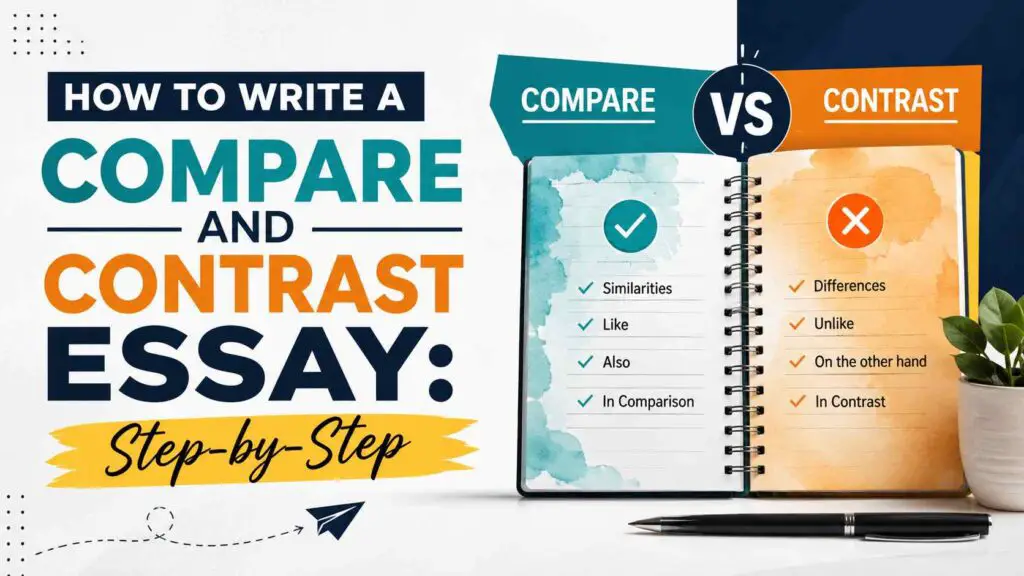
A compare and contrast essay is one of the most common assignments students receive in school and college. It asks the writer to study two or more subjects and explain how they are similar, different, or both.
This kind of essay may sound simple at first. After all, everyone knows how to say that two things are alike or different. But a strong compare and contrast essay does more than list similarities and differences. It makes a clear point. It helps the reader understand why the comparison matters.
To write it well, you need a focused topic, a clear thesis, strong organization, and meaningful examples. Once you understand the structure, the essay becomes much easier to plan and write.
What is a Compare and Contrast Essay?
A compare and contrast essay is a type of academic writing that examines two or more subjects by looking at their similarities and differences.
To compare means to show how subjects are alike. To contrast means to show how they are different. Some essays focus more on comparison. Others focus more on contrast. Many do both.
For example, a student might compare and contrast online classes and traditional classroom learning. The essay could discuss teaching style, flexibility, student interaction, cost, and learning outcomes.
The goal is not just to say, “These two things are similar and different.” The goal is to explain what those similarities and differences reveal. A good compare and contrast essay helps the reader see the subjects more clearly.
Essential Components of a Compare and Contrast Essay
A strong compare and contrast essay needs more than two subjects and a few observations. It needs structure, purpose, and evidence. The following components help turn a basic comparison into a clear and meaningful essay.
#1. Two or More Comparable Subjects
The essay must focus on subjects that can reasonably be compared. They should belong to the same general category.
For example, comparing two novels makes sense. Comparing a novel and a refrigerator usually does not, unless there is a very specific creative reason.
Good subjects for comparison may include two books, two historical events, two leaders, two theories, two careers, two products, or two educational systems. The subjects should have enough similarities to make the comparison logical and enough differences to make the essay interesting.
#2. A Clear Purpose
A compare and contrast essay should have a reason behind it. The writer should know why the comparison matters.
For example, if the essay compares public schools and private schools, the purpose might be to help readers understand which option offers more flexibility, stronger academics, or better social development.
Without a clear purpose, the essay can become a simple list of points. A strong purpose gives the essay direction.
#3. A Strong Thesis Statement
The thesis statement is the main point of the essay. It tells the reader what the comparison will show.
A weak thesis might say:
“Online learning and classroom learning are similar and different.”
A stronger thesis would be:
“Although online learning offers greater flexibility, traditional classroom learning provides stronger social interaction and more immediate academic support.”
This thesis does more than announce the topic. It gives the essay a clear argument.
#4. Organized Points of Comparison
The essay should focus on specific points of comparison. These are the categories used to compare the subjects.
For example, if comparing two jobs, the points of comparison might include salary, work-life balance, required education, career growth, and daily responsibilities.
These points help keep the essay focused. They also make it easier for the reader to follow the argument.
#5. Relevant Evidence and Examples
A strong essay uses evidence to support each point. Evidence may include facts, examples, quotations, statistics, personal observations, or references to texts.
For example, if comparing two novels, the writer might use quotes from both books. If comparing two learning methods, the writer might use examples from student experiences or research findings.
Evidence makes the comparison more convincing.
#6. Logical Organization
A compare and contrast essay needs a clear structure. The two most common structures are the block method and the point-by-point method.
In the block method, the writer discusses one subject fully, then discusses the other subject.
In the point-by-point method, the writer discusses one comparison point at a time and explains how both subjects relate to that point.
Both structures can work well. The best choice depends on the topic and the purpose of the essay.
#7. Meaningful Analysis
The essay should explain why each similarity or difference matters. This is where many students make mistakes. They list points but do not analyze them.
For example, it is not enough to say that one school has smaller classes and another has larger classes. The writer should explain how class size affects learning, student attention, or teacher support.
Analysis turns information into insight.
How to Write a Compare and Contrast Essay: Step-by-Step
Writing a compare and contrast essay becomes much easier when you follow a clear process. Instead of trying to write everything at once, move step by step from topic selection to final revision. Here is a practical process you can follow.
Step #1: Choose Two Subjects That Can Be Compared
Start by choosing two subjects that belong to the same general category.
For example, you might compare two books, two characters, two colleges, two political systems, two historical events, or two types of technology.
Make sure the subjects are not too similar. If they are almost identical, there may not be enough to discuss. Also make sure they are not too different. If they have nothing in common, the comparison may feel forced.
A good pair of subjects should create a useful discussion. Ask yourself:
What do these subjects have in common?
How are they different?
Why would someone care about this comparison?
If you can answer these questions, you likely have a workable topic.
Step #2: Identify the Main Purpose of the Essay
Next, decide why you are comparing these subjects.
Are you trying to show that one is better than the other? Are you explaining how two ideas developed differently? Are you helping readers understand a difficult topic by comparing it with a familiar one?
For example, if you are comparing high school and college, your purpose may be to show how college requires more independence and personal responsibility.
Your purpose will guide the rest of the essay. It will help you decide which points to include and which ones to leave out.
Step #3: Brainstorm Similarities and Differences
Before writing, make a list of everything you notice about the two subjects.
You can use a Venn diagram, a chart, or a simple list. Write one subject on the left, the other on the right, and similarities in the middle.
For example, if comparing online learning and classroom learning, you might list:
Online learning offers flexibility.
Classroom learning provides face-to-face interaction.
Both require assignments and assessments.
Online learning requires more self-discipline.
Classroom learning gives quicker access to the teacher.
At this stage, do not worry about perfect organization. The goal is to gather ideas.
Step #4: Select the Strongest Points of Comparison
After brainstorming, choose the most important points. Do not try to include everything.
A focused essay is stronger than an essay that jumps from one random point to another. Choose three or four main points that support your purpose.
For example, if your essay compares online learning and classroom learning, you might focus on flexibility, student interaction, learning environment, and personal responsibility.
Each point should help prove your thesis. If a point is interesting but does not support the main argument, leave it out.
Step #5: Create a Clear Thesis Statement
Now write your thesis statement. This should appear near the end of the introduction.
Your thesis should name the subjects and explain the main point of comparison.
For example:
“Although online learning and classroom learning both aim to educate students, they differ greatly in flexibility, interaction, and the level of self-discipline required.”
This thesis tells the reader what the essay will discuss. It also gives the essay a clear direction.
Avoid vague thesis statements. Do not simply say that the subjects are “similar and different.” Explain what the comparison reveals.
Step #6: Choose the Best Essay Structure
Decide whether to use the block method or the point-by-point method.
The block method works well when you want to discuss each subject separately. In this structure, you explain all the main points about the first subject, then all the main points about the second subject.
The point-by-point method works well when you want to compare the subjects directly. In this structure, each body paragraph focuses on one point of comparison.
For most student essays, the point-by-point method is often clearer because it keeps the comparison active throughout the essay.
For example:
Paragraph 1: Flexibility in online and classroom learning
Paragraph 2: Interaction in online and classroom learning
Paragraph 3: Self-discipline in online and classroom learning
This structure helps the reader see the comparison more easily.
Step #7: Write a Strong Introduction
The introduction should introduce the topic and prepare the reader for the comparison.
Start with a general statement about the subject. Then give brief background information. Finally, end with your thesis statement.
For example, if writing about online and classroom learning, you might begin by discussing how education has changed in recent years. Then introduce the two learning methods. End with a thesis that explains the main difference between them.
Keep the introduction focused. Do not explain all your points yet. Save the details for the body paragraphs.
Step #8: Develop the Body Paragraphs
Each body paragraph should focus on one main idea.
If you use the point-by-point method, each paragraph should discuss one point of comparison and explain how both subjects relate to that point.
A strong body paragraph should include:
A topic sentence
Evidence or examples
Explanation and analysis
A connection back to the thesis
For example, a paragraph about flexibility could explain how online learning allows students to study from different locations and at different times. Then it could contrast this with classroom learning, which usually follows a fixed schedule.
Do not just state facts. Explain why those facts matter.
Step #9: Use Clear Transition Words
Transition words help the reader follow your comparison.
Use words like “similarly,” “likewise,” and “in the same way” when showing similarities.
Use words like “however,” “on the other hand,” “in contrast,” and “unlike” when showing differences.
For example:
“Similarly, both methods require students to complete assignments.”
“However, online learning often demands more self-discipline than classroom learning.”
Transitions make the essay smoother and easier to read.
Step #10: Write a Thoughtful Conclusion
The conclusion should bring the essay together. Restate the thesis in a fresh way and summarize the most important points.
Do not simply repeat everything word for word. Instead, remind the reader what the comparison has shown.
A strong conclusion may also explain the larger significance of the comparison. For example, if the essay compares online and classroom learning, the conclusion might explain why students should choose the learning style that best fits their needs.
The conclusion should leave the reader with a clear final impression.
Step #11: Revise for Clarity and Balance
After writing the first draft, review the essay carefully.
Check whether both subjects are discussed fairly. A common mistake is giving too much attention to one subject and not enough to the other.
Also check whether each paragraph supports the thesis. Remove details that do not fit. Add examples where the argument feels weak.
Read the essay aloud if possible. This can help you notice awkward sentences, unclear transitions, or repeated ideas.
Step #12: Proofread for Grammar and Style
Finally, proofread the essay for grammar, punctuation, spelling, and sentence flow.
Look for common errors such as unclear pronouns, weak transitions, sentence fragments, and repeated words.
Also make sure the formatting follows the assignment instructions. Check the title, spacing, citations, and paragraph structure if required.
A clean final draft makes the essay look more polished and professional.
Closing Thoughts
A compare and contrast essay is not just about finding similarities and differences. It is about using those similarities and differences to make a meaningful point.
The best essays begin with a clear purpose. They compare subjects that belong together, use focused points of comparison, and support each point with evidence and analysis.
Once you understand the process, writing this type of essay becomes much easier. Choose strong subjects, create a clear thesis, organize your ideas, and explain why the comparison matters. That is the key to writing a compare and contrast essay that is clear, useful, and convincing.