
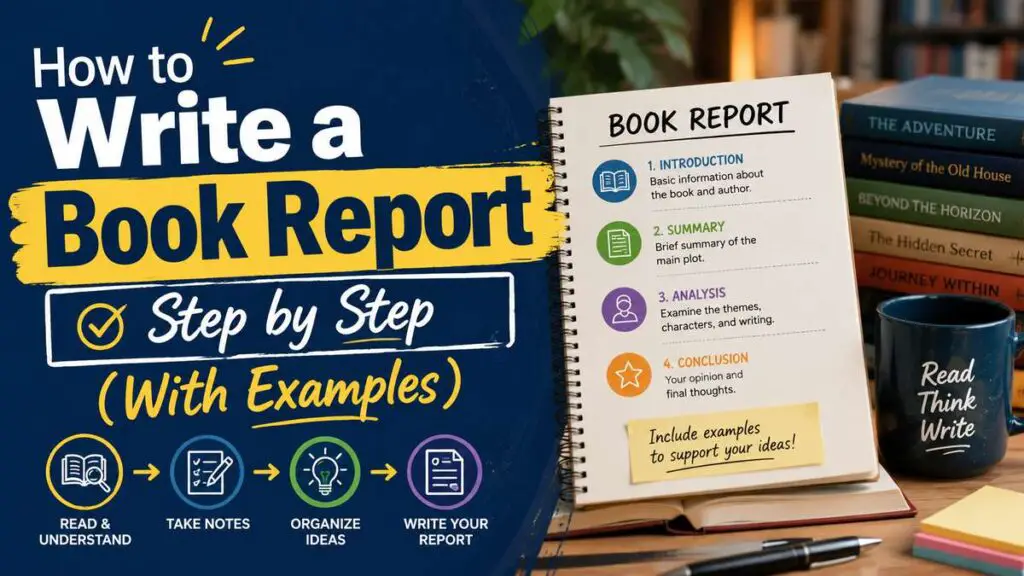
Book reports are one of the most common assignments students receive in school. They help readers show that they understood a book, thought carefully about its ideas, and can explain those ideas clearly in their own words.
A good book report does more than retell the story. It identifies the main characters, explains the setting, summarizes the plot, and discusses the book’s major themes. It also gives the reader’s response to the book and supports that response with examples.
Understanding a Book Report
A book report is a written summary and analysis of a book. Its main purpose is to show that the reader understands what the book is about and can explain its key parts clearly. It demonstrates not only comprehension but also the ability to organize ideas, identify important details, and communicate them in a structured way.
Most book reports include the book’s title, author, setting, main characters, plot summary, central conflict, important themes, and a short personal evaluation. For fiction books, the report usually focuses on the story, characters, and message. For nonfiction books, it may focus more on the main argument, facts, structure, and usefulness of the book. In both cases, the goal is to present the most important information in a clear and logical order so that someone who has not read the book can still understand its main ideas.
A strong book report also shows careful thinking. Instead of simply listing facts, it connects different parts of the book. For example, it may explain how a character’s actions relate to the theme, or how the setting influences the events of the story. This deeper level of explanation helps show that the reader has engaged with the book, not just read it.
A book report is different from a book review. A book review usually gives more opinion and judgment, often focusing on whether the book is good or bad and why. A book report focuses more on explaining the book accurately, though it can still include personal thoughts near the end. The emphasis is on understanding first, and evaluation second.
In many classrooms, book reports are used to build reading and writing skills. They encourage students to pay attention to details, think critically about what they read, and express their ideas clearly. Over time, writing book reports can help readers become more thoughtful and confident in discussing literature.
How to Write a Book Report Step by Step With Examples
Writing a book report becomes much easier when the process is broken into clear steps. Instead of trying to write everything at once, start by understanding the book, gathering notes, and organizing your ideas before drafting the final report.
Here is a step-by-step process you can follow.
Step #1: Read the Book Carefully
Start by reading the entire book, not just a summary. Pay attention to the title, author, setting, main characters, and major events.
As you read, ask simple questions:
What is happening?
Who are the most important characters?
What problem or conflict drives the story?
What message does the author seem to communicate?
For example, while reading To Kill a Mockingbird, you might notice that the story is not only about a court case. It is also about prejudice, childhood, courage, and moral growth.
Step #2: Take Notes While Reading
Do not wait until the end to remember everything. Take short notes as you read.
Write down important details such as:
The main characters
The setting
Major events
Important quotes
Repeated ideas or themes
Questions or reactions
For example, while reading For Whom the Bell Tolls, you could note Robert Jordan’s role in the Spanish Civil War, his relationship with Maria, and his inner conflict about duty, death, and sacrifice.
These notes will help you write the report faster and with more accuracy.
Step #3: Identify the Basic Book Information
Before writing the main body, gather the basic facts about the book.
Include:
Title
Author
Genre
Publication date, if required
Main setting
Main characters
Example:
To Kill a Mockingbird is a novel by Harper Lee. It is set in the fictional town of Maycomb, Alabama, during the 1930s. The story is told through the eyes of Scout Finch, a young girl whose father, Atticus Finch, defends a Black man falsely accused of a crime.
This information helps the reader understand the background of the book before moving into the summary.
Step #4: Write a Clear Plot Summary
The plot summary should explain the main events of the book in order. Keep it clear and focused. Do not include every small detail.
A good plot summary explains:
How the story begins
What major conflict develops
What important events happen
How the conflict is resolved
How the story ends
For example, in To Kill a Mockingbird, the plot summary should include Scout’s childhood in Maycomb, Atticus defending Tom Robinson, the trial, the town’s prejudice, and Boo Radley’s role near the end of the story.
Avoid turning the report into a chapter-by-chapter retelling. Focus only on the most important events.
Step #5: Describe the Main Characters
After summarizing the plot, explain the major characters and their roles in the story.
For each main character, mention who they are, what they want, and how they change or affect the story.
Example:
Atticus Finch is Scout’s father and a lawyer. He represents honesty, courage, and justice. His decision to defend Tom Robinson shows his moral strength, even when the town criticizes him.
Character descriptions should connect to the larger meaning of the book.
Step #6: Explain the Main Themes
Themes are the deeper ideas in the book. They are not just topics. They are messages or lessons the author explores.
Common themes include:
Courage
Justice
Friendship
War
Prejudice
Loss of innocence
Sacrifice
Moral responsibility
For example, For Whom the Bell Tolls explores sacrifice, love, death, and the cost of war. To Kill a Mockingbird explores racism, justice, empathy, and growing up.
When writing about themes, support your points with examples from the book.
Step #7: Include Personal Response
A book report often includes your opinion, but it should not be random. Explain what you thought about the book and why.
You might discuss:
What you liked
What you found difficult
Which character stood out
What message affected you
Whether the book was meaningful or effective
Example:
The most powerful part of To Kill a Mockingbird is its message about empathy. Atticus teaches Scout to understand others by seeing life from their point of view. This lesson gives the novel lasting value.
Your response should be thoughtful and connected to the book.
Step #8: Write a Strong Conclusion
End the report by summarizing your overall view of the book. Restate its main importance and explain why it matters.
A good conclusion should not introduce a completely new idea. Instead, it should bring the report together.
Example:
Overall, To Kill a Mockingbird is a powerful novel about justice, courage, and moral growth. Through Scout’s childhood experiences, Harper Lee shows how prejudice harms society and how empathy can help people become better human beings.
Sample Book Report: For Whom the Bell Tolls
For Whom the Bell Tolls is a novel by Ernest Hemingway. It was published in 1940 and is set during the Spanish Civil War. The story follows Robert Jordan, an American volunteer fighting with Republican guerrilla forces against the Fascists. The novel explores war, sacrifice, love, death, and the meaning of human connection.
The main character, Robert Jordan, is given a dangerous mission. He must blow up a bridge to support a larger military attack. To complete this mission, he joins a group of guerrilla fighters hiding in the mountains. The group includes Pablo, Pilar, Maria, Anselmo, and several others. Each character responds to war in a different way.
Robert Jordan is disciplined, brave, and committed to his mission. He believes in the cause he is fighting for, but he also understands the terrible cost of war. His thoughts often reveal his awareness that death may be near. This makes him a serious and reflective character.
One of the most important relationships in the novel is between Robert Jordan and Maria. Maria has suffered deeply because of the war, but her relationship with Robert gives both characters comfort and hope. Their love develops quickly, but it feels meaningful because they live under the shadow of danger and death.
Pilar is another important character. She is strong, wise, and emotionally powerful. She helps hold the guerrilla group together. Pablo, on the other hand, is fearful and unreliable. His hesitation creates tension because the mission depends on trust and cooperation.
The central conflict of the novel is Robert Jordan’s mission to destroy the bridge. However, the deeper conflict is internal. Robert must decide what his duty means when he knows it may cost him his life. He must balance personal love with political commitment and military responsibility.
One major theme in the novel is sacrifice. Robert Jordan is willing to risk his life for a cause larger than himself. The title itself suggests that no person’s death is isolated. The suffering of one person affects all people. Hemingway shows that war connects human beings through shared loss and shared responsibility.
Another major theme is the brutality of war. The novel does not present war as glorious or simple. Instead, it shows fear, betrayal, violence, and moral confusion. Even those fighting for a cause must face painful choices.
In my opinion, For Whom the Bell Tolls is a powerful and serious novel. Its strength lies in the way Hemingway combines action with deep reflection. The book is not only about a military mission. It is about what people value when time is limited and death is close.
Overall, For Whom the Bell Tolls is a moving story about courage, love, duty, and sacrifice. Through Robert Jordan’s final mission, Hemingway shows that human life is fragile, but meaningful actions can still matter.
Sample Book Report: To Kill a Mockingbird
To Kill a Mockingbird is a novel by Harper Lee. It was published in 1960 and is set in the fictional town of Maycomb, Alabama, during the 1930s. The story is told by Scout Finch, a young girl who learns important lessons about justice, prejudice, courage, and empathy.
The novel follows Scout, her brother Jem, and their father Atticus Finch. At the beginning of the story, Scout and Jem are curious about their mysterious neighbor, Boo Radley. They imagine him as frightening because they do not understand him. As the story continues, their view of Boo changes.
The main conflict of the novel centers on Atticus Finch, a lawyer who defends Tom Robinson, a Black man falsely accused of attacking a white woman. Even though many people in Maycomb are racist and angry about Atticus’s decision, he chooses to defend Tom because it is the right thing to do.
Atticus Finch is one of the most important characters in the novel. He represents fairness, courage, and moral strength. He teaches Scout and Jem that people should try to understand others before judging them. His famous lesson about seeing life from another person’s point of view becomes one of the central messages of the book.
Scout is also an important character because readers see the story through her eyes. At first, she does not fully understand the racism and injustice around her. As she grows, she begins to see that the adult world is often unfair and complicated.
Jem changes throughout the novel as well. He starts as a playful child, but the trial deeply affects him. When Tom Robinson is found guilty despite clear evidence of his innocence, Jem becomes upset and disillusioned. He begins to understand how cruel society can be.
Tom Robinson’s trial is the most important event in the novel. It reveals the deep racism of Maycomb. Although Atticus proves that Tom is innocent, the jury still convicts him because he is Black. This shows how prejudice can defeat justice.
Boo Radley’s role becomes important near the end of the novel. When Bob Ewell attacks Scout and Jem, Boo saves them. Scout finally sees Boo as a real person, not as the frightening figure she imagined. This moment completes one of the novel’s most important lessons: people should not be judged by rumors or appearances.
One major theme in To Kill a Mockingbird is prejudice. The novel shows how racism harms innocent people and corrupts the idea of justice. Tom Robinson suffers not because he is guilty, but because society refuses to treat him fairly.
Another major theme is empathy. Atticus teaches his children to understand others before judging them. Scout’s final understanding of Boo Radley shows that she has learned this lesson.
Courage is also a key theme. Atticus shows courage by defending Tom Robinson even though he knows he may lose. His courage is moral, not physical. He does what is right even when it is unpopular.
In my opinion, To Kill a Mockingbird is a powerful and important novel. It tells a simple story through a child’s eyes, but its message is deep. The book shows how children begin to understand injustice and how moral courage can stand against prejudice.
Overall, To Kill a Mockingbird is a meaningful novel about justice, empathy, and growing up. Harper Lee uses Scout’s experiences to show that people must look beyond fear, hatred, and rumor to understand the truth about others.
Closing Thoughts
Writing a book report is easier when you follow a clear process. Start by reading carefully, taking notes, identifying the main details, summarizing the plot, describing the characters, explaining the themes, and giving your personal response.
A strong book report should be clear, organized, and thoughtful. It should prove that you understood the book and can explain why it matters. With the right structure, a book report becomes more than a school assignment. It becomes a way to think deeply about literature and communicate those ideas with confidence.