
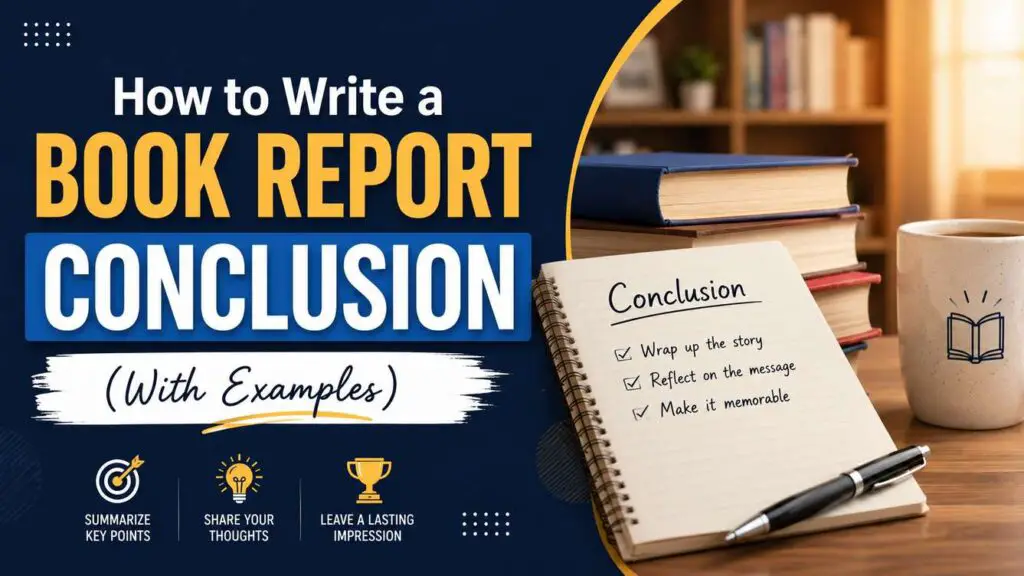
A strong book report conclusion does more than end the paper. It reminds the reader what the book was about, restates the main idea of the report, and leaves a final impression. Many students rush the conclusion because they think the hard work is already done. But the conclusion is important because it shows that the report has a clear ending and that the reader has understood the book.
A good conclusion should not simply repeat everything from the introduction. It should bring the main points together in a clear and thoughtful way. It should also show what the book teaches, why it matters, or how it affected the reader’s understanding. Before learning how to write one, it helps to know what to keep in mind.
Things to Consider When Writing a Book Report Conclusion
A book report conclusion should be short, clear, and connected to the rest of the report. It should not introduce a completely new argument or suddenly discuss details that were not mentioned earlier. Instead, it should help the reader understand the final meaning of the report.
Here are the main things to consider when writing a book report conclusion.
#1. Restate the Main Idea Clearly
The conclusion should remind the reader of the main idea of the book report. This does not mean copying the thesis or main point word for word. Instead, rewrite it in a fresh way.
To do this in real life, look back at your introduction and identify your main claim about the book. Then ask yourself, “What was I trying to prove about this story?” Once you have that answer, rewrite it using different words and a slightly more reflective tone. For example, if your introduction says, “This book shows that courage is important,” your conclusion might say, “The story ultimately demonstrates how courage shapes the characters’ choices and outcomes.”
For example, if the report explains that a novel shows the importance of courage, the conclusion should return to that idea. It can explain how the main character’s actions prove that courage is one of the central lessons of the book.
#2. Summarize the Key Points Briefly
A conclusion should briefly mention the most important points from the report. This may include the main character, the central conflict, the theme, or the lesson of the book.
To apply this, quickly scan your body paragraphs and pick two or three key ideas you discussed. Then combine them into one or two sentences instead of listing everything. For example, you might mention how the main character changed and how the conflict helped reveal the theme. Avoid retelling the entire plot—focus only on the parts that support your main idea.
However, the conclusion should not become a full summary of the entire book. Keep it focused. Mention only the points that help support the final message of the report.
#3. Avoid Adding New Information
The conclusion is not the place to introduce new characters, new events, or new arguments. If an idea is important, it should already appear in the body of the report.
When writing your conclusion, check each sentence and ask yourself, “Did I already explain this earlier?” If the answer is no, remove or revise it. For example, do not suddenly mention a side character or a plot twist that you never discussed before. Instead, stick to ideas you have already explained so the reader can easily follow your thinking.
Adding new information at the end can confuse the reader. It can also make the report feel unfinished because the reader does not have enough explanation for the new idea.
#4. Show the Importance of the Book
A good conclusion often explains why the book matters. This can be done by discussing the lesson, theme, message, or emotional impact of the story.
To do this effectively, ask yourself questions like: “What did this book teach me?” or “Why should someone else read this?” Then turn your answer into a clear sentence. For example, you might explain how the story helps readers understand friendship, fairness, or personal growth. You can also connect the message to real life by explaining how the lesson applies outside the book.
For example, a book may teach readers about friendship, honesty, survival, prejudice, family, or personal growth. The conclusion should help the reader see why these ideas are meaningful.
#5. Keep the Tone Thoughtful and Final
The conclusion should sound complete. Avoid ending suddenly or casually. The final sentence should feel like a natural closing thought.
To achieve this, read your last sentence out loud. Ask yourself if it sounds like a strong ending or if it feels unfinished. A good final sentence often reflects on the book’s message or leaves the reader thinking. For example, instead of ending with “That is why I liked the book,” you could write, “The story leaves readers with a lasting reminder that even small acts of kindness can make a difference.”
A strong ending may reflect on the book’s message, the reader’s experience, or the lasting value of the story. The goal is to leave the reader with a clear final impression.
How to Write a Book Report Conclusion
Writing a book report conclusion becomes easier when it is broken into simple steps. The conclusion does not need to be long, but it should be organized. Each sentence should have a clear purpose.
Here is a step-by-step process for writing a strong book report conclusion.
Step #1: Restate the Main Point of the Report
Begin the conclusion by restating the main point of the report in different words. This helps remind the reader what the report has been trying to show.
For example, if the report is about Charlotte’s Web, the main point may be that the book shows the power of friendship and kindness. The conclusion can begin by saying that the story demonstrates how true friendship can change lives.
Avoid writing the exact same sentence from the introduction. Use new wording so the conclusion feels fresh.
Step #2: Mention the Most Important Supporting Ideas
After restating the main point, briefly return to the most important ideas discussed in the report. These may include the plot, characters, conflict, setting, or theme.
For example, if the report discussed a character’s growth, mention how that growth supports the main idea. If the report focused on a theme, mention how the events of the book develop that theme.
Keep this section short. Two or three sentences are usually enough.
Step #3: Explain the Book’s Lesson or Message
Next, explain what the book teaches or why its message matters. This gives the conclusion more depth.
For example, a book about a difficult journey may teach perseverance. A book about a friendship may show the importance of loyalty. A book about injustice may help readers understand fairness and courage.
This part helps the conclusion move beyond summary and into reflection.
Step #4: Give a Final Thought About the Book
End with a final sentence that leaves the reader with a strong closing idea. This sentence should feel complete and meaningful.
You can mention why the book is worth reading, how it affects the reader, or what makes it memorable. The final thought should connect to the main idea of the report.
For example, instead of ending with “That is why this is a good book,” write something stronger, such as “Through its honest characters and powerful message, the book reminds readers that small acts of courage can make a lasting difference.”
Step #5: Revise for Clarity and Flow
After writing the conclusion, read it again. Make sure it connects smoothly to the rest of the report. Check that it does not repeat too much, introduce new information, or end too suddenly.
A good conclusion should be easy to understand. It should sound polished, thoughtful, and complete.
Examples of Book Report Conclusions
Examples can make it easier to understand how a book report conclusion should sound. A conclusion may vary depending on the book, grade level, and assignment, but the basic purpose stays the same. Each example below restates the main idea, briefly summarizes important points, highlights the book’s message, and ends with a thoughtful final statement.
Here are several examples of book report conclusions.
#1. Example Conclusion for Charlotte’s Web
In conclusion, Charlotte’s Web is a touching story about friendship, kindness, and sacrifice. Throughout the novel, Charlotte repeatedly puts Wilbur’s needs ahead of her own, showing what true friendship looks like. Her clever plan to save Wilbur and Wilbur’s appreciation for her kindness demonstrate how compassion and loyalty can change someone’s life. The story also reminds readers that acts of love often require selflessness and courage. Overall, the novel leaves readers with a powerful lesson about friendship, making it a timeless book that continues to inspire people of all ages.
#2. Example Conclusion for The Giver
Overall, The Giver explores the importance of memory, choice, and individuality. Jonas begins the story believing that his community is peaceful and perfect, but he gradually realizes that eliminating pain has also eliminated love, freedom, and genuine happiness. His experiences show that difficult emotions are an important part of being human. By choosing to seek a better future despite great risks, Jonas demonstrates courage and hope. The novel encourages readers to think deeply about the value of freedom and reminds us that a meaningful life requires both joy and hardship.
#3. Example Conclusion for To Kill a Mockingbird
In conclusion, To Kill a Mockingbird is a powerful novel about justice, prejudice, and moral courage. Through Scout’s experiences and Atticus Finch’s unwavering commitment to doing what is right, the story reveals the damaging effects of racism and unfair judgment. The characters learn valuable lessons about empathy, integrity, and standing up for others even when it is unpopular. Although the novel is set in the past, its themes continue to be relevant today. Its lasting message encourages readers to treat others with fairness, compassion, and respect.
#4. Example Conclusion for Harry Potter and the Sorcerer’s Stone
Overall, Harry Potter and the Sorcerer’s Stone is an exciting story about friendship, bravery, and discovering one’s true identity. Harry begins the novel as a lonely boy who feels like he does not belong, but he finds confidence, purpose, and lifelong friends at Hogwarts. Along the way, he learns that courage, loyalty, and selflessness are more important than fame or talent. The adventures throughout the story make it entertaining, while its themes give it lasting meaning. The novel reminds readers that true strength often comes from the people who stand beside us and the choices we make.
#5. Example Conclusion for The Outsiders
In conclusion, The Outsiders shows that people should not be judged by their appearance or social class. Ponyboy’s experiences reveal that both the Greasers and the Socs struggle with pain, fear, and the desire to belong, despite their differences. As the story unfolds, the characters learn important lessons about empathy, family, and understanding others beyond stereotypes. The novel challenges readers to look past labels and recognize the shared humanity in everyone. Its thoughtful message continues to make it an important and meaningful book for readers of every generation.
Closing Thoughts
A book report conclusion should bring the report to a clear and thoughtful end. It should restate the main idea, summarize the most important points, and explain why the book matters. It should not introduce new information or simply repeat earlier sentences.
The best conclusions help the reader understand the final meaning of the book. They show that the writer has thought carefully about the story, its characters, and its message. With a clear structure and a strong final thought, any student can write a book report conclusion that feels complete and meaningful.