
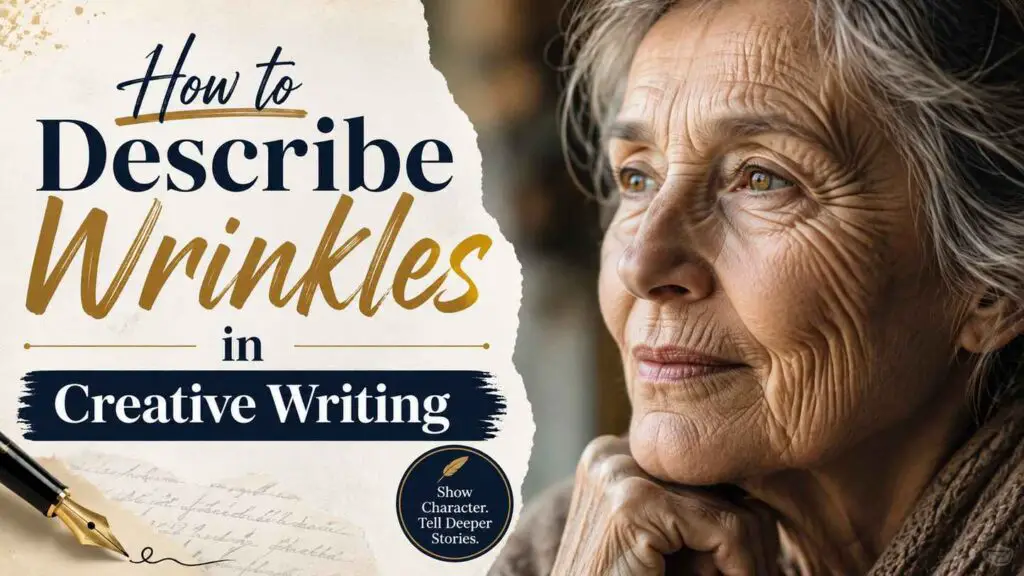
Wrinkles are the only physical feature that a character earns — everything else is issued at birth, but lines are written in, one expression and one summer at a time, until the face becomes a record of how it has been used. That makes them gold for characterization and a minefield for prose: the moment a writer types “weathered” or “etched by time,” the record goes blank and a stock old person shuffles in. The craft is reading wrinkles the way the body wrote them — as evidence of laughing, squinting, worrying, and enduring — and letting the reader do the arithmetic.
Here’s how to write lines that hold lives.
How to Describe Wrinkles in Creative Writing
#1. Read Them as Handwriting
Every wrinkle was drafted by a repeated expression — crow’s feet by squinting and laughing, the brow’s rails by worry, brackets round the mouth by decades of smiling. Describing lines as the fossil of a habitual expression tells the reader what this face has done most, which is the fastest biography available.
The lines at her eyes fanned out like the creases in a map folded to the same beach for forty years — all that squinting into sun, all that laughing at the same husband.
Two deep rails ran up his forehead, worn straight by sixty years of raising the same doubtful eyebrows at the same optimistic sons.
You could read her verdict on life in the brackets around her mouth — carved by smiling, both of them, which is its own kind of court record.
#2. Watch Them Move
Wrinkles aren’t static — they deepen with the expression that made them, vanish briefly when a face goes slack, multiply around a genuine smile. Describing lines in motion keeps an older face alive on the page instead of carved, and the difference between engaged and emptied lines can carry a scene’s emotion.
When he grinned, every line on his face reported for duty — the fans at the eyes, the long parentheses down the cheeks — a whole workforce assembling for its favorite job.
Asleep in the chair, her face went strangely young — the day-lines smoothed to pencil marks — and Nora saw, for one minute, the girl in the wedding photo.
The bad news landed and his face folded along all its prepared creases at once, the way a map knows how to close.
#3. The Hands Age First
Hands carry age more honestly than faces — creped knuckles, raised veins, the loosened skin that holds a pinch, rings gone loose or embedded. Because hands do a life’s work, their lines carry occupation and habit, and characters study hands (their own, their mothers’) in ways they can’t study faces.
Her hands on the piano keys had gone topographic — ridged, veined, creased at every knuckle — and they still knew the nocturne better than her face knew her daughters.
He caught sight of his own hand on the railing — his father’s hand, suddenly, crepe and rope — and stood a moment on the stairs adjusting to the inheritance.
The wedding band had settled into her finger like a fence post into forty years of ground, its own little valley of skin around it.
#4. Name the Weather That Made Them
Sun, wind, salt, cigarettes, cold — skin records its climate, and a farmer’s neck, a sailor’s squint, a smoker’s lip-lines each have distinct signatures. Tying wrinkles to their causes embeds a character’s history and workplace in their face, so the description does setting’s work as well as portraiture’s.
The back of his neck was cross-hatched like old saddle leather — fifty hay seasons filed there, in a grid the sun had ruled line by line.
Her mouth wore the fine vertical pleats of forty years of cigarettes and pursed judgments, and lipstick traveled up them now like ink up a nib.
The islander’s face had taken the wind’s advice for seventy years and folded accordingly — everything creased toward the lee, like the pines on the point.
#5. Let Touch Do the Describing
Wrinkles are tactile — a grandchild’s finger tracing a cheek’s creases, the papery softness of an old hand held, a thumb smoothing lines it can’t erase. Touch scenes describe skin more intimately than sight and carry relationship in the same gesture: who is allowed to touch this face, and how.
The baby patted her great-grandmother’s cheek with a flat starfish hand, fascinated by the softness — skin like a rose petal kept in a book — and neither of them wanted the examination to end.
Holding his mother’s hand in the hospital, he was startled by its new geology — loose over the bones, silk over sticks — and he held it more carefully than he had ever held anything.
She traced the deep line between his brows with her thumb, once, downhill — “this one’s mine,” she said, “I put it there in 1989” — and he didn’t argue.
#6. The Owner’s Opinion
How characters feel about their own lines — grief at the mirror, indifference, pride, the ritual of creams, the decision to stop minding — is characterization the wrinkles merely occasion. The same crow’s feet are a loss to one character and a trophy to another; write the relationship, not just the skin.
She inventoried the new line by the bathroom’s honest light, decided it was from laughing — it was, mostly — and billed it, as she billed all of them, to the good years.
He had his father’s frown-line now and hated it less than he’d expected — the old man had earned it honestly, and apparently so had he.
The little jars on her shelf promised to erase her forties, and she used them nightly, faithfully, without belief — a rosary said to a god she was fond of but done fearing.
#7. Lines Before Old Age
Wrinkles aren’t only for the old — there’s the young mother’s new tiredness at the eyes, the soldier’s premature squint, the first forehead line that shocks a thirty-year-old in an elevator mirror. Early lines mark what a life has cost ahead of schedule, and their arrival is a scene in itself.
At thirty-one she found the first line the twins had left her — a faint stitch between the brows, worry’s down payment — and felt she should at least have been consulted.
Two tours had given him an old man’s eyes in a young man’s face — the squint lines of a thousand hours of horizon — and recruiters’ posters never showed that part.
The residency wrote its first draft on her in a single winter: a crease at each eye, a groove by her mouth from held opinions, the face of someone billed early for other people’s emergencies.
#8. Retire the Weathered Roadmap
“A face like a roadmap,” “etched by time,” “weathered and lined with age” — the kit ages every character into the same anonymous elder. The repair is singularity: give the face one specific line with one specific origin, named or guessed at, and let it stand for the rest. One earned wrinkle beats a whole weathered atlas.
Forget the roadmap: she had one line that mattered, a deep vertical between the brows, and the family divided history into before and after the year it arrived.
His face wasn’t weathered so much as annotated — a scar-thin crease at the left eye from the year on the trawlers, and nothing else on it worth footnoting, he said.
Time hadn’t etched her. Laughing at Gerald for fifty-one years had — two clean strokes, one either side of her mouth, his initials as far as she was concerned.
Closing Thoughts
The reframe to keep: wrinkles are not damage, they’re authorship — the face’s own handwriting, accumulating one repeated feeling at a time until the dominant emotions of a life are legible at a glance. That’s why the stock phrases fail: “weathered” reads none of the writing, it just reports that writing exists. Your job is to quote a line or two — the squint from the boats, the groove the twins installed, the brackets earned laughing at one particular man — and let the reader infer the rest of the manuscript. Describe what the face has practiced. The years will describe themselves.