
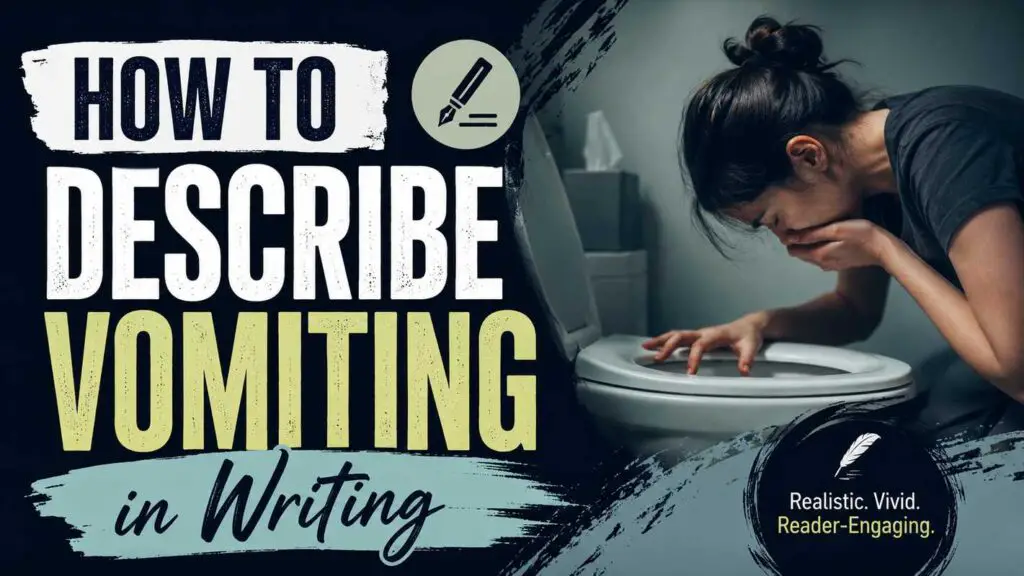
Few bodily reactions are as instantly visceral as vomiting. It’s a moment writers often shy away from or rush past, but done well, it can reveal character, heighten tension, or ground a scene in brutal physical reality. Whether it’s from sickness, fear, disgust, or grief, describing vomiting convincingly means paying attention to the buildup, the act itself, and the aftermath. Here are the key techniques to make this moment land on the page.
How to Describe Vomiting in Writing
#1. Build the Warning Signs
Vomiting rarely comes out of nowhere. The body announces it first: a lurch in the stomach, a rush of saliva, a cold sweat breaking across the skin. Showing these early signals lets the reader anticipate what’s coming, which builds tension and makes the eventual release feel earned rather than sudden. This also gives you a chance to slow down the pacing and let discomfort simmer before it boils over.
Her mouth flooded with saliva, thick and metallic, and she swallowed hard against the rising tide in her throat.
The room tilted, and a cold sweat prickled across his neck, his stomach clenching like a fist.
She felt it before she understood it — that awful looseness in her gut, a warning she’d learned not to ignore.
#2. Capture the Physical Mechanics
The act itself is intensely physical, and specific, grounded details make it feel real instead of vague or sanitized. Focus on the involuntary nature of it — the way the body takes over, the muscles contracting, the throat and stomach working together in a way the person can’t control. Avoid overly clinical language, but don’t shy away from precision either.
Her body doubled over before her mind caught up, stomach heaving in violent, involuntary waves.
He gripped the edge of the sink as his stomach clenched again, forcing its contents up in a hot, burning rush.
Each heave wrung him out further, his abdomen cramping so hard he thought his ribs might crack.
#3. Use Sound and Sensory Detail
Vomiting is loud, wet, and unmistakable, and sound is one of the fastest ways to convey it without over-explaining. A retch, a splash, a gasp for air afterward — these sounds do a lot of narrative work in just a few words. Pairing sound with smell or texture rounds out the sensory picture and makes the moment harder to look away from.
A wet, guttural retch echoed off the tile, followed by the unmistakable splash into the bowl.
The acrid smell hit her first, sharp and sour, before she even registered what had happened.
He gagged, a raw, ragged sound, then spat and gasped like a man surfacing from underwater.
#4. Show the Emotional and Physical Aftermath
What happens after someone vomits often carries as much weight as the act itself. Exhaustion, shame, relief, or trembling weakness can reveal character and emotional state far more than the vomiting itself. This is also where you can pull back from the visceral and into interiority, letting the reader sit with how the character feels now that it’s over.
She slumped against the cool tile, drained and shaking, tears stinging the corners of her eyes.
His legs trembled as he stood, wiping his mouth with the back of his hand, humiliated by how weak he suddenly felt.
Relief washed over her, thin and fragile, as if her body had finally exhaled after holding its breath too long.
#5. Tie It to Emotional or Narrative Context
Vomiting in fiction rarely exists just for shock value — it usually signals something deeper, whether that’s fear, illness, grief, disgust, or even a turning point in the story. Connecting the physical reaction to the emotional or narrative stakes gives the scene purpose. A character vomiting from nerves before a confrontation tells a different story than one vomiting from grief at a funeral.
It wasn’t the smell of blood that undid him — it was the realization that this was his fault.
She hadn’t cried at the funeral, but her body had its own way of grieving, doubling her over the moment she was alone.
The fear finally caught up with him, all at once, and his body rejected it the only way it knew how.
#6. Vary the Verbs and Avoid Repetition
Relying on the same word choices — “vomit,” “threw up,” “puke” — over and over flattens the scene and makes it feel clinical or repetitive, especially in longer passages. Varying your verbs and phrasing keeps the prose dynamic and lets you control the intensity of each beat. Stronger, more specific verbs can also do double duty by conveying emotion alongside the physical action.
She retched into the grass, her whole body convulsing with each ragged heave.
He emptied his stomach in three brutal spasms, then knelt there, hollowed out and trembling.
Bile rose and spilled from her in a rush, sour and burning, before she could even turn away.
#7. Use Restraint for Maximum Impact
Not every vomiting scene needs graphic, blow-by-blow detail. Sometimes the most effective choice is restraint — cutting away at the right moment, or summarizing quickly, so the reader’s imagination fills in the rest. This works especially well in scenes where the emotional beat matters more than the physical one, or when you want to avoid dwelling on something for pacing reasons.
She barely made it to the trash can before her stomach turned itself inside out.
He was sick behind the shed, quick and quiet, and came back pale but composed.
One retch was all it took before she waved him off, insisting she was fine.
#8. Adapt the Description to the Character and Situation
Not every character experiences or reacts to vomiting the same way, and the context of the scene should shape how you describe it. A frightened child, a hungover adult, and a soldier reacting to violence will all have different physical and emotional responses worth capturing distinctly. Tailoring the description to who’s experiencing it and why keeps the moment feeling specific rather than generic.
The little boy cried between heaves, more frightened by his own body than by what had scared him in the first place.
He groaned into the toilet bowl, the hangover finally collecting its dues, and muttered an apology to no one.
The soldier vomited without breaking stride, wiping his mouth as he kept moving, as if his body had learned not to stop for this anymore.
Closing Thoughts
Vomiting is one of those moments that can easily feel gratuitous if handled carelessly, but with the right balance of physical detail and emotional grounding, it becomes a powerful tool for characterization and tension. Focus on the buildup, the mechanics, the sensory texture, and the aftermath, and always tie the moment back to what it reveals about your character. Handled with care, even the body’s most unglamorous reactions can deepen a reader’s connection to the story.