
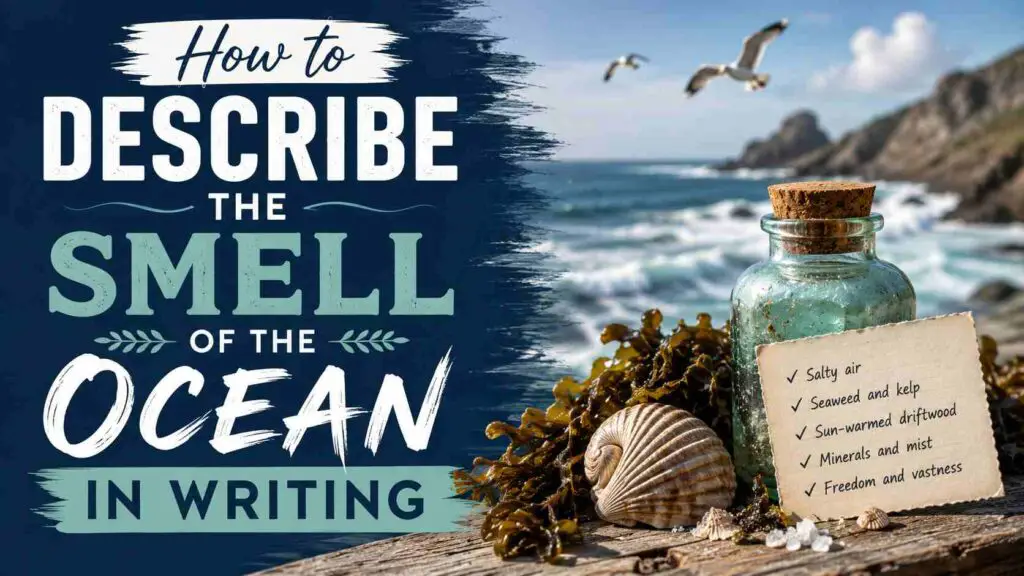
“Salty air” is the phrase every writer reaches for first and the one that does the least actual work, since the ocean’s smell is really a layered mix of brine, decay, minerals, and whatever the tide happens to be carrying that day. Getting it right means treating the smell as specific to a place and moment rather than a single interchangeable coastal note. Below are the techniques for describing the ocean’s smell with real precision, each with examples you can study and adapt.
How to Describe the Smell of the Ocean in Writing
#1. Layer Salt With Other Distinct Coastal Smells
The ocean’s smell is rarely just salt — it’s salt mixed with decaying seaweed, wet rock, fish, and mineral-rich sand. Naming two or three of these layered elements together creates a far more convincing, specific smell than salt alone.
Salt mixed with something sharper underneath it, seaweed rotting somewhere just out of sight along the tideline.
The smell carried brine, wet stone, and the faint, mineral edge of low tide all at once.
Fish and salt hung together over the docks in a combination she’d stopped noticing years ago.
#2. Use the Smell to Announce Proximity Before Sight Does
The ocean’s smell often reaches a character before the water itself comes into view — through a car window miles inland, or around a bend in a coastal road. Letting the smell arrive first builds anticipation and grounds the reader in the approach rather than a sudden arrival.
She caught the first trace of salt through the cracked car window a full ten miles before the water appeared.
The smell reached him at the top of the dune, thick and unmistakable, before the ocean itself finally came into view.
Salt hung in the air long before the road curved toward anything resembling a coastline.
#3. Show How the Smell Changes With Tide and Weather
Low tide exposes decaying organic material and intensifies the ocean’s smell, while a storm can sharpen it, and a calm, sunny day can make it almost faint by comparison. Reflecting these shifts adds realism and lets the smell function as its own kind of weather report.
Low tide brought out the sharper, muddier smell of exposed sand, nothing like the cleaner scent of high water.
The storm rolling in seemed to sharpen everything, the salt smell suddenly more insistent than it had been an hour before.
On a calm, sunny afternoon, it barely registered at all, faint and easy to forget was even there.
#4. Use the Smell to Trigger Memory or Nostalgia
Because smell is so tightly bound to memory, the scent of the ocean can pull a character instantly back into a specific childhood summer or past relationship, adding emotional depth to what could otherwise be a purely environmental detail.
The smell alone brought back every summer of her childhood at once, indistinguishable from each other now except by the smell itself.
He hadn’t smelled salt air in a decade, and it undid something in his chest almost instantly.
It smelled exactly the way it had the last summer they’d come here together, which was, she supposed, exactly the problem.
#5. Contrast Ocean Smell With an Unfamiliar Inland Setting
A character unfamiliar with the coast, encountering the smell for the first time, offers a chance to describe it fresh — through comparison and confusion — rather than through the practiced familiarity of someone who grew up nearby.
He’d never smelled anything like it, sharp and strange, nothing like the landlocked air he’d grown up breathing.
It took her a moment to place the smell at all, unfamiliar enough that her first guess was entirely wrong.
Nothing in his life so far had prepared him for how strong it actually was, this close.
#6. Use Specific Marine Detail — Seaweed, Brine, Salt Spray
Reaching for precise marine vocabulary — brine, kelp, salt spray, low-tide mud — rather than generic beach language gives the description authenticity and specificity that a casual visitor’s account often lacks.
Salt spray carried up over the rocks, sharp and cold against her face.
Kelp had washed up in heavy, dark ropes along the tideline, its smell distinct from the water itself.
The brine thickened the closer they got to the water, until it was nearly all she could smell at all.
#7. Show a Character’s Physical Reaction to the Smell
A character’s involuntary response to the ocean’s smell — a deep, automatic inhale, a visible relaxing of the shoulders — conveys its emotional pull more effectively than a direct statement that they liked it.
She breathed it in deeply, without deciding to, the way she always did the second she got close enough.
His shoulders dropped an inch the moment the smell reached him, tension he hadn’t realized he was carrying.
She closed her eyes for a second, just to take it in fully before opening them again.
#8. Avoid Generic “Salty Air” — Get Specific
The phrase has become such a default that it barely registers anymore, doing little to distinguish one coastline from another. Reaching for a more precise, layered description keeps the ocean’s smell from feeling interchangeable across every beach scene.
It wasn’t just salty air — it was brine and diesel and something faintly fishy from the harbor, all mixed together into something unmistakably specific.
Calling it salty undersold it; it carried the sharp, mineral bite of rock pools left exposed by the tide.
There was nothing generic about this particular coastline’s smell — she could have told you which beach it was blindfolded.
Closing Thoughts
The ocean’s smell earns its place on the page when it’s built from layered, specific detail — brine, seaweed, tide, weather — rather than reduced to a single stock phrase. Let it announce proximity before the water is visible, shift with the conditions, and trigger memory where it fits the scene, and readers will trust your coastline the way they’d trust their own memory of one.