
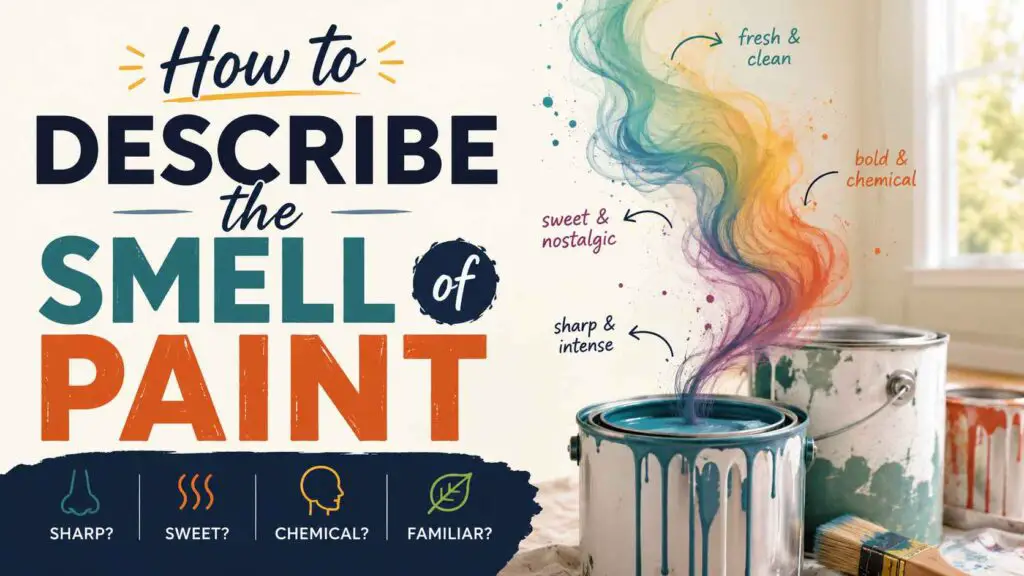
Fresh paint is the smell of change — new nurseries, covered pasts, landlords between tenants, artists mid-canvas — and fiction reaches for it whenever a life is being redone. But the smell itself gets lazy treatment: “the smell of fresh paint hung in the air” reports the wallpaper of the sentence, not the chemical fact. Real paint smell is sharp, headachy, and time-stamped — strongest the first night, fading on a schedule everyone knows — and it differs by kind: latex’s mild tang, oil’s deep solvent drawl, the artist’s turpentine weather. Precision here buys both atmosphere and meaning.
Here’s how to write the smell of a surface starting over.
How to Describe the Smell of Paint
#1. It’s Sharp Before It’s Anything
Paint’s first fact is its chemical edge — a solvent brightness that sits high in the nose, tightens the temples, and demands an open window. Write the sharpness and its physical effects first; the smell means renovation only after it means fumes.
The smell sat high and bright in the nose, a chemical treble with no bass, and by the second wall she had the beginnings of the painter’s headache, worn like a union badge.
It wasn’t unpleasant, exactly — it was insistent, a smell with its elbows out, occupying the whole room it was busy improving.
Every window in the flat stood open, curtains breathing, the paint smell streaming out into the evening like a pressure being equalized.
#2. Know Your Kind
Latex wall paint, oil gloss, spray enamel, and artist’s oils are different smells — mild and milky, deep and solvent, aerosol-sweet, linseed-and-turpentine. Naming the kind places the scene precisely: a hallway being freshened is not a studio at work.
The bedroom smelled of latex — mild, almost milky, gone in a weekend — but the stairwell gloss was oil, and its deep solvent drawl would own the house till Thursday.
The garage exhaled spray enamel, that sweet aerosol bite, and one look at his son’s guilty bicycle — now midnight blue — completed the report.
Her studio ran on linseed and turpentine, a weather system of it, and visitors breathed the trade itself: flowers dissolved in fuel.
#3. The Smell Keeps Time
Paint smell has a schedule — overwhelming at brush-time, strong the first night, a tang by day three, a ghost in a cold room weeks later. Use the fade as a clock: how much smell remains tells the reader how recently this life was redone.
They slept the first night with the windows cracked and the new room breathing over them, and by Sunday the smell had retreated into the corners, only coming out when the radiator warmed.
A month on, the smell was down to a rumor you caught opening the closet — the renovation’s last syllable, still finishing.
The viewing agent didn’t need to say “recently redone”; the hallway said it, faintly and chemically, the way hotels say “cleaned.”
#4. Fresh Paint Means a Fresh Start
The smell’s emotional job is beginnings — the nursery done before the due date, the first flat painted by friends, the classroom in September. Attach the fumes to hope and the chemical sharpness reads as promise; the reader smells the future being prepared.
The nursery smelled of yellow — that’s how she thought of it, the color and the fumes one thing — the room holding its breath, four weeks early, for its tenant.
Their first flat smelled of cheap white paint and pizza for a week, the two smells of being twenty-four and just beginning, and years later either one alone could summon the other.
September’s classroom smelled of fresh paint and floor wax — the building’s annual promise that this year, everything, including you, could start clean.
#5. Paint Covers — Write What’s Underneath
Paint is also erasure — the landlord’s coat over the smoke stains, the crime scene’s respray, the height marks gone under two layers of magnolia. When the smell means something hidden, its freshness turns sinister or sad: someone wanted yesterday gone by Tuesday.
The whole stairwell had been done in one urgent weekend, and the smell asked the question the landlord wouldn’t answer: what, exactly, had needed covering that fast?
Under the wet magnolia lay the doorframe’s pencil marks — Ella at four, at five, at seven — going under the roller one stroke at a time, and her mother had to leave the room.
The house went on the market smelling entirely of fresh paint, which is to say, smelling of everything it declined to mention.
#6. The Painter at Work
Give the smell its scene: the roller’s wet sound, tea breaks tasting faintly of fumes, the radio, white-spattered forearms, the ritual of cutting-in. Painting is labor with a soundtrack, and the smell woven through work reads truer than smell alone.
By noon the room was half its new self, the roller keeping its wet metronome, and their sandwiches tasted faintly of the trade — everything in that flat, that day, seasoned with beginning.
Her father cut in at the ceiling line with surgeon’s patience, radio murmuring, and the smell of the work settled into her memory next to his whistling, inseparable now.
The crew broke for lunch on upturned buckets in the fume-bright room, and the new white walls stood around them wet and blank, waiting to be somebody’s years.
#7. The Studio Version
Artist’s paint is the smell of vocation — oils, medium, turpentine rags — clinging to clothes and identifying its owner across a room. For painter characters the smell is signature and home; for those who love them, it’s the person’s second name.
You could find her in any crowd blindfolded — turpentine and linseed under whatever perfume the occasion demanded — a woman signed by her own studio.
Opening the studio after his death was the hard part: the smell still working, rags still folded, a vocation’s atmosphere outliving its owner by exactly one unbearable month.
The paint smell in the attic meant she was working again — the whole family tracked her weather by it — and nobody knocked when the turpentine was strong.
#8. Retire the Hanging Smell
“The smell of fresh paint hung in the air” — the sentence that has redecorated a thousand manuscripts while describing none. Smells don’t hang; they occupy, sting, fade, and mean. The repair: give the paint smell a verb with intent and one consequence — a headache, a memory, a question about what got covered.
Stock: fresh paint hung in the air. Working: the paint met them at the front door and escorted them through the whole viewing, sharp and recent, answering questions ahead of the agent.
The smell didn’t hang; it pressed — temple-high and bright — until she taped the last edge, opened the windows, and let the evening dilute her work.
He stepped into his childhood bedroom and the fresh paint told him first, before his mother could: the room had been reassigned, and his posters were in the garage, and time was what it was.
Closing Thoughts
The reframe worth keeping: paint smell is never about paint — it’s the scent of a decision. Someone chose to begin, to cover, to prepare, to move on, and the fumes are that choice still evaporating off the walls. That’s why the same sharpness reads as hope in a nursery, grief over pencil marks, and suspicion in a hastily whitened stairwell. Establish whose decision the smell is and what it cost or promises, and the chemistry writes itself. Walls get repainted; lives get repainted more — and the nose, in fiction, always knows which happened first.