
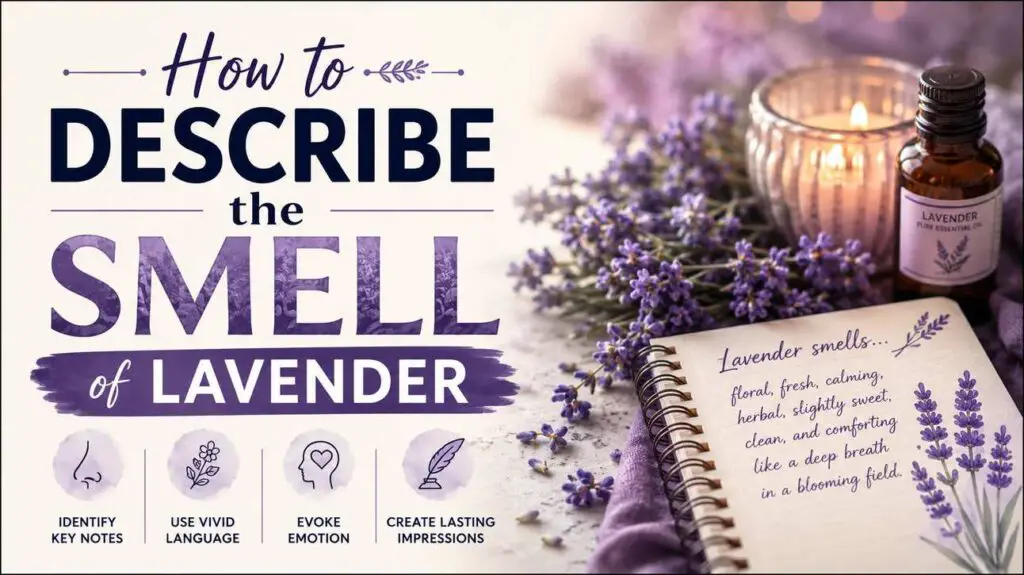
Lavender has been marketed so hard as “soothing” that writers forget to smell it — the real plant is sharper than its reputation, an herb before it’s a perfume, with a camphor edge that clears the head as much as calms it. On the page, lavender carries whole worlds by association: linen drawers and grandmothers, Provençal fields buzzing at noon, sleepless nights and their remedies. The craft is choosing which lavender your scene needs — the living plant, the dried sachet, or the bottled promise — and describing that one honestly instead of gesturing at relaxation.
Here’s how to get the actual scent onto the page.
How to Describe the Smell of Lavender
#1. Respect the Herbal Edge
Real lavender is not sweet syrup — it’s floral over a clean, almost medicinal sharpness, cousin to rosemary and camphor. Naming that edge separates your description from the fabric-softener version and signals a writer who has actually crushed a sprig.
She rolled a head of it between her palms and the smell came up in two layers — flowers on top, and underneath something sharper, cleaner, almost antiseptic, like a nurse who also sings.
It wasn’t sweet, not really — it was floral the way mint is sweet, with a cool edge that went up behind the eyes and tidied something there.
The bruised stems smelled of purple and pine at once, garden and pharmacy sharing a border.
#2. The Living Plant in Sun
Lavender in a garden is a warm, active smell — strongest at noon, released by touch, held in a bee-loud hedge. Writing the plant at work (heat lifting the oil, a hand trailed through it) gives the scent a location and a temperature.
By noon the hedge cooked gently in the sun and gave itself up in waves — you didn’t have to touch it; the heat did the crushing.
She walked the path with one hand out, trailing it through the lavender the way you trail a hand in water, and the smell followed her to the gate like a well-mannered dog.
The whole border hummed — bees working the purple like a trading floor — and the scent and the sound became one thing, the smell of industrious summer.
#3. The Drawer and the Sachet
Dried lavender is domestic archaeology — sachets among the linens, a scent gone papery and faint with years, released when a drawer opens. It’s the smell of care taken long ago, and it can date a household or resurrect its keeper in one line.
The drawer opened on forty years of order — folded pillowcases, and between them the little sachets gone flat and pale, still faintly speaking their one word.
The dried bundle above the mirror had kept its color better than its voice; you had to crush a floret now to hear the old summer in it.
Every sheet in that house came to the bed smelling of lavender and ironing — a signature her grandmother pressed into the household so deeply it outlived her by years.
#4. The Sleep Trade
Lavender’s modern job is sleep — pillow sprays, bath oils, the insomniac’s last resort — and characters reaching for it are characters in negotiation with their own nights. Write the ritual and its results honestly: sometimes it works, and sometimes it’s just hope with a scent.
She misted the pillow the way the bottle promised and lay down in the little purple cloud of it, negotiating — the smell pleasant, the insomnia unmoved, the ritual somehow still worth it.
The baby’s bath ran lavender-warm, and by the last verse of the towel song the small body had gone heavy — the oldest sales pitch in the world, still closing.
He kept the little roller by the bed, applied it to his wrists like a man taking medicine he half believed, and slept, on average, no better and slightly calmer about it.
#5. The Grandmother Frequency
For generations of readers lavender is a person — soap, talc, cardigans, a particular embrace. Use the inherited association deliberately: as warmth, as grief’s trigger, or subverted, on a character nothing like the stereotype.
The charity-shop cardigan came home smelling of lavender and someone else’s grandmother, and she wore the borrowed comfort all winter without guilt.
Two years after the funeral, a stranger passed her in the pharmacy wearing the exact soap, and the aisle went underwater for a moment while she held the shelf.
The tattooed doorman smelled, unexpectedly, of lavender — his mother’s soap, he said flatly, end of discussion — and the queue found him ten percent less frightening ever after.
#6. Field Scale
Lavender by the hectare is a different phenomenon — heat, haze, and a scent with geography, arriving before the view and staying in the car afterward. Field scenes let you write smell as landscape: direction, distance, and weather all apply.
They smelled the farm a full minute before the rows came into view — the valley running the scent downhill like a broadcast — and the children in the back seat went quiet, sensing an event.
Between the purple rows the heat stood still and thick with it, and walking the field was wading — scent to the knees, then the chest, then over her head somewhere near the middle.
The rental car held the field for three days afterward, and every errand in it was briefly Provence.
#7. Let It Work on a Scene’s Nerves
Whatever science says, lavender in fiction functions as a de-escalator — shoulders drop, voices lower, the argument loses altitude. Use it as staging: the smell entering a tense room changes the scene’s temperature without a word of dialogue.
The mediator’s office smelled quietly of lavender, which everyone noticed and nobody mentioned, and the opening statements came out two notches softer than rehearsed.
She crushed a sprig from the windowsill pot while he shouted, and did not throw it, and by the time the room smelled of it they were both merely tired.
The waiting room’s diffuser worked at its hopeless task all day — one small purple voice against the fear of forty patients — and still, somehow, earned its plug socket.
#8. Retire the Soothing Scent
“The soothing scent of lavender filled the air, instantly calming her” — the spa-brochure sentence, in which the smell does nothing but its own marketing. The repair: give the lavender a source, a texture, and an earned effect — crushed by whom, from where, changing what — or let a character notice it resisting the cliché entirely.
Brochure: the soothing scent instantly calmed her. Earned: she stripped a stem through her fist on the way up the path — an old habit from an old garden — and arrived at the terrible conversation smelling of her grandmother’s courage.
The candle claimed lavender and delivered purple soap; the plant on the sill, ignored, held the real thing an inch above its dry soil.
It did not calm him. It reminded him — sharply, of a hallway and a house and a voice — and he stood in the garden section of the hardware store having a moment the receipts couldn’t explain.
Closing Thoughts
Keep one image as calibration: an old dressing table by an open window — hairbrush, photographs, a dish of dried lavender gone pale — and outside, past the curtain, the living hedge in full sun with the bees at work. Between those two lavenders, the faded and the blazing, is everything this smell can do in fiction: memory and presence, keeping and blooming, the person gone and the summer still arriving. Choose which end of that window your scene stands at, describe that lavender with its true sharp edge, and the soothing will take care of itself.