
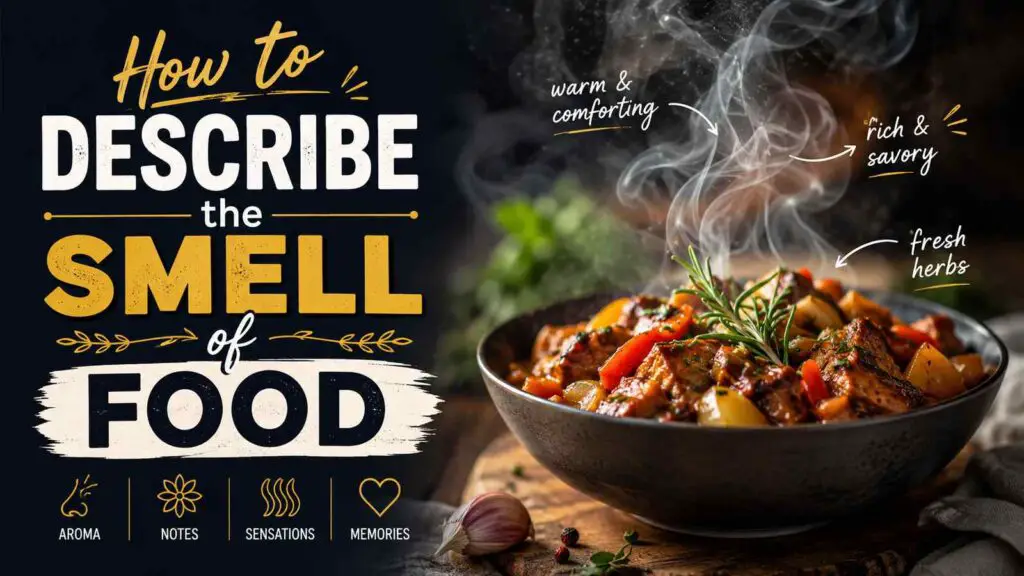
Food smells are fiction’s most reliable physical trigger — written well, they make actual mouths water at actual pages — and they carry more than appetite: a household’s identity, a culture’s signature, a childhood’s whole address can ride on one pot. Yet most food description stays visual, plating the dish for the eye while the nose, which does the real seducing, goes unserved. The craft is specificity, sequence, and knowing what each smell means to the person smelling it. Below are the techniques for describing the smell of food, each with examples you can study and adapt.
How to Describe the Smell of Food
#1. Start the Pan — Cooking Smells as Live Events
Food smells strongest in the making — onions hitting butter, garlic’s forty-second announcement, bacon waking a household, bread’s slow build — and cooking smells are events with timelines, not states. Write the smell arriving and developing, and the scene gains a clock and a promise at once.
The onions went into the butter and the house changed governments — within a minute every room had heard, and appetite arrived ahead of any menu.
Bacon has no stealth setting; by the third minute the teenagers had materialized in the kitchen doorway like summoned spirits, still half asleep, fully negotiating.
The bread was a three-hour broadcast — yeast, then warmth, then that final golden hour when the whole house leaned toward the oven — and she timed her asking-of-favors to the last twenty minutes.
#2. Layer the Plate — Smells Arrive in Order
A dish’s smell is sequenced — the top note that reaches you first (lemon, smoke, spice), the body underneath (meat, broth, starch), the trace that finishes it (char, herbs, sweetness) — and describing two layers in order beats naming the dish. The nose reads food like a chord; write the arpeggio.
The stew reached her in installments — thyme and wine first, then the deep beef underneath, then, at the last, a low sweet note of onions that had been cooking since noon.
The curry announced its spices individually at the door — cumin loudest, then ginger, then something dark and toasted she couldn’t name — a smell with paragraphs in it.
Over everything the grill wrote its one-word signature: char.
#3. Let the Smell Mark the Household
Every home has a food signature — the spices in the walls, Sunday’s roast or Friday’s fish, the pot that defines the building’s stairwell — and characters returning home smell their family before they see it. What a house smells of at 6 p.m. is its culture, economy, and calendar in one breath.
The stairwell told you the building’s whole census — garlic and oregano on two, cardamom on three, something frying in lard on four that the vegetarians on five had learned to forgive.
Her grandmother’s house smelled permanently of dill and broth, a base coat under everything, and no realtor’s candle would ever paint over it.
He knew the day of the week by the kitchen: cumin meant Tuesday, fish meant Friday, and the slow all-day onions meant someone’s trouble was being cooked for.
#4. Feed the Hungry Character — Smell as Torment and Promise
Food smells calibrate to the smeller’s stomach — heaven to the hungry, torment to the broke passing the bakery, nausea to the grieving or ill — and the same aroma runs the full emotional range depending on who’s downwind. Write the smell through the appetite, and the description becomes character.
The bakery exhaled onto the street with every opening door, and the boy with the empty pockets took the long way to school all winter, unable to decide whether the smell was a kindness or a toll.
After the funeral the kitchen filled with the neighbors’ best cooking, and none of it smelled like anything to her — grief having unplugged the appetite the casseroles were addressed to.
Three days of trail rations, and the farmhouse’s frying onions reached them a quarter mile out — and the whole party’s pace, without a word, picked up.
#5. Work the Market and the Street
Public food smells build place fast — a market’s competing stalls, street vendors’ smoke and sugar, festival grease, the fishmonger’s corner announcing itself early — and navigating a market by nose is a scene structure: the character pulled stall to stall like a fish on a line. One street of smells can establish a whole city.
The market argued with itself all morning — grilled corn against fresh coriander, sugar-roasted nuts against the fish corner — and she shopped the way everyone shopped it: steered entirely by nose, list abandoned by the second stall.
The night market’s smell arrived three streets early — charcoal smoke, frying batter, something caramelizing — the city’s whole evening summarized on the wind.
Fair season had one smell — fried dough and hot sugar and trampled grass — and forty years of Augusts were filed under it, retrievable at any funnel-cake stand in the nation.
#6. Open Memory’s Kitchen — Food as Time Machine
Food smell is memory’s strongest key — the madeleine principle every reader has lived — and one dish’s aroma can deliver a character to a dead grandmother’s kitchen mid-sentence. The trigger works best specific and involuntary: not remembering the past but being ambushed by it, mid-errand, over a stranger’s stove.
Someone in the new building was making rice pudding with cinnamon, and she stood in the corridor with her mail in her hand, eight years old, in an apron, in a country that no longer existed.
He hadn’t smelled that exact combination — fried fish, vinegar, newspaper — since the seafront of his childhood, and the man he became for the next ten minutes was considerably younger and happier.
The first time her new husband made his mother’s soup, she understood she had married the smell too — that it came with him, a dowry of broth, and their children would someday be ambushed by it in strangers’ hallways.
#7. Sour It — Spoilage, Grease, and the Smell Gone Wrong
Food’s shadow register is powerful — milk gone over, the fridge’s guilty corner, old fryer grease in a failing diner’s curtains, the sweetness of fruit turning — and bad food smells carry neglect, poverty, or decline more delicately than any exposition. The nose audits a kitchen’s truth in one inhale.
The milk announced itself from the carton’s mouth before any pouring — that flat sour note — and with it the small accounting of how many days the apartment’s grief had now lasted.
The diner smelled of decades of fryer grease gone into the curtains and the wood — not dirty, exactly, but tired, a kitchen running on its own history.
The fruit bowl had turned its corner — that heavy sweetness one day past pleasant — and the smell said what the calendar had been saying: nobody in this house was eating properly.
#8. Cook It for Someone — Food Smell as Message
Cooking smells are addressed — the dish made to welcome, apologize, court, or console, its aroma reaching the recipient before any words — and the smell of someone cooking for you is among fiction’s warmest signals. What a character chooses to fill the house with, and for whom, is love’s most legible logistics.
She came home from the worst day of the year to a house full of her own mother’s recipe — he’d called long distance for it, burned the first batch — and the smell in the hall said everything the card on the counter was still trying to.
The apology was never spoken; it was cooked — his famous Sunday sauce on a Wednesday — and she accepted it by setting the table.
The new neighbors’ welcome was a plate still warm under its cloth, and the smell through the wrapping — cardamom, butter, something festive — introduced the family better than the doorbell speech did.
#9. Ban “Delicious Aromas Wafted” — Name the Pot
“Delicious aromas wafted from the kitchen” is the empty plate of food writing — no dish, no layer, no appetite in it — and “mouthwatering” is a verdict the prose hasn’t earned. The repair is naming: the actual dish, one top note, one body note, and a smeller whose stomach has an opinion. Readers salivate at specifics, never at adjectives.
The draft had delicious aromas wafting; the revision had garlic and ginger hitting hot oil at the exact moment the guests’ coats came off, and two readers reported making the recipe up from context.
Not “mouthwatering” — say the roast’s fat had just started to catch, that edge of crackle and salt, and let the reader’s own glands file the verdict.
Name the pot, the note said — nobody’s stomach has ever growled at the word “aroma.”
Closing Thoughts
Food smell is the one description with a measurable success condition: done right, the reader gets hungry. The method is all specifics — the pan’s live timeline, the dish’s layered chord, the household signature in the stairwell, the smeller’s own stomach setting the emotional key. Use the memory ambush once per book at full strength, keep the spoiled register for scenes about neglect and grief, and remember that cooking is correspondence: the pot is always addressed to someone. Then apply the only test that matters — read your food scene before lunch, and if your own mouth doesn’t water, the reader’s won’t either.