
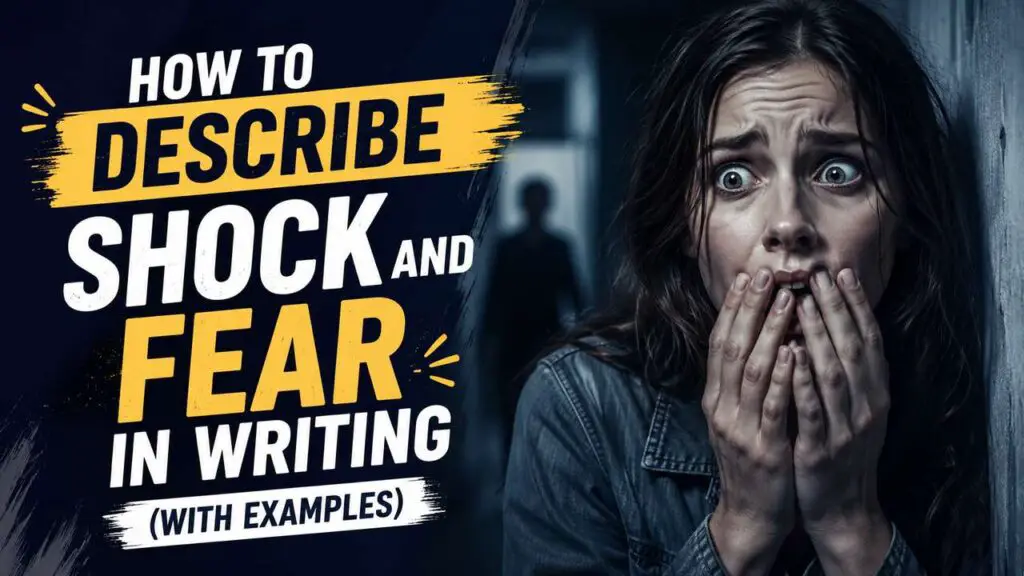
Shock and fear are among the most intense emotions a person can experience, making them some of the most compelling emotions to portray in fiction. Whether a character unexpectedly witnesses a tragedy, narrowly escapes danger, confronts a terrifying enemy, or receives devastating news, the way they react can shape the emotional impact of an entire scene. Readers connect most deeply with characters whose emotional responses feel genuine, making believable descriptions of shock and fear essential for immersive storytelling.
One of the biggest mistakes writers make is simply telling the reader that a character was “shocked” or “afraid.” While these words communicate the emotion, they do little to help readers experience it. Instead, effective writing shows how shock and fear affect every part of a character. Their heartbeat changes. Their breathing becomes uneven. Their thoughts become disorganized. Their senses sharpen or blur. Their speech changes. Their decisions become driven by instinct rather than logic.
Shock and fear also vary greatly depending on the situation and the individual. One character may scream and run. Another may freeze completely. A trained soldier may remain outwardly calm while internally fighting panic. A child may cry, hide, or cling to someone for safety. Understanding these differences allows writers to create unique and memorable reactions rather than relying on the same descriptions repeatedly.
These emotions are also powerful tools for building tension. A well-written moment of fear keeps readers turning pages because they begin to experience the uncertainty alongside the character. By slowing down important moments and focusing on specific physical, emotional, and sensory details, writers can transform an ordinary frightening scene into one that readers vividly remember.
The following techniques will help make descriptions of shock and fear feel authentic, emotionally engaging, and believable while providing practical examples that can be adapted to many different genres and writing styles.
How to Describe Shock and Fear in Writing
Shock and fear can be described in many ways depending on the scene, the character, and the intensity of the moment. Sometimes fear is loud and chaotic. Other times, it is silent and paralyzing. A character may experience only a brief moment of surprise, or they may be overwhelmed by terror that completely changes how they think and behave. The best descriptions take into account not only what the character feels emotionally but also how those emotions influence their body, thoughts, actions, and perception of the world around them.
Rather than relying on words like scared, terrified, or shocked, focus on observable reactions that allow readers to draw their own conclusions. Showing the emotion instead of naming it creates a much stronger emotional connection. The following methods offer different ways to accomplish this while keeping each scene fresh and realistic.
#1. Show the Body Reacting First
Shock and fear usually affect the body before the conscious mind has time to process what is happening. The nervous system immediately triggers physical responses that the character cannot easily control. Their heart may pound violently, their muscles may tighten, their breathing may become rapid or shallow, and their hands may begin to shake. Some characters feel suddenly cold, while others break into a sweat. These involuntary reactions communicate fear naturally because readers recognize them from real life.
Focusing on physical sensations also grounds the reader in the moment. Instead of simply stating that the character was frightened, showing how their body reacts allows the emotion to unfold organically. Small details such as trembling fingers, a tightening chest, or a racing pulse make the experience more immersive and believable.
Examples:
Her heart slammed against her ribs, hard and fast, as if it were trying to escape before she could.
His knees softened beneath him, and for one terrifying second, he thought he might collapse right there on the floor.
A cold wave passed through her body, starting at her chest and spreading down to her fingertips.
#2. Describe the Loss of Thought
One of the defining characteristics of shock is that it temporarily disrupts normal thinking. Instead of forming logical conclusions, the mind often stalls completely. Characters may struggle to understand what they are seeing, become fixated on a single thought, or find themselves unable to process even simple information. This mental paralysis is especially common after witnessing something unexpected or traumatic.
Showing confusion instead of immediate understanding makes the reaction feel more authentic. Real people rarely analyze a horrifying situation the instant it occurs. Their thoughts may become fragmented, repetitive, or entirely absent as their brain struggles to catch up with reality.
Examples:
No. That was the only word in his mind. No, no, no.
She stared at the letter, but the words no longer made sense. They were only shapes on paper.
For a moment, his thoughts disappeared completely, leaving only a hollow ringing inside his skull.
#3. Use Short, Broken Sentences
The rhythm of a scene has a powerful effect on how readers experience emotion. During moments of fear or panic, characters rarely think in long, carefully constructed sentences. Their attention jumps rapidly from one threat to another, producing fragmented observations and incomplete thoughts. Reflecting this in the writing helps readers feel the urgency.
Short sentences increase tension by speeding up the pace and emphasizing immediate danger. Sentence fragments can also mirror a character’s scattered mental state. Used carefully, this technique places readers directly inside the character’s panicked perspective rather than observing it from a distance.
Examples:
A sound behind her. A breath. A footstep. Too close.
He couldn’t move. Couldn’t speak. Couldn’t even breathe.
The door opened. Slowly. Quietly. Then the lights went out.
#4. Focus on the Senses
Fear changes the way people experience the world around them. Some senses become incredibly sharp while others fade into the background. A character might suddenly notice every creaking floorboard, every distant footstep, or the smell of smoke drifting through the air. Their heartbeat may become so loud it drowns out other sounds, or they may become intensely aware of the metallic taste of adrenaline in their mouth.
Using sensory details makes readers feel present inside the scene rather than simply reading about it. The more vivid the sensory experience, the easier it is for readers to imagine themselves alongside the character, sharing the same uncertainty and fear.
Examples:
The air smelled of rain and rust, and beneath it, something darker.
Her mouth filled with a bitter, metallic taste as the footsteps stopped outside her room.
The room had gone silent except for the thin buzz of the light above her head.
#5. Show the Character Freezing
Contrary to popular belief, fear does not always produce immediate action. Many people freeze when confronted with danger because their brain needs time to process the threat before deciding how to respond. This involuntary stillness can create incredibly suspenseful scenes because the character desperately wants to act but physically cannot.
A frozen character often notices every passing second. Their breathing becomes shallow, their muscles tense, and even the smallest movement feels impossible. This contrast between internal panic and external stillness can be even more powerful than scenes filled with frantic action.
Examples:
She stood perfectly still, one hand on the doorknob, afraid that even breathing would give her away.
His body refused to obey him. He could only stare as the shadow moved across the wall.
The scream rose in her throat, but it never came out.
#6. Describe the World Feeling Different
Shock and fear often distort perception. Familiar places suddenly seem unfamiliar, comforting surroundings become threatening, and ordinary sounds feel ominous. Time itself may appear to slow down or speed up. These changes do not necessarily reflect reality but rather the character’s altered state of mind.
Describing the environment through the lens of fear helps readers understand how deeply the emotion has affected the character. Rather than merely describing the setting objectively, filter every observation through the character’s emotional experience.
Examples:
The hallway looked longer than before, darker too, as though the house had quietly changed around her.
The cheerful music from the café sounded far away now, thin and wrong.
His mother’s face was the same face he had known all his life, but in that moment, it felt unfamiliar.
#7. Use Silence and Stillness
Silence can be just as frightening as loud noises. After a shocking event, an unexpected pause often creates more tension than immediate action. Readers naturally anticipate what might happen next, making silence an effective way to build suspense.
Stillness also gives emotional weight to an important moment. Instead of rushing past a frightening discovery, allowing both the character and the environment to become quiet gives readers time to absorb what has happened. The absence of movement or sound often feels unsettling because it suggests that something worse may be about to occur.
Examples:
No one spoke. Even the clock seemed to hold its breath.
The room went still around her, as if everyone had been turned to stone.
For several seconds, there was nothing but silence and the slow drip of water into the sink.
#8. Show Denial or Disbelief
Shock frequently begins with disbelief rather than acceptance. The human mind often resists painful truths because accepting them all at once would be emotionally overwhelming. Characters may convince themselves they misunderstood what they saw, expect someone to explain the situation, or repeatedly tell themselves that the event cannot be real.
Including denial makes emotional reactions more layered and realistic. Instead of instantly accepting devastating news or horrifying events, characters behave the way real people often do by clinging to hope, searching for alternative explanations, or refusing to believe the evidence before them.
Examples:
He gave a small, empty laugh, because the truth was too large to accept all at once.
She shook her head again and again, as if the motion could undo what she had seen.
This was a mistake. It had to be. Any second now, someone would explain everything.
#9. Let Fear Change the Voice
A person’s voice often reveals fear long before they consciously acknowledge it. Words may become difficult to form, sentences may trail off, and voices may crack, whisper, or become unnaturally loud. Some characters speak too quickly, while others struggle to say anything at all. Even confident individuals may lose control of their speech when confronted with overwhelming danger.
Paying attention to dialogue and vocal changes adds another layer of realism to fearful scenes. Readers not only hear what the character says but also sense the emotional strain behind every word.
Examples:
“Please,” she whispered, though she was not sure who she was speaking to.
“I don’t… I don’t understand,” he said, his voice breaking on the final word.
“Stay back,” she said, but the tremor in her voice betrayed her.
#10. Use Internal Conflict
Fear becomes even more compelling when it forces a character to choose between competing instincts. They may desperately want to flee but know they must protect someone else. They may feel compelled to hide while understanding they must act immediately. This struggle between emotion and responsibility creates rich character development while increasing dramatic tension.
Internal conflict reminds readers that courage is not the absence of fear. Instead, courage often exists because fear is present. Showing characters wrestling with impossible choices makes their emotional journey more meaningful and memorable.
Examples:
Every instinct told her to run, but her brother was still inside.
He wanted to look away. He needed to look away. But his eyes would not move.
She pressed both hands over her mouth, trapping the scream before it could betray them.
Closing Thoughts
Describing shock and fear in writing is about far more than choosing stronger adjectives. These emotions become memorable when readers experience them alongside the character through physical sensations, scattered thoughts, distorted perceptions, altered speech, and difficult choices. Every frightening moment offers an opportunity to reveal character, build suspense, and deepen the reader’s emotional investment in the story.
The most effective descriptions rely on specific details instead of generic labels. A racing heartbeat, trembling hands, frozen muscles, fragmented thoughts, or an oppressive silence often communicate fear more powerfully than simply stating that a character was terrified. By combining multiple techniques, writers can create emotional scenes that feel vivid, authentic, and impossible to forget.
Like every aspect of creative writing, describing shock and fear improves with observation and practice. Paying attention to how real people respond to stressful situations—and varying those responses from one character to another—will help every scene feel fresh and believable. The more unique and specific each reaction becomes, the more readers will feel every moment of danger right alongside the characters.