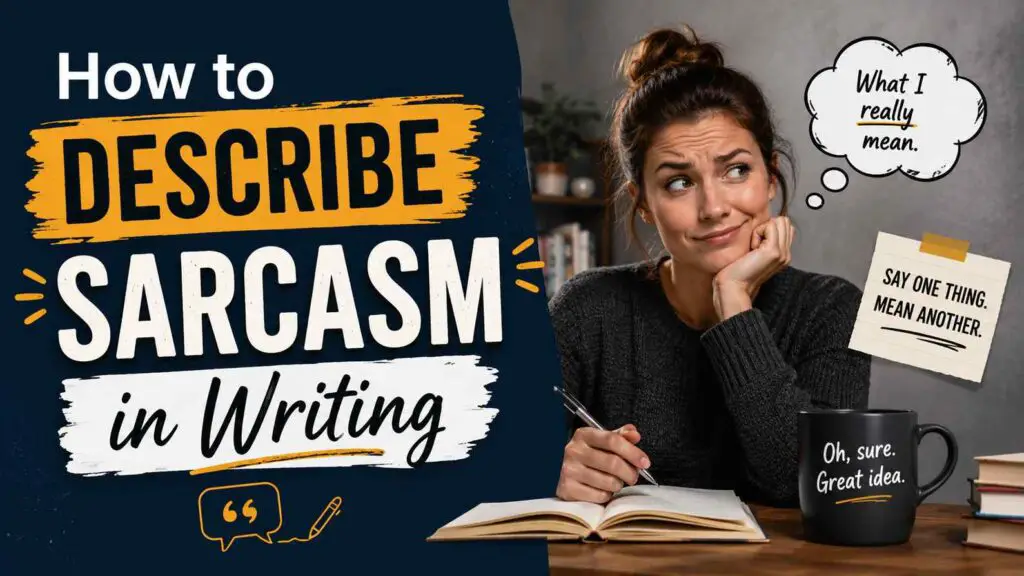
Sarcasm is a sound before it’s a meaning — a flatness, a stretch, a weight on the wrong syllable — and prose has no soundtrack. That’s the whole challenge: on the page, “What a great idea” is sincere until something makes it otherwise, and the writer controls what that something is. Done well, sarcasm characterizes faster than almost any other speech; done clumsily, it needs a stage direction leaning on every line.
Here’s how to make irony land on paper without an adverb holding its hand.
How to Describe Sarcasm in Writing
#1. Let Context Flip the Sentence
Sarcasm is sincerity contradicted by circumstances, so build the circumstances first — then the polite words detonate on their own. If the reader can see the flat tire, the burned dinner, the third cancelled visit, “perfect” needs no tag; the gap between word and world does all the work.
Rain came through the new roof in three places, drumming into the saucepans. “Money well spent,” Ines said, moving the big pot an inch to the left.
The tow truck was two hours out, the temperature two below. “I love camping,” said Priya, from inside her coat.
Dad surveyed the kitchen — flour on the ceiling, smoke alarm still catching its breath. “Restaurant quality,” he said, and got the mop.
#2. Weaponize Over-Agreement
The sarcast rarely argues — they agree too hard, too completely, with a bow. Exaggerated assent (“No, you’re right, it’s genius”) reads as irony automatically because no one sincere agrees at that volume. It’s the easiest sarcasm to write tag-free, and the extra agreement is where the knife goes in.
“No, absolutely, quit the job, buy the boat. Boats are famously free after you buy them.”
“You’re so right. Four a.m. is the perfect time to practice trumpet. I can’t think of a better time. Historians will agree.”
“Sure, invite Derek. Derek makes everything better. Derek is the seasoning of the group.”
#3. The Courtesy That Cuts
Excessive politeness is sarcasm in formalwear — the thank-you that itemizes the offense, the “so kind of you” delivered to someone who was not kind. It suits characters who can’t afford open war (employees, in-laws, diplomats) and reads as controlled fury, which is scarier than shouting.
“Thank you for the feedback,” she said. “Especially the part in front of the clients. That’s the part I’ll treasure.”
“How thoughtful — a diet book. For Christmas. You always know exactly what to get me, Barbara.”
“Please, take my parking spot too. Honestly. You’ve taken the promotion; the spot would just be loose ends.”
#4. The Deadpan Echo
Repeating someone’s own words back flat — no spin, no addition — is sarcasm at its most economical. The echo isolates the absurdity and holds it up to the light; the flatter the delivery, the harder it lands. On the page, a short repeated fragment with a period does the acoustic work.
“It’s a temporary setback,” Gil said. “Temporary,” said his wife, looking at the crater where the deck had been.
“The dog did the taxes wrong. That’s your position. The dog.”
“We’ll circle back,” the consultant promised. Renata wrote circle back in her notebook, slowly, the way you’d record a symptom.
#5. Punctuate the Flatness
Print can fake tone with rhythm: short sentences, full stops where enthusiasm would put exclamation marks, an italic lean on one word only. “Great. Love that.” reads dead-flat because the punctuation refuses the feeling the words claim. Use these tools in moderation — they’re spice, not structure.
“Great. A team-building retreat. With trust falls. I’m thrilled. This is my thrilled voice.”
“Oh good,” said Marcus. “Karaoke.” Both periods were audible.
“I’m sure your brother will pay you back. He’s so reliable.” The italics were hers, and they had a twenty-year history.
#6. Show the Hit Landing
When tone is ambiguous, the listener’s reaction settles it — a flinch, a laugh, a slow turn, a “that’s not fair.” Reactions confirm sarcasm without tags and let you measure its cruelty: the same line is banter if the target grins and violence if the table goes quiet.
“Nice of you to make it,” Coach said, and the whole bench looked at their laces while Danny found his seat.
She said it lightly — “well, some of us had help with the deposit” — and watched her sister set down the wine glass with laboratory care.
“Love the beard. Very castaway.” Theo laughed and kept it; that was the kind of friends they were, which is to say, the kind who checked afterward with a glance.
#7. Give the Sarcasm a Source
Constant irony is armor, and armor implies a wound — grief, disappointment, a family where sincerity was dangerous. Deciding why your character deflects tells you when they’d stop: the moment sarcasm fails them, or falls away entirely, is one of fiction’s most reliable emotional beats.
Her jokes were a moat, and everyone who loved her knew it; the trick was noticing the day the drawbridge stayed up, and the jokes got faster, and her eyes didn’t come along for any of it.
“So how was the funeral?” — and for once nothing arrived, no line, no deflection, just his hands turning the coffee cup, and she understood the size of it.
In the Kowalczyk house, saying what you actually felt was like handing over a loaded weapon, so the children grew up fluent in the other language — quick, dry, safe — and two of them never learned the first one back.
#8. Delete “He Said Sarcastically”
The adverb tag — “she said sarcastically,” backed by its cousin the eye-roll — is the genre’s white flag: it means the line couldn’t carry its own tone. If the sarcasm needs labeling, rewrite the line using context, over-agreement, echo, or punctuation until it doesn’t. Trust built this way pays double: readers love decoding tone themselves.
Weak: “Nice haircut,” he said sarcastically. Stronger: “Nice haircut. Did they catch the guy?”
Weak: “Great party,” she said, rolling her eyes. Stronger: “Great party. The cheese cubes really anchored it.”
Weak: “I’m sure you studied hard,” Mom said sarcastically. Stronger: “I’m sure you studied hard. The Xbox looks exhausted.”
Closing Thoughts
Sarcasm on the page is a trust exercise. Every time you resist the tag and let the reader catch the irony themselves, you’re telling them: you’re quick, you’ll get this — and they do, and they like you for assuming it. Every “he said sarcastically” says the opposite. So write the flat tire before the “perfect,” sharpen the compliment until it cuts unassisted, and save the moment the armor drops for when it counts. If a line can’t survive without its adverb, the line isn’t done. When it can, neither the character nor the writer ever has to explain the joke.