
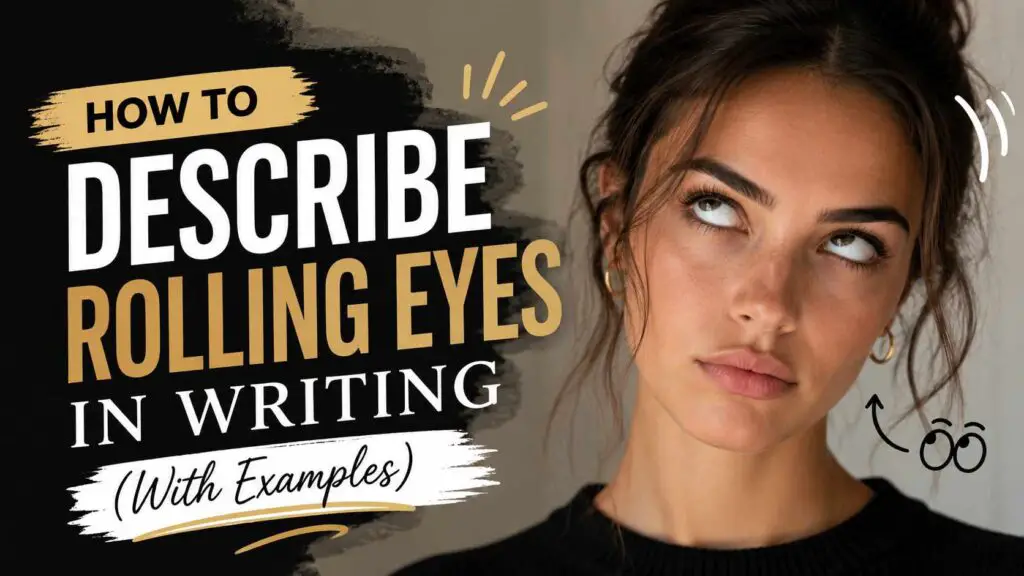
Rolling eyes is one of the most recognizable forms of nonverbal communication. In everyday life, it often conveys annoyance, disbelief, impatience, sarcasm, frustration, or even playful teasing without a single word being spoken. In fiction, this small gesture can reveal a character’s personality, emotions, relationships, and attitude in an instant. A well-placed eye roll can communicate contempt during an argument, skepticism in response to an unbelievable claim, or exhaustion after hearing the same complaint for the tenth time.
Because it is such a common gesture, many writers rely on the phrase “rolled her eyes” or “rolled his eyes” repeatedly throughout a story. While there is nothing wrong with using the direct expression, repeating it too often can make dialogue and action feel repetitive. Fortunately, there are many ways to describe the same action by focusing on the movement itself, the emotion behind it, or the accompanying body language. Varying your descriptions also helps your characters feel more natural and gives each scene its own emotional tone.
The following techniques will help you describe rolling eyes in fresh, engaging ways while keeping your writing vivid and expressive.
How to Describe Rolling Eyes in Writing
#1. Use the Direct Phrase
The simplest and most straightforward way to describe the gesture is to state that the character rolled their eyes. Readers immediately understand what the action means, making this an excellent choice when the gesture is not the primary focus of the scene. It keeps the pacing quick and avoids drawing unnecessary attention to a minor reaction.
Although this phrasing is perfectly acceptable, it works best when used sparingly. If multiple characters roll their eyes throughout a chapter, consider alternating with more descriptive approaches to keep your writing varied.
Maya rolled her eyes and turned back to her book.
He rolled his eyes as if he had heard the excuse a hundred times before.
#2. Describe the Eye Movement
Instead of naming the gesture directly, describe what the eyes physically do. Mentioning a character’s gaze lifting toward the ceiling or drifting upward allows readers to visualize the action without repeating the same wording. This approach often feels more cinematic and can subtly vary the rhythm of your prose.
Focusing on the movement itself also allows you to match the description to the character’s emotional state. A quick upward glance may suggest mild irritation, while a slow, exaggerated movement can imply deeper frustration or sarcasm.
Her gaze flicked toward the ceiling before returning to him.
His eyes lifted in silent disbelief.
She looked heavenward, as though asking for patience.
#3. Show the Emotion Behind It
An eye roll is rarely just about the physical movement. It reflects an emotion, and emphasizing that emotion often creates a stronger image than describing the gesture alone. Ask yourself why the character is rolling their eyes. Are they irritated? Embarrassed? Amused? Tired? Disappointed? Let the description answer those questions.
Showing the emotion helps readers connect with the character’s internal state while avoiding repetitive action beats. The same gesture can communicate very different feelings depending on the context.
Lena’s eyes drifted upward, heavy with exhaustion.
He gave a slow roll of his eyes, more amused than angry.
Her eyes turned skyward with sharp impatience.
#4. Pair It with Body Language
Body language rarely exists in isolation. People often roll their eyes while sighing, crossing their arms, shaking their heads, looking away, or tightening their lips. Combining multiple physical cues creates a richer, more realistic picture of the character’s emotional response.
Adding supporting gestures also strengthens characterization. A confident character may roll their eyes with folded arms, while a nervous character might glance upward briefly before quickly looking away. These combinations make scenes feel more dynamic and believable.
She folded her arms and rolled her eyes, refusing to answer.
He let out a long sigh, his eyes turning upward in defeat.
Her mouth tightened as her gaze swept toward the ceiling.
#5. Use Dialogue to Support the Gesture
Dialogue and body language work best when they reinforce one another. A sarcastic comment paired with an eye roll immediately communicates a character’s attitude without requiring lengthy explanation. Sometimes the dialogue itself implies the gesture so clearly that only a subtle description of the eyes is needed.
This technique allows readers to infer emotion naturally. Instead of telling them a character is annoyed, you show it through both speech and physical expression, creating a more engaging scene.
“Wonderful,” he said, eyes lifting toward the ceiling. “Another meeting about meetings.”
“Of course you forgot,” she said, giving him a look of tired disbelief.
#6. Make It Subtle
Not every eye roll needs to be dramatic. Many people suppress the gesture, especially in professional settings or around authority figures. A slight upward flick of the eyes or a nearly completed eye roll can communicate restrained irritation just as effectively.
Subtle descriptions are particularly useful when writing emotionally complex characters who try to hide their true feelings. These understated reactions often feel more realistic because they reflect how people behave when they are attempting to remain polite or avoid conflict.
For half a second, her eyes shifted upward before she forced a smile.
His gaze flickered toward the ceiling, but he said nothing.
She caught herself before the eye roll fully formed.
#7. Make It Dramatic
Sometimes an exaggerated eye roll is exactly what the scene requires. Humor, teenage drama, sibling rivalry, and heated arguments often benefit from larger-than-life gestures that emphasize emotion. A dramatic description can add personality and even provide comic relief.
The key is to reserve exaggerated eye rolls for characters and situations where they feel appropriate. Overusing them may weaken their impact, but when used strategically, they can make memorable moments even more entertaining.
She rolled her eyes so hard he was surprised they did not disappear into her head.
His eyes made a full journey toward the ceiling before he answered.
Clara gave the kind of eye roll that deserved its own applause.
#8. Avoid Overusing It
Because rolling eyes is such a familiar gesture, it can quickly lose its impact if every irritated character reacts the same way. Readers notice repeated actions, especially during dialogue-heavy scenes. Varying your character reactions keeps your writing fresh and prevents different characters from sounding or behaving alike.
Consider replacing some eye rolls with raised eyebrows, cold stares, sighs, nervous glances, tightened jaws, shrugs, or brief silences. These alternatives can communicate similar emotions while making each character’s reactions feel more individual.
Instead of answering, she gave him a flat stare.
His eyebrow rose, saying everything his mouth did not.
She breathed out through her nose and looked away.
Closing Thoughts
Rolling eyes can be a powerful gesture when used with purpose. It can reveal irritation, sarcasm, boredom, disbelief, or hidden frustration in a single moment. The key is to vary the description so the action does not feel stale.
Use the direct phrase when you need clarity. Describe the movement when you want a stronger image. Add body language, dialogue, and emotion when the scene needs more depth. With the right wording, an eye roll can say more than a full paragraph of explanation.