
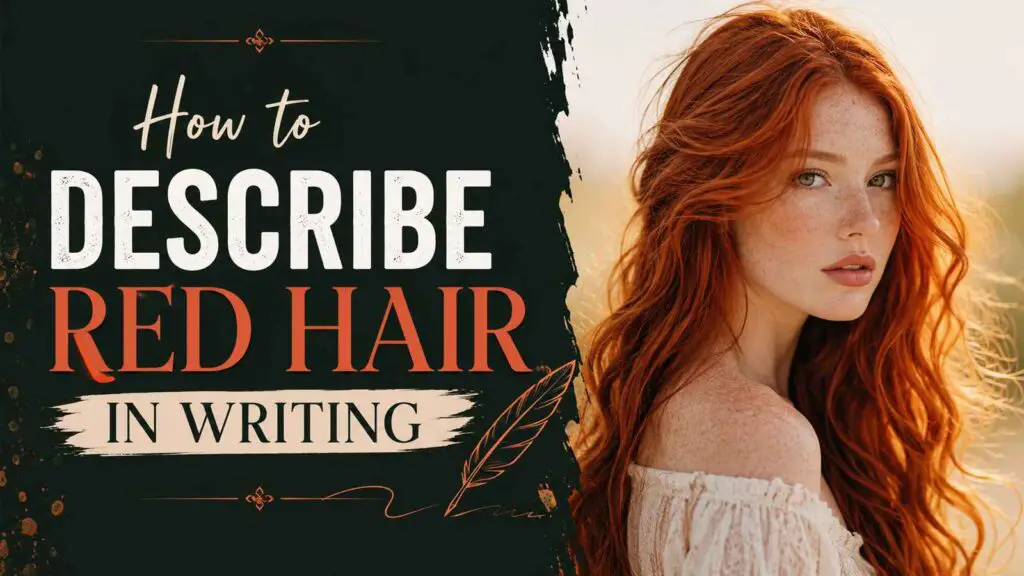
Red hair is the rarest natural hair color, which gives it a visual power on the page that no other shade quite matches — and a long history of literary shorthand that a careful writer needs to navigate rather than repeat. The difference between a memorable redheaded character and a stock one comes down to specificity: the exact shade, how it behaves in light, and whether it belongs to a person or a trope. Below are the techniques for describing red hair with real precision, each with examples you can study and adapt.
How to Describe Red Hair in Writing
#1. Name the Exact Shade on the Red Spectrum
Red hair spans a wide spectrum — pale strawberry, bright orange-copper, deep auburn, dark mahogany — and each shade creates a distinctly different visual impression on the page. Naming the precise point on that spectrum does far more work than the single word “red,” which flattens all of them into one.
Her hair was true copper, bright and unmistakably orange, the shade people mean when they say red and rarely actually see.
His was a dark mahogany red, subtle enough indoors that some people never noticed it at all.
It was pale strawberry, more suggestion than statement, deepening only slightly at the roots.
#2. Use Light as Red Hair’s Amplifier
Red hair reacts to light more dramatically than any other color — igniting in direct sun, smoldering near firelight, going nearly brown in dim rooms. Describing this range gives the color a dynamic, scene-by-scene life that a single fixed description can’t, and it rewards placing the character in varied settings.
In direct sunlight it lit up like something struck, every strand suddenly its own distinct shade of flame.
Indoors it settled into a quiet auburn; outside, it announced itself from a block away.
The candlelight found the red in it that the office fluorescents had spent all day hiding.
#3. Use Its Rarity as a Narrative Tool
Because natural red hair is genuinely uncommon, it functions as an instant identifier — easy to spot in a crowd, hard to forget, difficult to disguise. This rarity can serve plot as well as description, making a redheaded character findable, memorable, or exposed exactly when the story needs them to be.
She was the easiest person to find in any crowd, a fact she’d alternately loved and resented her whole life.
The witness remembered nothing about his face and everything about the hair, which was, in the end, all they needed.
Going unnoticed had never once been an option for her, so she’d learned early to work with being seen.
#4. Pair Red Hair With Its Companion Features
Natural red hair usually arrives with a set of companions — pale skin that burns rather than tans, freckles, light lashes and brows — and including these grounds the character in genetic reality. Presenting the hair alongside its usual package makes the description feel observed rather than assembled from a costume box.
The hair came with the standard package — skin that burned in twenty minutes and freckles that multiplied every summer.
Her lashes were so pale they disappeared without mascara, the quiet tax of the hair everyone complimented.
He kept sunscreen in the car, the garage, and both jacket pockets, a redhead’s version of common sense.
#5. Distinguish Natural Red From Dyed Red
Dyed red reads differently than natural red — more uniform, often more saturated, and chosen rather than inherited — and that choice itself says something meaningful about a character. Making the distinction clear adds precision and characterization at once, since a bottle red announces a decision where a natural red announces genetics.
The color was too uniform to be natural, a single saturated red from root to tip — chosen, and chosen boldly.
Hers was unmistakably real: a dozen shades at once, copper over gold over brown, the kind no box ever produced.
She’d dyed it red at forty, and everyone who knew her agreed it looked like a decision rather than a disguise.
#6. Show How It Changes Across a Lifetime
Red hair often shifts over a lifetime — bright orange in childhood, deepening toward auburn in adulthood, fading toward sandy blonde or white rather than gray. Referencing this arc adds history to the character, quietly marks their age, and gives family photographs and old memories a concrete visual anchor.
The bright orange of his childhood photos had deepened into auburn by thirty, the flame banked but still there.
Her red hadn’t gone gray so much as faded, softening year by year toward a pale, rosy gold.
Only his beard still held the old color, the red hanging on there long after his hair had let it go.
#7. Sidestep the Fiery-Temper Trope
Fiction has spent centuries wiring red hair to a hot temper, wildness, or otherness, and repeating that link flattens a character into inherited shorthand readers can predict from the first page. Letting the personality contradict or simply ignore the hair keeps the character an individual and often generates useful, quiet tension.
People kept waiting for the temper the hair supposedly promised, and were consistently disappointed by the calmest man in the building.
She’d spent her whole life being cast as fiery by strangers who’d never once seen her raise her voice.
The hair said one thing, apparently; she’d long since stopped taking responsibility for what it said.
#8. Avoid Generic “Flaming Red” — Get Specific
“Flaming red locks” and its cousins have been worn smooth by overuse, and they now read as recital rather than observation. Reaching for a precise, grounded comparison — rust, copper wire, autumn leaves, a new penny — gives the reader an exact color instead of a cliché, and it costs one thought.
It wasn’t flame so much as rust — a deep, weathered orange-red that looked like it had a history.
The color was closest to a new penny, bright and metallic, impossible to reproduce and impossible to miss.
There was nothing generic about it — it was the exact red-orange of maple leaves at their peak, about a week before they fall.
Closing Thoughts
Red hair earns its visual power on the page when it’s rendered precisely — the exact shade on the spectrum, its dramatic relationship with light, the companion features and lifetime arc that come with it — rather than borrowed from centuries of fiery shorthand. Let the character exist independently of what the color supposedly means, and the rarest hair color in fiction will feel like it belongs to one specific person.