
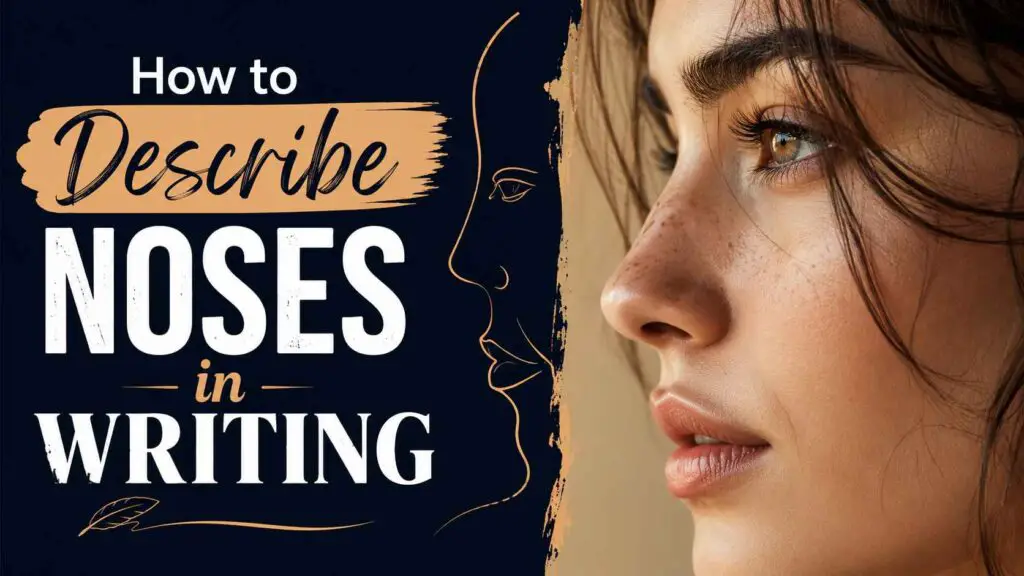
The nose is the most prominent feature on a face and the one writers describe least, usually because eyes and mouths seem to carry more emotion. But a nose holds history — breaks, family inheritance, a whole childhood of being teased or ignored — and it moves more than people think, wrinkling, flaring, and reddening on cue. Below are the techniques for describing noses with real specificity, each with examples you can study and adapt.
How to Describe Noses in Writing
#1. Use Specific Shape Vocabulary
Aquiline, snub, Roman, broad, hooked, upturned — nose shapes have a rich, precise vocabulary that most description never touches. Choosing the accurate term over a vague “big” or “small” gives the reader a real face to picture and signals a writer who actually looked at their character.
His nose was aquiline, a clean curve that gave his profile the look of an old coin.
Hers was small and slightly upturned, a nose that made her look more amused than she usually was.
He had a broad, solid nose that anchored the whole face — nothing delicate about it, and nothing apologetic either.
#2. Use a Broken or Crooked Nose as Compressed Backstory
A nose that’s been broken tells a story before the character says a word — a fight, an accident, a sport played too long — and the reader will wonder which. That visible history makes a crooked nose one of the most efficient backstory devices a face can carry.
His nose had been broken at least once and set carelessly, a small bend that made strangers guess boxer and friends know better.
The bump on the bridge was from a fence, a horse, and being fourteen, in roughly that order.
She never explained the slight crook in it, which meant every new coworker eventually invented their own version.
#3. Show the Nose Moving With Emotion
Noses are surprisingly expressive — wrinkling at a smell or an idea, flaring with anger, reddening with cold or tears — and these small movements convey feeling without naming it. A flared nostril often says more about suppressed fury than a full paragraph of internal monologue would.
Her nose wrinkled before she’d said a word, which was all the review the casserole was going to get.
His nostrils flared once, briefly, the only part of his calm expression that told the truth.
The tip of her nose had gone pink, which happened when she was about to cry and always announced it first.
#4. Use the Nose to Carry Family Resemblance
Noses are among the most strongly inherited features, and “he had his mother’s nose” is instantly understood by every reader. A shared family nose can establish lineage, spark grief or tenderness in the person noticing it, and connect generations in a single physical detail.
The baby had arrived with the family nose already installed, unmistakable even at two days old.
She caught her father’s profile in her own reflection sometimes, the same strong bridge, and never quite knew how to feel about it.
All the cousins had it — the long, straight nose from their grandmother’s side, appearing in every wedding photo like a signature.
#5. Show a Character’s Relationship to Their Own Nose
Few features generate more private self-consciousness or eventual acceptance than a nose, and how a character feels about theirs is real characterization. A teenager angling away from cameras and an adult who has grown into the same nose are telling two different stories with one feature.
She’d spent her teens turning three-quarters away from every camera, and her thirties wondering why she’d bothered.
He’d hated his nose until he saw his grandfather’s portrait at the funeral, and after that he mostly didn’t.
The nose she’d once begged to change had become, somewhere along the way, simply her face.
#6. Use Small Details — Freckles, Glasses, Cold, Sunburn
The nose collects small, specific evidence of a life — freckles across the bridge, the dents glasses leave, sunburn on a fair-skinned hiker, a permanent redness from wind or drink. These incidental details make a face feel lived-in rather than assembled from standard parts.
Freckles crossed the bridge of her nose in a band, the one part of her that had never once tanned.
Twin dents sat on either side of his nose where the glasses lived, visible whenever he took them off.
Her nose had burned and peeled twice already that summer, and it was only June.
#7. Use the Nose in Profile and Silhouette
The nose defines a profile more than any other feature, and describing a character in silhouette — against a window, a fire, a car’s side glass — naturally centers it. Profile moments let a writer describe a nose gracefully, without the description feeling like a clinical inventory of the face.
In silhouette against the window, his profile was mostly nose — strong, straight, and somehow reassuring.
The firelight caught her profile, and he found himself memorizing the small, precise slope of her nose.
He knew her by profile from three cars away, that particular nose unmistakable at any distance.
#8. Avoid Generic “Perfect Nose” — Get Specific
“A perfect little nose” describes nothing and flattens a character into catalog copy, since perfection has no shape. Naming the actual feature — the slight bump, the roundness at the tip, the length — gives the reader a face, and imperfection is almost always more memorable than symmetry.
It wasn’t a perfect nose — it was slightly long, faintly crooked, and entirely hers, which was better.
Calling it perfect would have missed the point; the small bump on the bridge was the part he liked.
There was nothing catalog about it — a round, friendly tip and one freckle just off-center, like a signature.
Closing Thoughts
Noses earn their place in character description when they’re treated as carriers of history and feeling — the break never explained, the family bridge repeating across generations, the nostril flare that betrays a calm face. Use precise shape vocabulary, catch the small evidence of a lived life, and skip “perfect” entirely, and the most overlooked feature on the face becomes one of the most telling.