
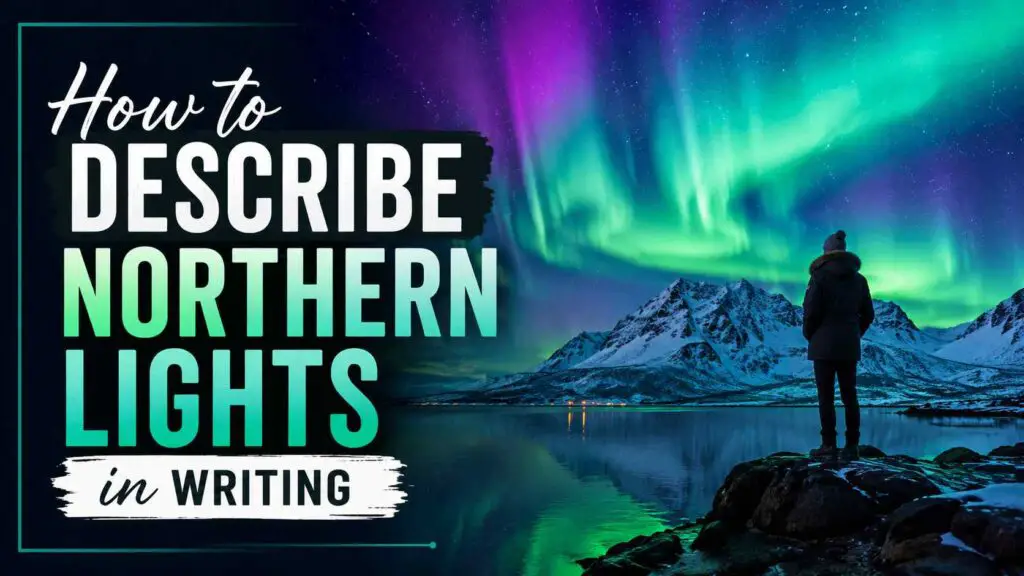
The northern lights are one of the few natural phenomena that genuinely exceed most readers’ experience, which makes describing them both a gift and a trap — a gift because the subject carries built-in wonder, a trap because “dancing curtains of light” has been written thousands of times. The real aurora is stranger, slower, and more variable than the clichés suggest. Below are the techniques for describing the northern lights with real precision, each with examples you can study and adapt.
How to Describe Northern Lights in Writing
#1. Describe the Movement Precisely, Not Just “Dancing”
The aurora moves in specific ways — rippling like fabric in slow water, pulsing, folding, draining and refilling with light — and “dancing” flattens all of them into one word. Naming the actual motion is what separates a description that was observed from one that was inherited.
The green band rippled slowly, the way a sheet moves underwater — nothing like dancing, closer to breathing.
Light drained out of one fold of the sky and refilled another, the whole display rearranging itself over minutes, not seconds.
For a while it barely moved at all, a still green arc — and then the whole thing shivered at once.
#2. Get the Colors Right — Including Their Faintness
Real aurora is usually pale green, sometimes edged in pink or violet, and often fainter to the naked eye than photographs suggest — a detail that surprises many first-time viewers. Writing that honest faintness, or the rare saturated display, grounds the scene in credibility rather than postcard color.
It was fainter than the photos had promised — a pale, gray-green shimmer she might have missed if she hadn’t been told to look.
The green deepened as their eyes adjusted, and a thin edge of pink appeared along the bottom, like a hem.
That night was the rare kind the locals talked about — saturated green and violet, bright enough to read by.
#3. Use the Cold and Silence as the Aurora’s Setting
The lights are almost always watched in deep cold, deep dark, and deep quiet, and that physical context — numb fingers, breath clouds, snow squeaking underfoot — is half the experience. Grounding the sky-show in the body’s discomfort keeps the scene embodied rather than purely visual.
They watched until their toes went numb, the cold itself somehow part of the price of admission.
Her breath rose in clouds between her face and the sky, so that she watched the lights through her own weather.
The snow squeaked under his boots — the only sound for miles — while the whole sky moved without any sound at all.
#4. Show the Waiting Before the Display
Real aurora viewing is mostly waiting — hours of checking forecasts, standing in the dark, mistaking faint clouds for the start — and that anticipation is narratively useful. The waiting builds the payoff, and characters stuck together in the cold dark have time to talk, argue, or fall in love.
For two hours the sky offered nothing but stars, and they had nearly given up twice before the first pale band appeared.
Twice she mistook thin clouds for the beginning of it, and felt foolish, and kept watching anyway.
They talked about everything in the waiting dark, which was, he realized later, the actual point of the trip.
#5. Show Characters’ Reactions Instead of Only the Sky
Awe reads most convincingly on the faces of the people experiencing it — going quiet mid-sentence, forgetting the camera, laughing at nothing — rather than in more adjectives aimed at the sky. Cutting from the lights to the watchers gives the reader someone to feel the moment through.
She stopped talking in the middle of her own sentence and never did finish it.
He’d driven nine hours to photograph it and stood there with the camera hanging at his side, unused.
The kids went silent — actually silent, both of them, for the first time all day — and nobody ruined it by pointing that out.
#6. Use Scale to Convey the Sky Taking Over
A strong aurora doesn’t sit politely in one corner of the sky — it can arch horizon to horizon and move directly overhead, forcing viewers to turn and crane and give up on seeing all of it. Conveying that overwhelming scale separates the aurora from every smaller light effect.
It arched from one horizon to the other, and there was no way to look at all of it at once, so they stopped trying.
When it moved directly overhead they lay down in the snow, because necks weren’t built for this.
The whole valley stood under it like the floor of something — lit, briefly, from a ceiling that kept rearranging.
#7. Let the Lights Carry Meaning Without Overexplaining
Characters often watch the aurora at meaningful moments — a last trip, a reconciliation, an anniversary — and the lights can hold that weight quietly if the writer resists spelling out the symbolism. Let the display and the moment sit beside each other; the reader will make the connection unprompted.
They watched it together without talking, the trip’s real conversation happening in the standing still.
Her mother had always wanted to see them. She watched the whole display for both of them and didn’t explain that to anyone.
Neither of them said anything about signs or meaning. They just stayed out much longer than the cold made sensible.
#8. Avoid the “Dancing Curtains” Cliché — Find Your Own Image
“Dancing curtains of light” is the aurora’s stock phrase, worn to invisibility by every travel brochure ever printed. One fresh, specific comparison — drawn from what the display actually resembled that particular night — will do more than the inherited image ever can, and it costs one honest look.
It looked less like curtains than like smoke from a green fire somewhere over the horizon, blown sideways in slow motion.
The band folded and unfolded like something being handed down carefully from a high shelf.
It reminded her, absurdly, of static on an old television — if static could be beautiful, and green, and half the sky wide.
Closing Thoughts
The northern lights earn their wonder on the page through honesty — the precise motion, the surprising faintness, the cold and the waiting that frame the display — rather than through brochure language. Show the watchers as much as the sky, let the moment carry its meaning quietly, and one genuinely observed image will outshine every dancing curtain ever written.