
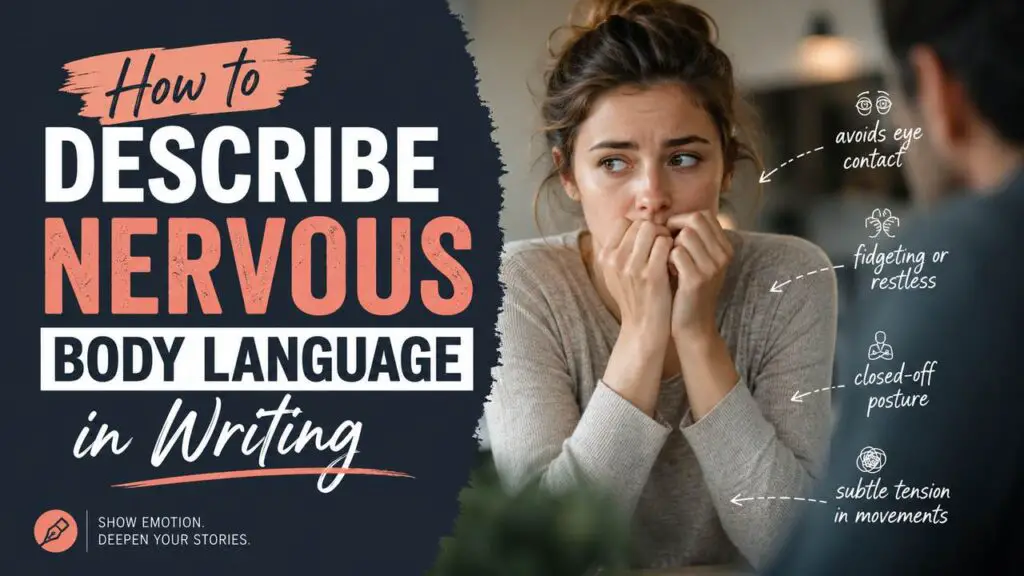
“She looked nervous” tells a reader almost nothing, since nervousness shows up differently on every person — some people go still, some can’t stop moving, some talk too fast while others go quiet entirely. The specific physical tell is what makes a nervous character feel real rather than generically anxious. Below are the techniques for writing nervous body language with real precision, each with examples you can study and adapt.
How to Describe Nervous Body Language in Writing
#1. Use Small, Repetitive Gestures
Nervousness often shows up as a repeated, almost unconscious motion — clicking a pen, twisting a ring, tapping a foot. The repetition itself is what reads as nervous, more than any single gesture in isolation.
She clicked the pen open and closed without seeming to notice she was doing it at all.
He kept turning the ring on his finger, around and around, a habit that had outlasted the relationship it commemorated.
Her foot tapped a steady, unconscious rhythm against the floor the entire time she waited.
#2. Show Eye Contact Breaking Down
A nervous character often struggles to hold eye contact — glancing away too quickly, staring too long and then overcorrecting, or fixing their gaze on a neutral object instead. This specific pattern reads as more authentic than a generic statement about avoiding someone’s eyes.
Her eyes kept sliding away from his and then snapping back, as if she’d caught herself doing something wrong.
He fixed his gaze on a spot just past her shoulder, unable to quite manage anything closer than that.
She held eye contact a beat too long, overcorrecting so hard it became its own kind of tell.
#3. Use Vocal Tells Alongside Physical Ones
Nervousness affects the voice as much as the body — speeding up, cracking, dropping in volume. Pairing a vocal tell with a physical one gives a fuller, more convincing picture of a character trying and failing to appear calm.
Her words came out faster than usual, tumbling over each other in a way that made her wince internally.
His voice cracked on the second word, and he cleared his throat as if that might undo it.
She dropped her voice lower than usual, as if speaking quietly might make the words themselves less consequential.
#4. Show a Character’s Hands Seeking Occupation
Nervous hands often reach for something to hold, fold, or fidget with — a napkin, a phone, the hem of a sleeve. This search for occupation reveals a mind that doesn’t know what else to do with the body it’s attached to.
She’d folded the napkin into a small, tight square before she’d even realized her hands were busy.
He kept his phone in his hand the entire time, thumb moving over the screen without actually doing anything on it.
Her fingers found the hem of her sleeve and worried at a loose thread until it finally came free.
#5. Use Posture to Convey Guardedness
Nervousness often shows up in posture — shoulders drawn in, arms crossed protectively, a body angled slightly away from the source of anxiety. This physical guardedness communicates unease before a character has said a single word.
Her shoulders had crept up toward her ears without her noticing, a small, defensive posture she’d carried since childhood.
He crossed his arms tightly, less a gesture of confidence than an attempt to make himself smaller.
She angled her body slightly toward the door, a small, unconscious readiness to leave if she needed to.
#6. Show Nervous Energy Redirected Into Movement
Some characters channel nervousness into larger, more visible movement — pacing, rearranging objects, finding reasons to stand up and sit back down. This restlessness shows a body trying to discharge energy it doesn’t know what else to do with.
He paced the length of the kitchen twice before he even noticed he’d started.
She rearranged the pens on her desk into a straight line, then immediately messed them up again.
He stood up to get water he didn’t actually want, just to have somewhere else to be for a minute.
#7. Track How Nervousness Changes Under Pressure
Nervous behavior often intensifies as stakes rise within a scene — a small fidget escalating into something more visible. Showing this progression gives the reader a sense of mounting tension alongside the character’s own escalating discomfort.
The pen-clicking had started slow and grown steadily faster as the silence stretched on.
What had been a small foot tap became, by the third question, a full-body restlessness she couldn’t quite contain.
Her voice, steady at first, had gone thin and quick by the time she reached the hardest part.
#8. Use Restraint — Not Every Tell Needs Naming
Piling on multiple nervous tells in a single passage can overwhelm rather than convince. Choosing one or two specific, well-observed details usually communicates nervousness more effectively than an exhaustive catalog of fidgets.
Just the pen-clicking, really. That alone said everything anyone needed to know.
She didn’t fidget at all, actually, which somehow read as more nervous than if she had.
One detail was enough — the white-knuckled grip on the coffee cup told the whole story without any further explanation.
#9. Avoid Generic “She Looked Nervous” — Show the Specific Tell
The phrase asks the reader to imagine an unspecified nervousness rather than showing them what that actually looked like on this particular character. Naming the exact physical detail makes the moment specific and believable.
It wasn’t just that she looked nervous — her hands hadn’t stopped moving since the moment she sat down.
Calling him nervous undersold it; he’d checked the clock four times in under a minute.
There was nothing generic about how she showed it — just that same small, private habit of pressing her thumbnail into her palm.
Closing Thoughts
Nervous body language convinces the reader when it’s specific to the character — a particular gesture, a distinct vocal tell, a posture that reveals guardedness — rather than a generic statement that someone “looked nervous.” Track how the behavior escalates under pressure, and trust one or two well-chosen details over an exhaustive list, and your character’s nerves will feel authentically, individually theirs.