
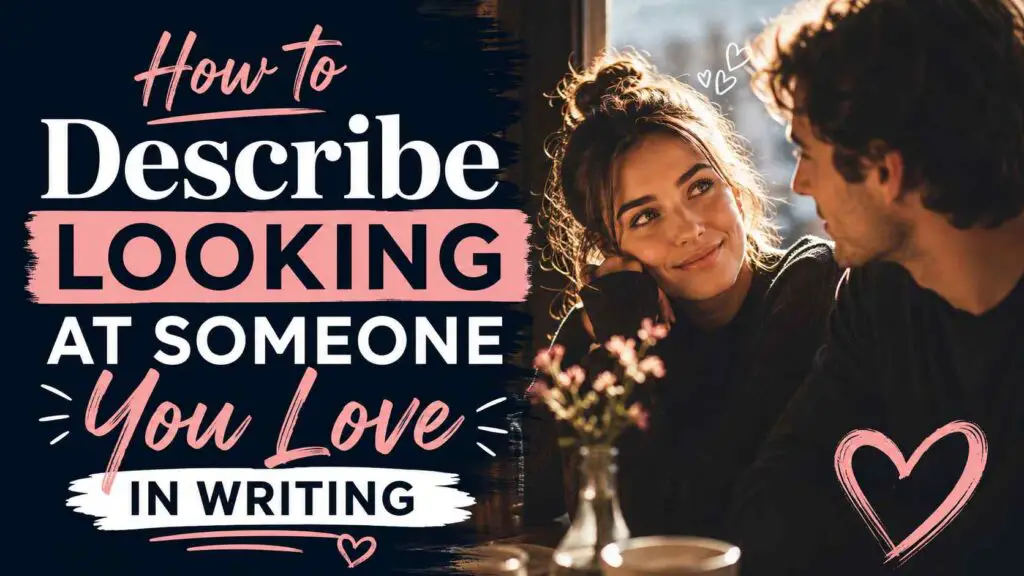
The way someone looks at a person they love is different from any other kind of look in fiction — softer, slower, less concerned with being noticed. It’s easy to overwrite this moment into something breathless and dramatic, when the more convincing version is often quieter: a gaze that lingers a beat too long, or catches on some small, unremarkable detail. Below are the techniques for capturing that specific tenderness, each with examples you can study and adapt.
How to Describe Looking at Someone You Love in Writing
#1. Let the Gaze Linger Past Necessity
A look of love often outlasts its practical reason for existing — staying a beat longer than the conversation requires, watching someone even after they’ve stopped being interesting to watch for any other reason. This lingering, more than any single detail, signals affection.
He kept watching her long after she’d stopped talking, well past the point where watching was actually necessary.
She didn’t look away when the conversation moved on to someone else, still caught somewhere in his last sentence.
His eyes stayed on her face for a full extra second after she’d finished the story, as if he wanted to keep it there a little longer.
#2. Use Small, Specific Details the Gaze Catches
Love often shows up in attention to the smallest, most unremarkable details — the way someone’s hair falls, a habit of chewing their lip while reading. Naming these specific things a gaze fixes on is more convincing than a general statement of adoration.
He noticed, not for the first time, the small crease that appeared between her eyebrows whenever she concentrated.
She watched him chew the inside of his cheek, a habit she’d catalogued years ago and never once mentioned to him.
His eyes traced the same small scar on her chin they always did, an old detail that had never once stopped being interesting to him.
#3. Show the Look Softening an Otherwise Guarded Face
A character who’s controlled or reserved in most situations letting their expression soften specifically when looking at someone they love reveals the relationship’s significance through contrast with their usual demeanor.
His face, usually unreadable to everyone in the office, went soft the second she walked through the door.
She dropped the careful composure she wore for everyone else the moment she looked at him.
Something in his expression eased, almost imperceptibly, the way it only ever did around her.
#4. Use Stillness to Convey the Weight of the Moment
A character going quiet and still while looking at someone they love — pausing mid-task, forgetting what they were about to say — conveys the weight of the feeling without any need for internal monologue explaining it.
She stopped folding the laundry entirely, just for a second, watching him laugh at something on his phone across the room.
He lost the thread of what he’d been about to say, distracted completely by the way the light caught her hair.
She went still in the doorway, watching him sleep for a moment longer than she probably should have.
#5. Show a Character Caught in the Act of Looking
Being noticed mid-gaze, and the small, unguarded reaction that follows — an embarrassed smile, no attempt to look away — adds vulnerability and intimacy to the moment, since the look was never meant to be observed in the first place.
“What?” she asked, catching him staring, and he just shook his head, smiling, without any real explanation to offer.
He didn’t look away when she caught him. There didn’t seem to be much point in pretending anymore.
She felt his eyes on her before she looked up, and found him not even bothering to look elsewhere once she had.
#6. Use the Gaze in Quiet, Unremarkable Moments
Placing this kind of look in an ordinary, undramatic setting — doing dishes, waiting at a red light — rather than a grand romantic set piece often makes it feel more genuine, since it suggests the feeling exists constantly rather than only on special occasions.
He watched her do the dishes with an attention the task itself had never once earned on its own.
She glanced over at the red light, just to look at him for a second, an old habit that had never worn off.
He looked up from the crossword just to watch her reading for a moment, no particular reason, no occasion at all.
#7. Contrast This Look With How They Look at Everyone Else
Showing how a character’s expression or attention shifts specifically for this one person, compared to how they engage with everyone else in a scene, isolates the feeling and gives it clear, comparative weight.
He gave everyone else at the party a polite, distracted nod. For her, he actually stopped.
She’d been half-listening to the whole table all evening, until he walked in, and suddenly she was listening to exactly one person.
His eyes moved past every other face in the crowd without stopping, the way they always did until they found hers.
#8. Avoid Overwrought Description — Trust Restraint
Phrases like “his eyes held galaxies” or “she saw her whole future in his gaze” tip quickly into melodrama. A single, specific, understated detail almost always lands harder than an elaborate, sweeping declaration.
He didn’t need galaxies in his eyes. He just looked at her the way he always did, and that was somehow enough.
Nothing about the look was dramatic. He just watched her laugh, and something in his chest settled quietly into place.
It wasn’t a look that belonged in a movie. It was just the way he’d been looking at her for six years now.
Closing Thoughts
Looking at someone you love reads as genuine on the page when it’s grounded in small, specific detail and quiet, unremarkable moments — not sweeping declarations about eyes or galaxies. Let the gaze linger past necessity, contrast it with how a character looks at everyone else, and trust restraint over melodrama, and even a single glance can carry more feeling than an entire page of stated affection.