
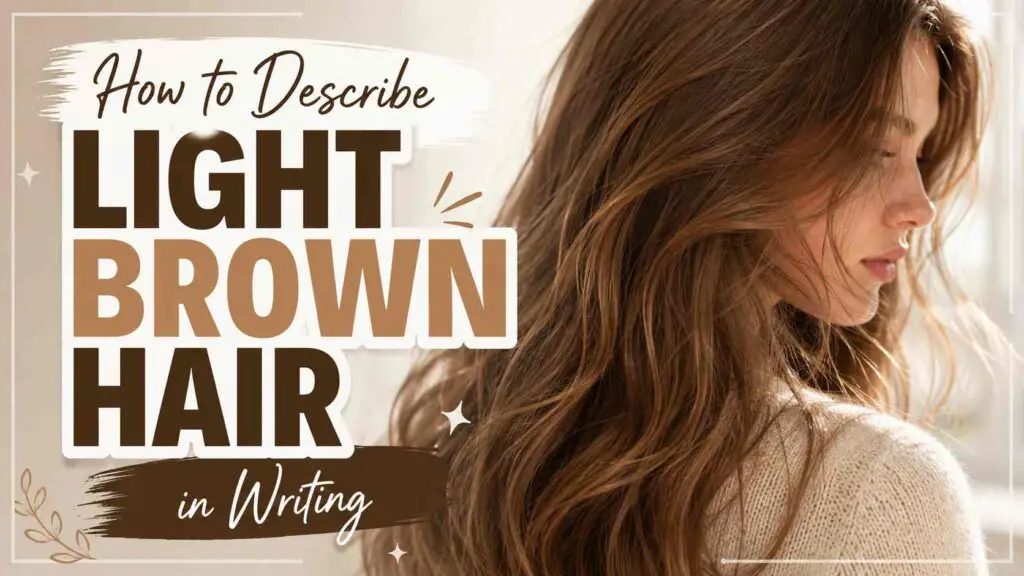
Light brown may be the most common hair color in fiction and the least described — treated as a default setting, mentioned once and forgotten, precisely because it doesn’t announce itself the way red or platinum does. But its very ordinariness is workable material: light brown hair is full of undertones, seasonal shifts, and quiet variation that reward a writer who actually looks. Below are the techniques for describing light brown hair with real specificity, each with examples you can study and adapt.
How to Describe Light Brown Hair in Writing
#1. Find the Undertone — Warm, Ash, or Golden
Light brown is never just brown — it leans warm toward caramel, cool toward ash, or golden toward blonde, and naming that undertone turns a default color into a specific one. The undertone is usually what makes one person’s light brown genuinely different from another’s, so it’s worth identifying first.
Her hair was a warm light brown, caramel at the surface, the kind of color that looked expensive and wasn’t.
His was cooler, an ashy brown with no red in it anywhere, matte even in full sun.
It hovered at the golden edge of brown, close enough to blonde that summer usually finished the argument.
#2. Use Concrete Comparisons From Daily Life
Grounding the shade in a familiar object — milky coffee, walnut shells, dry autumn leaves, toast — hands the reader an exact color rather than a category, and the choice of comparison can also set tone. A warm, domestic image and a dusty, weathered one produce very different characters from identical hair.
It was the color of coffee with too much milk in it, which happened to be exactly how she took her coffee.
His hair was the light, dusty brown of a walnut shell, and about as fussy.
The shade landed somewhere near toast — warm, plain, and quietly pleasant.
#3. Show the Sun Doing Its Seasonal Work
Light brown hair lightens readily — pulling gold streaks out of a summer spent outdoors, then darkening back to its true shade through winter — and that seasonal movement gives the color a timeline as well as a hue. It’s a quiet, built-in way to mark months passing without stating dates.
By September the top layer had gone golden, a free summer highlight job that would fade by Christmas.
Winter always returned his hair to its true, darker self, the sun-streaks retreating like the daylight.
Her ponytail had lightened two shades past the hair underneath, a stripe of summer she carried into fall.
#4. Use Light to Reveal Its Hidden Colors
Light brown hair holds other colors in reserve — gold, red, ash — that only show themselves under certain light, in certain rooms, at certain hours. Describing what the light finds in it turns an unassuming color into a small, ongoing surprise, and rewards placing the character in varied settings.
In afternoon sun there was suddenly red in it, a warmth that vanished completely the moment she stepped inside.
Under the café’s warm bulbs his hair went amber at the edges, a color it never showed in daylight.
The light found gold in it that she would have sworn, in any bathroom mirror, wasn’t there.
#5. Use Its Ordinariness Deliberately
Light brown’s unremarkable reputation can itself be a tool — for characters who blend in, go unnoticed, or actively prefer not to be described. The color’s forgettability becomes genuine characterization when it’s chosen on purpose, whether by a spy, a wallflower, or someone simply done performing for other people.
Her hair was the kind of light brown witnesses fail to remember, which, in her line of work, was an asset.
Nothing about his hair invited comment, and he’d arranged the rest of his appearance to match.
She’d dyed it back to its original light brown after years of louder colors, and found she liked disappearing a little.
#6. Pair the Color With Texture and Style
Because the color itself is quiet, texture and styling carry extra descriptive weight — fine and flyaway, thick and heavy, always worn in the same practical braid. These daily, habitual details keep the hair attached to a living character with routines and preferences rather than a flat color chart.
Her light brown hair was heavy and straight, sliding out of every clip that tried to hold it.
His was fine and soft, going shapeless by afternoon no matter what the morning had promised.
She wore it in the same low braid every day, the tail lightening to gold where it hung past her collar.
#7. Tie It to Family and Change Over Time
Light brown is often a destination — the color blonde childhood hair darkens into, the shared middle shade of an entire family — and referencing that history adds depth to an otherwise quiet color. It lets a single description carry genetics, the passage of years, and family resemblance all at once.
She’d been blonde until about ten, when the light brown moved in and stayed, the same schedule her mother’s had kept.
All four siblings had ended up with the same light brown, four variations on one inherited theme.
His son’s hair was exactly the color his own had been before it darkened — a preview in reverse.
#8. Avoid “Mousy” as a Lazy Default — Get Specific
“Mousy brown” is the reflexive phrase for this color, and it smuggles in a judgment — drab, timid, forgettable — that may not fit the character at all. Choosing precise, neutral, or warm language instead keeps the description honest, keeps the character un-flattened, and retires a cliché that was never accurate.
It wasn’t mousy — it was a soft, even fawn brown, and calling it drab said more about the speaker than the hair.
She’d heard “mousy” her whole life for a color that, in the right light, held more gold than most blondes.
There was nothing timid about it — just a plain, warm brown that suited her and asked for no one’s approval.
Closing Thoughts
Light brown hair rewards the writer who refuses to treat it as a default — naming the undertone, tracking its seasonal shifts, and catching the gold and red the light finds in it. Use its quietness deliberately where it fits the character, retire “mousy” from the vocabulary, and the most common hair color in fiction becomes specific, warm, and genuinely observed.