
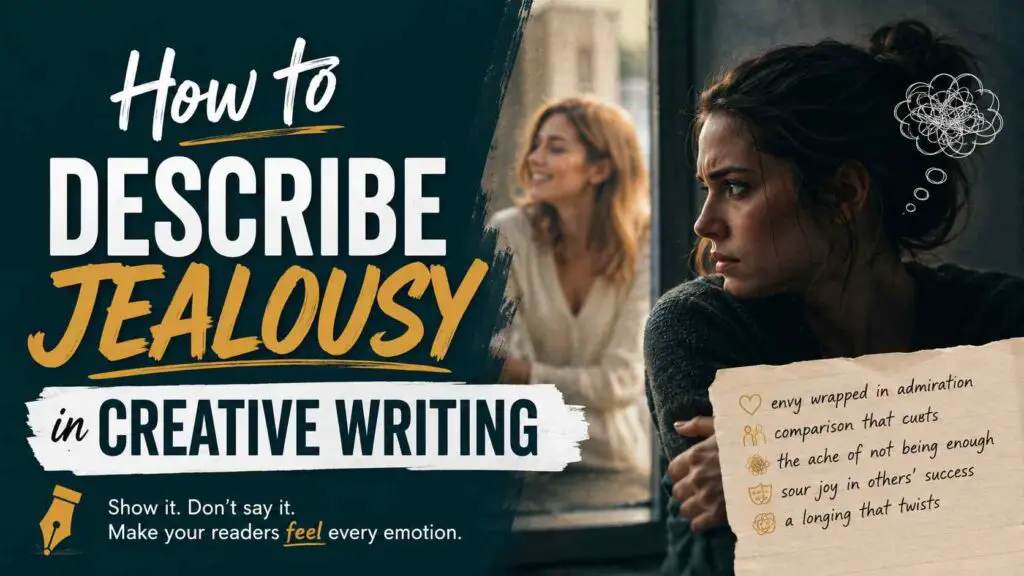
Jealousy is the emotion characters lie about most — to others, and to themselves. Nobody announces it; it comes out disguised as concern, as criticism, as a sudden fascination with a rival’s flaws, as a compliment through gritted teeth. That makes it a gift for fiction and a trap for prose: written honestly, it’s one of the most recognizable feelings on the page, but written lazily it collapses into green eyes and burning envy. The craft is in the disguises — showing the reader a feeling the character is working full-time not to show anyone, including themselves.
These techniques get that double game onto the page.
How to Describe Jealousy in Creative Writing
#1. The Involuntary Audit
Jealousy is an accountant: it counts the rival’s advantages compulsively — the ring, the promotion, the ease — in lists the character can’t stop compiling. Writing this itemized noticing puts the reader inside the obsession, and the pettiness of the details is exactly what makes it true.
She catalogued Marta’s kitchen against her will: the double oven, the herbs in labeled pots, the fruit bowl that looked curated — each item entered into a ledger she hated keeping and could not close.
He heard himself asking casual questions about the new hire’s salary, title, office — casual the way a metal detector is casual.
Within a minute of the engagement announcement she knew the carat count, the neighborhood, the honeymoon itinerary — her attention had gone through her sister’s news like customs through a suitcase.
#2. Write It in the Body, Low and Hot
Jealousy has a physical signature — a heat in the chest, a dropped stomach, a tightness in the jaw when the rival’s name lands, hands that need something to do. Bodily symptoms let you report the feeling before the character admits it, which is precisely how jealousy actually operates.
The name went through him like a swallowed coin — a small, hard wrongness settling somewhere under the sternum — and he kept smiling and passed the potatoes.
She was fine, completely fine, except that she had been scrubbing the same clean pan for four minutes.
Every time the two of them laughed at the far end of the table, something in his chest turned over its engine — a low, hot idling he could feel in his teeth.
#3. Dress It as Concern
Jealousy’s favorite costume is worry: “I just don’t want you to get hurt,” “I’m only saying it because I care.” Let your character voice objections that sound protective and read possessive, and give the listener — or the reader — the first flicker of seeing through it.
“I just think it’s fast,” her mother said, folding towels with forensic care. “He’s wonderful. Obviously. I only wonder what he wants.” The towels were suffering.
He worried aloud about her new friends — their spending, their hours, their influence — a whole weather system of concern that never once rained on anything but her happiness.
“Someone has to ask the hard questions about this promotion,” Dale told the break room, selflessly, for the third day running.
#4. The Compliment With a Splinter
Jealous characters rarely attack; they praise with one sharp edge left in — “She’s so lucky,” “It must be nice,” “You always land on your feet.” These splintered compliments are instantly recognizable social behavior, and they characterize the speaker far more than the target.
“No, it’s great,” said Priya. “Some people just have that ease, you know? Things open for them. It’s honestly fascinating.”
“Must be nice,” he said, twice in one dinner — once about the car, once about the trip — each time lightly, each time setting the phrase down like a coaster with a crack in it.
“You look amazing,” Corinne told the bride, and then, unable to stop the rider clause: “I could never pull off something that simple.”
#5. Jealousy of Time and Attention
The sharpest jealousy isn’t romantic — it’s a child watching the new baby, a friend replaced by a fiancé, a dog and a crib. Widening the emotion beyond love triangles gives you fresher scenes and lets you write it in characters who can’t articulate it, where it shows as pure behavior.
The week the baby came home, Milo — six, previously an only child — began needing help with everything he had mastered years ago: shoes, spoons, stairs, existence.
She was happy for Dee, truly, but the wedding planning had eaten their Tuesdays, and she caught herself grieving a standing pizza order like a death in the family.
The old dog took to sleeping directly in the nursery doorway, facing out — not guarding the baby, they slowly realized, but blockading it.
#6. The Feed Is a Delivery System
Modern jealousy arrives by phone — the scroll through a rival’s vacation, the ex’s new person studied at 1 a.m., the party everyone else was at. Writing the ritual of digital surveillance is instantly contemporary and gives the emotion a private stage where the character performs it alone.
She knew the girlfriend’s coffee order, her half-marathon time, her mother’s name — knew everything except how to stop the nightly excavation that produced these artifacts.
He watched the reunion unfold in stories — the lake house, the toasts, the group photo with a gap in it where he would have stood — refreshing it like picking a scab in high definition.
Her thumb hovered over the like button on the promotion post for a long moment, weighing the cost of the tap, and then paid it, bitterly, like a toll.
#7. Let It Distort What They See
Jealousy is a lens: innocent details become evidence — a laugh lasts too long, a text lands at a suspicious hour, kindness looks like courtship. Narrating the world through this warp, while letting the reader glimpse the undistorted version, creates the dramatic irony this emotion was born for.
Twice the phone had buzzed during dinner, and twice she’d turned it face-down — which was nothing, which was manners, which he filed anyway in the growing dossier his evenings had become.
Anyone else would have seen a colleague fixing a colleague’s collar before a presentation. Renn saw choreography — practiced, tender, five seconds too comfortable.
The more reasonable the explanation, the worse it sat with her; innocence this airtight, said the lens she now looked through, must have been prepared.
#8. Retire the Green-Eyed Monster
“Consumed by the green-eyed monster,” “a stab of jealousy,” “burning with envy” — the stock kit names the feeling and delivers none of it. The upgrade is behavioral specificity: cut the label and show one small, concrete act of sabotage, comparison, or compulsion that only a jealous person would commit.
She forwarded the invitation to Lena a day late — “so sorry, it got buried” — a lie the size of a postage stamp, and the heaviest thing she carried all week.
He read his best friend’s novel in one sitting, hating every page that worked, and his congratulations text took him forty minutes and three drafts to make short enough.
When guests praised the garden, she always said “it’s mostly luck and rain” — never mentioning that her neighbor had taught her everything, because the debt was the part that stung.
#9. The Moment It’s Seen
Jealousy’s climax is exposure — the character catching themselves in the act, or being caught: “You’re jealous,” said out loud, landing like a slap because it’s true. Whether they deny, deflect, or finally admit it, the unmasking scene is where the emotion pays off everything your disguise-work built.
“You’re jealous,” Amir said — not cruelly, almost with wonder — and the word hung there, accurate, while she assembled and abandoned four denials.
He heard his own last three remarks played back in his head, in his father’s voice, and recognized the bitterness like a family resemblance surfacing in a mirror.
“I’m not jealous of her,” Cass said, and the silence that followed was long enough for both of them to hear the sentence fail its inspection.
Closing Thoughts
The reframe worth keeping: jealousy isn’t really about the rival — it’s a wound in the jealous person’s own story, the gap between the life they expected and the one they’re standing in, with someone else’s happiness serving as the measuring stick. Write toward that wound and the emotion stops being ugly decoration and becomes character. The audit, the splintered compliment, the 1 a.m. scroll — all of it is a person asking, in code, why not me? Answer that question somewhere in your story, even quietly, and the jealousy will read as human instead of monstrous — which is what it is.