
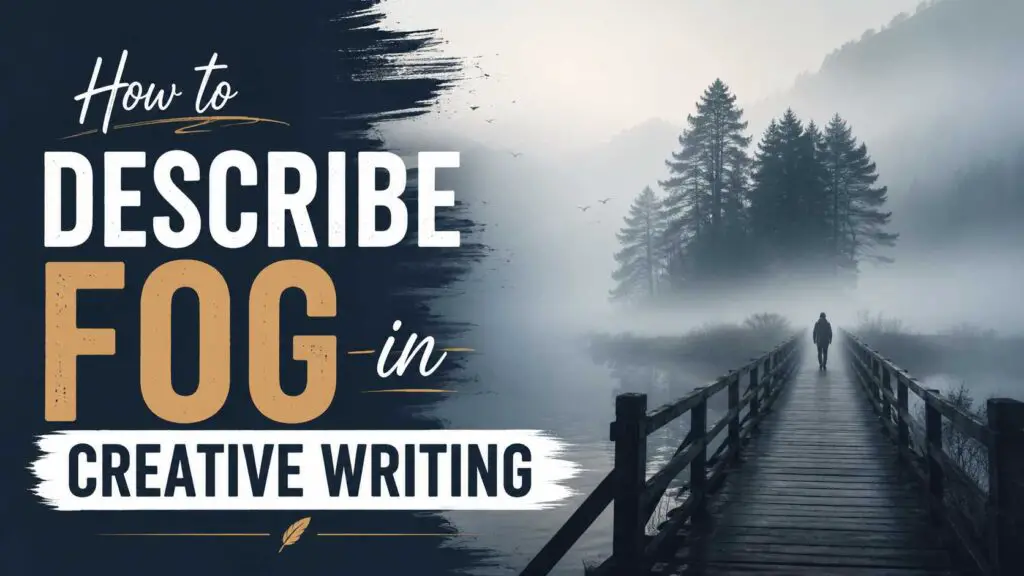
Fog is weather you can stand inside, and that makes it unlike anything else a writer gets to describe. It has texture, motion, and moods; it rewrites distance and sound; it beads on wool and tastes faintly of the river it rose from. Yet most fog on the page is a single gray adjective doing atmospheric duty, when the real thing is one of the most physically rich subjects available.
Here’s how to describe fog as the substance it actually is.
How to Describe Fog in Creative Writing
#1. Give It Motion and Manners
Fog behaves — it pours downhill, loiters in hollows, tests door gaps, backs off and returns. Describing its movement with precise verbs turns a static gray backdrop into something with intentions the reader can watch, and each verb sets a different mood: fog that “sidles” is a different scene from fog that “floods.”
The fog came down the valley road like something poured — slow, level-seeking, filling the churchyard first because the churchyard was lowest.
It didn’t advance so much as loiter forward, drifting between the parked cars with its hands in its pockets.
All morning the fog tried the house — thinning at the windows, thickening again, pressing a gray cheek to the glass — patient as a salesman who knows you’re home.
#2. It Edits the World’s Radius
Fog’s defining act is deletion: the world shrinks to a circle a few meters wide, and everything beyond it goes provisional. Describe what remains inside the circle and what has been repossessed — the mountain gone, the neighbor’s house reduced to a porch light — and the reader feels the claustrophobia directly.
The world came down to fifteen feet of lane, a gate, and the suggestion of a hedge. Everything else — the hill, the pylons, Wales — had been taken into storage.
She walked inside a moving room of visibility, its walls always ten steps off, taking the road apart ahead of her and reassembling it behind.
Of the bridge there remained two cables rising into blankness — the rest was rumor, and the cars drove into it on faith.
#3. Sound Loses Its Address
Fog does strange things to hearing: it softens edges, makes footsteps intimate and directionless, carries a foghorn or a voice from nowhere in particular. Writing this acoustic drift — near sounds muffled, far sounds orphaned — unsettles readers more reliably than anything visual, because they can’t triangulate either.
Somewhere in the white a dog barked twice — impossible to say whether across the street or across the harbor — and the sound hung there, unclaimed.
Footsteps kept pace with her, soft and close, and when she stopped they continued a moment before stopping too — an echo, she told herself, and walked faster to test the theory.
The foghorn spoke its one syllable every thirty seconds, mournful and municipal, and between calls the bay was so quiet you could hear the fog itself — a faint hiss of drip and settle.
#4. Light Behaves Differently Inside It
Fog is a lampshade over the world: headlights become cones you can see, streetlamps wear halos, the sun turns into a pale coin you can look at. Describing what fog does to each light source gives you specific, luminous images in a subject that lazy prose renders uniformly gray.
The headlights didn’t cut the fog, they furnished it — two solid cones of glow standing in front of the car like furniture that traveled with them.
Each streetlamp down the promenade wore its own soft globe of orange, a procession of dandelion clocks in the dark.
By ten the sun had risen somewhere overhead — a pale disc like a coin at the bottom of a milky pond, spendable nowhere.
#5. It Touches and It Tastes
Fog is the one weather that handles you gently — beading on wool and eyelashes, laying cold film on cheeks, arriving in the mouth with a taste of salt, smoke, or river. These close-range sensations put the reader’s body inside the scene, which distance-based description can never do.
By the end of the lane her coat was silvered all over, every wool fiber holding its bead, as if she’d walked through a jeweler’s patience.
The fog tasted of the estuary it had risen from — mud, salt, a memory of diesel — and it breathed cool on her lips like the mouth of a cave.
It laid a cold film on his cheeks and knuckles, fine as breath on glass, and his eyelashes came back from every blink a little heavier.
#6. Master the Emergence
Fog’s great narrative gift is the reveal: things assemble out of it by stages — a darkening, a shape, a walking man. Control the order of assembly (mass, then motion, then identity) and you control suspense; anything can approach your character, and neither they nor the reader knows what it is until the last stage.
Something took shape ahead — first a stain in the white, then a figure, then a man with a dog, then, at the last, Mr. Bellamy, raising a hand — the fog releasing him to her in installments.
The trawler arrived nose-first out of nothing, enormous and suddenly finished, as if the fog had been building it right up to the moment of delivery.
Trees came at them one at a time out of the white, each stepping forward, showing itself, and falling back — a receiving line of oaks the whole length of the drive.
#7. Name Your Fog
Sea fret, valley fog, freezing fog, ground mist over a night meadow, the yellow-gray industrial smother of an old city — each is a different substance with its own habits and history. Choosing a specific fog anchors the scene in geography and season, and specificity is what convinces the reader you’ve stood in it.
It was proper sea fret, cold and mobile, in off the North Sea before noon and gone by three, taking the beach’s whole holiday with it.
The freezing fog worked all night, and by morning every twig, wire, and railing wore a white fur of rime — the world drawn again in chalk.
Ground mist lay over the mowed field waist-high and level, so the cattle stood in it like ships’ hulls, keels down in a white harbor.
#8. Unroll the Blanket
“A thick blanket of fog rolled in” is the phrase every fog scene reaches for first, and it has been worn to lint. The escape route is precision: what kind of thickness, arriving how, doing what to which object first. Swap the blanket for one observed behavior and the sentence starts earning its place.
The fog didn’t roll in; it condensed, everywhere at once, the way a crowd becomes a mob — no arrival anyone could point to, only a before and an after.
First the fog took the fine print of the world — hedge leaves, roof tiles, the neighbor’s cat — then the paragraphs, then the chapters, until only headlines remained: HOUSE. TREE. ROAD.
It came up the river with the turning tide, keeping pace with the water, and docked itself over the town by six.
#9. The Lift Is the Payoff
Fog ends beautifully — burning off in patches, raising its ceiling, returning the world item by item, often with a strange post-fog clarity. Writing the lift gives your scene a natural arc and a closing image, and whatever the fog concealed is now, suddenly and sometimes terribly, back on display.
By eleven the sun had won on points: the fog thinned to gauze, then to an idea, and the bay reappeared so sharp and blue it looked freshly invented.
The fog raised itself like a curtain in no hurry, hills first, then hedges, then the lane — and at the end of the lane, where it had not been the night before, the red car.
It left the orchard in patches, pooling last under the apple trees, and the morning that followed had a rinsed, over-honest light, every leaf accounted for.
Closing Thoughts
The next fog that visits your town, go out in it — not to look at it, since looking is exactly what it refuses, but to be handled by it. Walk one familiar block and log what actually happens: which sound reaches you homeless, what beads on your sleeve, how the streetlamp wears its halo, what the world’s radius shrinks to. Ten minutes will hand you more usable material than every foggy paragraph you’ve ever read, because fog is the rare weather you experience from the inside — and inside is where your reader wants to stand.