
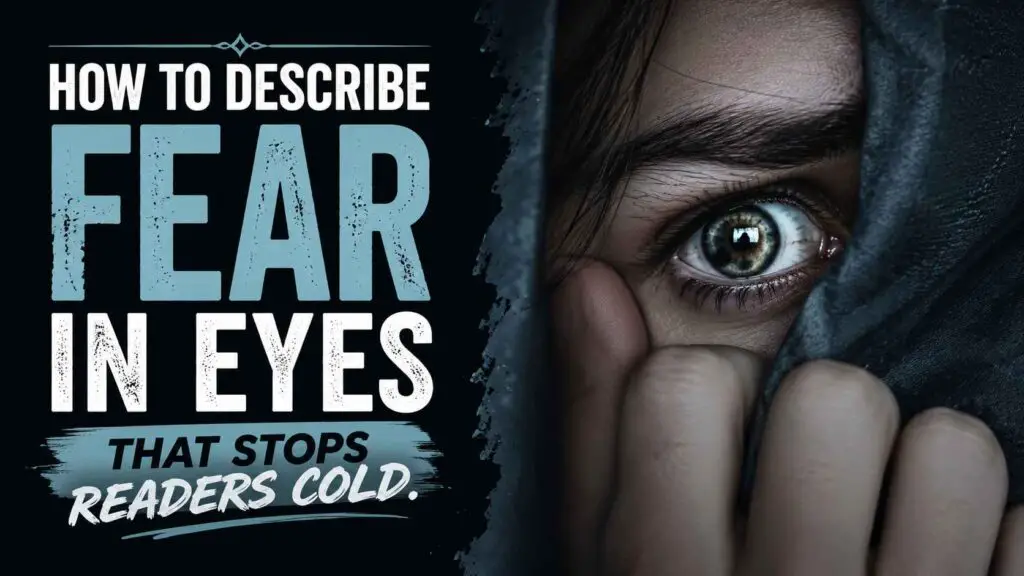
Fear is one of the most powerful emotions a writer can place on the page. It instantly raises the stakes, creates suspense, and keeps readers turning pages to find out what happens next. While body language, dialogue, and internal thoughts all help communicate fear, the eyes often reveal what a character cannot hide. They expose panic before words are spoken, betray courage that is beginning to crumble, and silently announce danger long before anyone reacts.
This is why descriptions of fearful eyes are so effective in fiction. A single glance can tell readers that a character has lost hope, discovered a terrible truth, or realized they are facing something beyond their control. Instead of relying on generic phrases like “his eyes were filled with fear” or “she looked scared,” skilled writers describe the physical changes in the eyes and connect them to the character’s emotional state. These small details make scenes more vivid and believable while allowing readers to experience the emotion for themselves.
The key is to move beyond simply naming the emotion. Think about how fear changes the way a character looks at the world. Their gaze may freeze on a threat, dart around searching for safety, become glassy with tears, or go strangely empty from shock. Every variation tells readers something slightly different about the character and the situation.
How to Describe Fear in Eyes
Fear changes the eyes in countless ways depending on its intensity. A startled character may have wide eyes for only a second before recovering. Someone experiencing overwhelming terror may be unable to blink, unable to look away, or unable to focus on anything at all. Fear can also make the eyes appear larger, darker, wetter, or unusually still. Understanding these subtle differences allows writers to create descriptions that feel fresh instead of repetitive.
The best descriptions also match the context of the scene. The eyes of someone hiding from a murderer will not look the same as someone receiving devastating news or watching a loved one in danger. Choosing details that fit the moment makes the emotion feel authentic and helps readers become immersed in the story.
Here are powerful ways to describe fear in eyes without relying on flat or predictable wording.
#1. Show Widened Eyes
Wide eyes are one of the most recognizable physical signs of fear because the body instinctively becomes more alert when danger appears. A character whose eyes suddenly widen is reacting to something unexpected, frightening, or overwhelming. Instead of simply stating that their eyes widened, focus on how much of the whites become visible, how their expression changes, or what the widening suggests about their thoughts. This gives readers a stronger mental image and allows the fear to feel immediate rather than summarized.
Wide eyes can also communicate different levels of fear. Mild surprise may cause only a slight widening, while intense terror can make the eyes seem unnaturally large. Matching the degree of widening to the seriousness of the situation helps make the scene more believable.
Example:
Her eyes stretched wide, the whites showing all around the dark centers, as if her mind had reached the truth before the rest of her body could move.
#2. Use Frozen Eye Contact
Fear does not always cause frantic movement. Sometimes it has the opposite effect, leaving a character unable to look away from whatever threatens them. This frozen gaze creates an eerie sense of helplessness because readers understand that the character is completely focused on the source of danger.
A fixed stare is especially effective during moments of suspense. It slows the pacing and forces readers to linger on the terrifying object or person alongside the character. Rather than describing the threat repeatedly, showing that the character cannot break eye contact often communicates just how frightening it truly is.
Example:
He stared at the door without blinking, his eyes nailed to the handle as it began to turn.
#3. Describe Darting Eyes
Fear often activates survival instincts, causing a person’s eyes to move rapidly from one place to another. A character may search for exits, weapons, allies, or any sign of escape. These quick movements create a feeling of panic and uncertainty that immediately increases tension.
Describing darting eyes also gives readers insight into the character’s thought process without lengthy exposition. Every glance reveals what the character considers important at that moment. Their eyes become a map of their desperate search for safety.
Example:
Her eyes flicked from the window to the hallway, then to the knife on the counter, measuring every possible escape and finding none.
#4. Focus on the Pupils
The pupils naturally react to fear through the body’s fight-or-flight response. They often dilate, making the eyes appear darker and more intense. This subtle physical change can make a character seem almost transformed by terror.
Because readers may not consciously think about pupils, mentioning them sparingly creates fresh, memorable descriptions. Rather than overexplaining the biology, simply showing how the pupils dominate the eyes or seem to swallow their color can make the fear feel strikingly real.
Example:
His pupils swallowed the color of his eyes, leaving behind two black circles that reflected the thing standing in front of him.
#5. Show Fear Through Blinking
Blinking is an overlooked detail that can communicate emotional pressure remarkably well. Some frightened characters blink rapidly because they are overwhelmed or trying to process what they are seeing. Others barely blink at all because they are completely locked onto the threat.
Small details like blinking make descriptions feel natural because they reflect unconscious behavior. They also prevent repetitive descriptions by giving writers another way to show fear without constantly mentioning widened eyes or trembling bodies.
Example:
She blinked too fast, as if each flutter of her lashes could erase what she had just seen.
#6. Use Glassy or Wet Eyes
Fear does not always produce immediate tears, but it often leaves the eyes looking moist or glassy. This detail suggests that emotions are building beneath the surface even if the character is desperately trying to remain composed.
Glassy eyes are especially useful when writing emotional scenes because they show vulnerability without requiring the character to cry outright. Readers can sense that the character is nearing their emotional limit, making the scene more powerful.
Example:
His eyes shone with unshed tears, but it was not grief in them. It was the raw, trembling knowledge that no one was coming.
#7. Make the Eyes Go Blank
Extreme fear sometimes overwhelms the mind so completely that emotion seems to disappear from the face. Instead of looking frightened, a character may appear strangely empty or disconnected. This blank expression often signals shock, emotional numbness, or psychological withdrawal.
Descriptions like these are particularly effective after traumatic events because they suggest that the character has moved beyond ordinary fear into something much deeper. The absence of visible emotion can often feel even more unsettling than obvious panic.
Example:
Her eyes went flat and distant, as though some part of her had stepped out of the room before the screaming started.
#8. Contrast the Eyes With the Face
People often try to hide fear by smiling, speaking confidently, or pretending everything is fine. The eyes, however, are much harder to control. This contrast between facial expression and eye expression creates dramatic tension because readers notice the truth beneath the performance.
Showing this contradiction also adds realism to your characters. In real life, people frequently conceal their emotions, yet subtle details in their eyes reveal what they are actually experiencing.
Example:
He smiled, but his eyes stayed sharp and frightened, watching every movement like a trapped animal pretending not to be trapped.
#9. Use Reflections in the Eyes
The eyes naturally reflect light and nearby objects, making reflections a powerful storytelling device. Instead of directly describing the danger, you can show it through what appears in the character’s eyes. This creates a more cinematic image while reinforcing the source of the fear.
Reflections also encourage readers to imagine the scene themselves. Whether it is fire, a weapon, approaching headlights, or a looming shadow, the reflected image often becomes more memorable than a straightforward description.
Example:
In her eyes, the flames danced higher, bright and merciless, turning her terror into something almost beautiful.
#10. Connect the Eyes to the Body
The eyes become even more expressive when combined with the body’s physical reactions. Trembling hands, rigid shoulders, a racing heartbeat, or shallow breathing all reinforce what the eyes are communicating. Together, these details create a complete picture of fear.
Using multiple physical cues also prevents your descriptions from feeling repetitive. Instead of placing all the emotional weight on the eyes, you allow them to work alongside the rest of the body to create a vivid emotional experience.
Example:
His eyes begged before his mouth could form the words, and his hands shook at his sides like they already knew the answer.
#11. Use Animal Imagery Carefully
Comparing fearful eyes to those of frightened animals can create memorable imagery because readers instinctively associate animals with survival instincts. A hunted deer, trapped rabbit, or cornered fox all evoke different shades of fear.
These comparisons are most effective when used sparingly. Overusing animal metaphors can become repetitive or melodramatic, but a carefully chosen comparison can instantly communicate vulnerability and desperation.
Example:
Her eyes had the bright, frantic look of a deer hearing branches snap in the dark.
#12. Let the Eyes Reveal What the Character Knows
Sometimes the most frightening moment is not the danger itself but the instant a character realizes what is happening. The eyes can communicate that realization before any words are spoken. Readers immediately understand that something has changed, even if they do not yet know what it is.
This technique is especially useful for building suspense. By showing fear appear in a character’s eyes before revealing the cause, you encourage readers to keep turning pages to discover what has terrified them.
Example:
The moment he read the note, his eyes changed. The anger vanished, and in its place came a quiet, terrible fear.
Closing Thoughts
Describing fear in eyes is about precision. Instead of naming the emotion, show what fear does to the gaze. Make the eyes widen, freeze, search, shine, empty, or betray what the character is trying to hide.
The best descriptions do not just tell readers that someone is scared. They make readers pause, picture the look, and feel the danger closing in.