
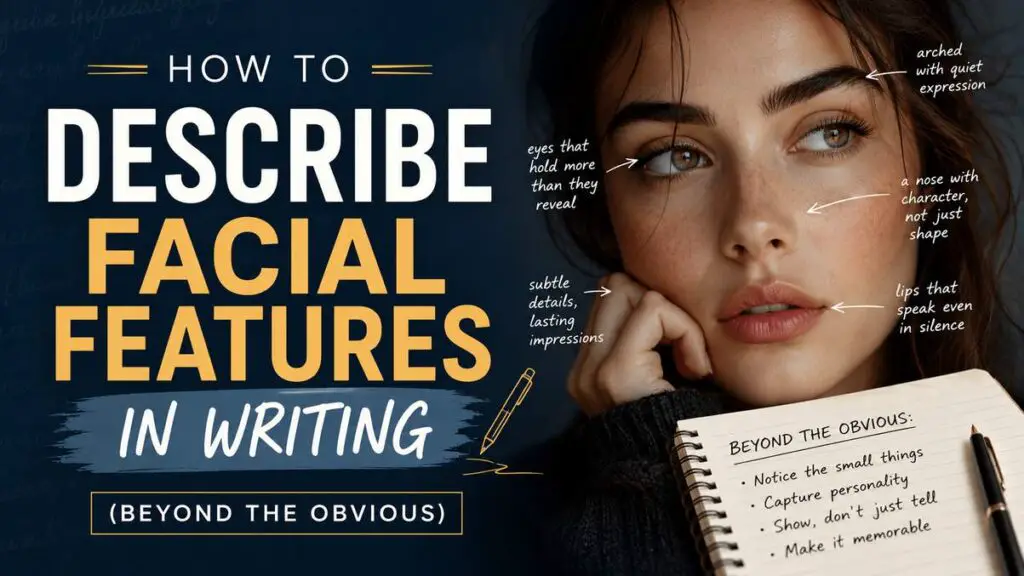
Facial features can do more than tell readers what a character looks like. They can reveal mood, background, personality, tension, attraction, fear, confidence, or hidden emotion. The best descriptions do not simply say someone has brown eyes, a sharp nose, or full lips. They help the reader understand how the face feels in the moment and what it communicates without words.
A face changes with light, emotion, movement, age, and perspective. A character’s features may look warm to one person and intimidating to another. Even the smallest details—a raised eyebrow, a tightened jaw, or a fleeting smile—can carry emotional weight and influence how readers perceive a scene. When facial descriptions are woven naturally into the narrative, they become a powerful storytelling tool rather than a pause in the action.
To describe facial features well, focus on what the face suggests, how it moves, and how others respond to it. The following techniques will help make facial descriptions more vivid, meaningful, and memorable.
How to Describe Facial Features in Writing Beyond the Obvious
Describing a face is not about listing every feature. It is about choosing the details that matter. A few strong observations can create a clearer image than a full catalog of eyes, nose, mouth, jaw, cheeks, and hairline. Readers rarely remember every physical detail, but they often remember the impression a face leaves behind.
The goal is to make facial descriptions serve the story. Whether you are introducing a new character, building tension, or revealing emotion, the right details can deepen characterization and bring scenes to life.
Here are practical ways to describe facial features in a richer and more memorable way.
#1. Describe the Effect of the Face
Instead of only describing what a face looks like, describe the effect it has on others. Does it calm people? Make them nervous? Invite trust? Demand attention? Readers often connect more strongly with the emotional impact of a face than with a list of physical traits.
This approach also allows different characters to perceive the same face in different ways. Rather than focusing solely on appearance, you show how the face shapes interactions and influences the atmosphere of a scene.
His face had the kind of stillness that made people lower their voices without knowing why.
She had a face that seemed to welcome secrets before anyone had spoken them.
#2. Use Movement Instead of Static Detail
Faces are rarely still. Eyebrows lift, lips tighten, eyes narrow, cheeks flush, and jaws clench. These subtle movements often communicate more than a detailed physical description ever could.
By focusing on motion, your descriptions become part of the action instead of interrupting it. Readers experience the character’s emotions as they unfold, making scenes feel more immediate and natural.
Her mouth almost smiled, then thought better of it.
A muscle jumped in his jaw, the only sign that her words had landed.
#3. Connect Features to Emotion
A facial feature becomes far more interesting when it reflects what the character feels. Eyes can harden with determination, lips can tremble with fear, and a smile can fade before it fully forms. Emotion transforms ordinary physical details into meaningful storytelling.
Rather than stating that a character is sad, angry, or relieved, let their facial features reveal those feelings. Readers are more likely to engage when they are allowed to interpret emotional cues for themselves.
His eyes lost their warmth first; the rest of his face followed a second later.
Her cheeks lifted with the smile, but her eyes stayed tired.
#4. Avoid Generic Beauty Descriptions
Words like beautiful, handsome, pretty, and attractive can communicate basic appearance, but they rarely leave a lasting impression. They tell readers how to judge the character without showing them why.
Instead, identify the features or qualities that make the character memorable. A distinctive smile, expressive eyes, or an unusual combination of features often creates a stronger image than broad compliments ever could.
She was not beautiful in a polished way. Her face became beautiful when she forgot to guard it.
His features were too sharp to be gentle, but when he smiled, the severity broke apart.
#5. Let Perspective Shape the Description
A face should not be described the same way by every observer. A child, lover, enemy, stranger, or jealous rival will each notice different details and attach different meanings to them.
Using perspective adds depth to both the observer and the person being described. It reminds readers that appearance is often filtered through emotion, experience, and personal bias rather than objective reality.
To strangers, his face looked stern. To his daughter, it looked like safety.
She noticed his smile first, then hated herself for noticing it at all.
#6. Use Metaphor Carefully
Metaphors can make facial descriptions vivid and memorable, but they work best when they feel natural and fit the tone of the story. A well-chosen comparison can capture mood, texture, or personality in just a few words.
Avoid overloading descriptions with elaborate imagery. One strong metaphor is usually far more effective than several competing comparisons that distract readers from the character.
His face was all angles, like it had been carved in a hurry and never softened afterward.
Her eyes held light the way dark water holds the moon.
#7. Focus on One Memorable Detail
Readers do not need every facial feature described at once. In fact, trying to include too much detail can overwhelm them and weaken the overall impression. Often, one striking feature is enough to make a character unforgettable.
Choose the detail that best reflects the character’s personality, history, or role in the story. That single observation can become a signature trait readers recognize throughout the narrative.
A thin scar crossed his upper lip, turning every smile into a warning.
Her left eyebrow arched higher than the right, giving her a permanent look of polite disbelief.
#8. Describe Change Over Time
A face can tell the story of a person’s life. Age, grief, laughter, illness, stress, and years of experience all leave visible marks that reveal more than simple physical appearance.
Showing how a face has changed adds depth to characterization. It suggests a history beyond the current scene and allows readers to imagine the events that shaped the person they are meeting.
The lines around his eyes did not make him look old. They made him look as if he had spent a lifetime laughing at pain.
Her face still carried traces of the girl she had been, though life had sharpened every soft edge.
#9. Use Contrast
Contrast makes facial descriptions more interesting because people are rarely defined by a single quality. A gentle smile may accompany cold eyes, while a severe expression may hide genuine kindness.
These unexpected combinations create complexity and make characters feel more realistic. Contrasting features also encourage readers to look beyond first impressions, which can become an important part of the story.
He had the smooth face of someone too young for the bitterness in his eyes.
Her mouth was stern, but her eyes kept betraying her kindness.
#10. Reveal Character Through Expression Habits
People often have repeated facial habits that appear without conscious thought. A character may smirk when nervous, blink slowly when angry, bite their lip before lying, or avoid eye contact when feeling vulnerable.
These recurring expressions become recognizable character traits over time. They also provide subtle ways to reinforce personality and emotion without repeatedly explaining how the character feels.
Whenever he lied, he smiled with only one side of his mouth.
She looked away before every honest answer, as if truth embarrassed her.
Closing Thoughts
Describing facial features in writing is not about giving readers a police sketch. It is about helping them feel the character’s presence. The best facial descriptions combine appearance, emotion, movement, and perspective.
A strong description does not need to mention every detail. It only needs to choose the right ones. When a face reveals something about the person, the scene, or the relationship between characters, it becomes more than description. It becomes storytelling.