
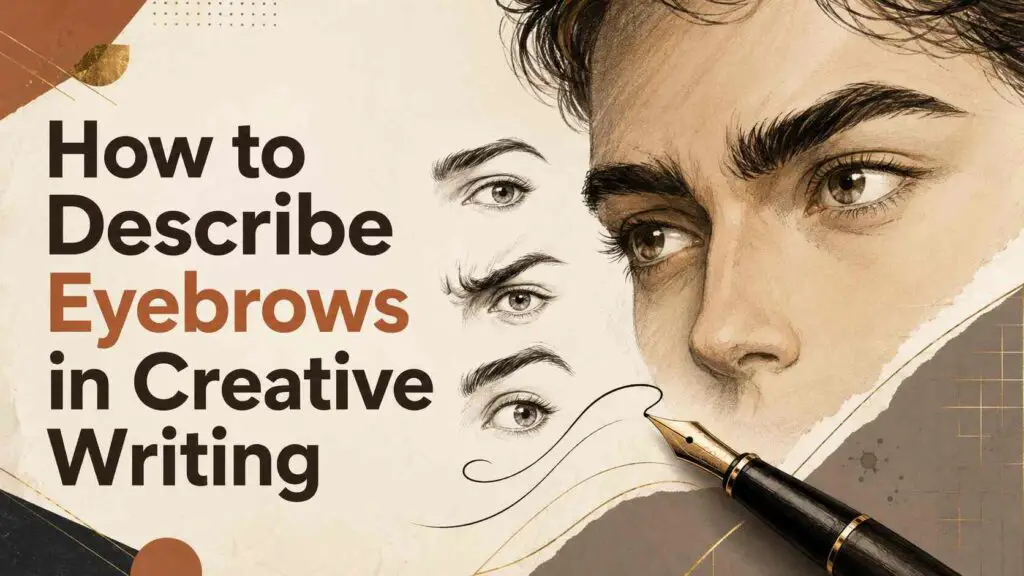
Eyebrows are the most underused feature in character description. Writers lavish paragraphs on eyes and hair while the brows — which frame every expression, carry age and grooming and heredity, and can steal a whole scene with one movement — get a single verb, usually “raised.” A well-described brow can introduce a character, run a silent conversation, or land a joke.
Here’s how to make eyebrows earn their place on the page.
How to Describe Eyebrows in Creative Writing
#1. Brows as a Portrait Feature
Shape, weight, and color make brows a fingerprint — heavy and straight, sparse and startled, one interrupted by a scar. Because most writers skip them, a single specific brow detail makes a character portrait feel closely observed rather than assembled from stock parts.
He had his grandfather’s eyebrows, two decisive black strokes that made even his apologies look like verdicts.
Her brows were so fair they vanished in sunlight, giving her face an unfinished, perpetually surprised openness that strangers mistook for innocence at their own expense.
A pale seam cut his left eyebrow in two — a hockey story he told three different ways, depending on the audience.
#2. The Silent Vocabulary
Brows conduct wordless dialogue — a lift that asks a question, a dip that vetoes, a double-raise that says did you see that. Writing these exchanges lets characters communicate over the heads of others, which is gold in dinner scenes, meetings, and marriages.
Across the table, Jo’s left eyebrow went up a quarter inch: your witness. He cleared his throat and took over the lie.
They had been married long enough to conduct entire arguments in eyebrow — hers rising, his flattening, hers rising further — while their daughter narrated her school day, oblivious.
The auctioneer watched the dealer’s brows rather than his paddle; the paddle was for the room, the brows were for the money.
#3. Grooming Tells a Story
Plucked, threaded, penciled, wild, or abandoned — how a character manages their brows is characterization you can see. Grooming implies time, money, vanity, grief, or rebellion, and a change in brow upkeep can mark a life change without a word of explanation.
Nonna’s eyebrows had been drawn on in the same optimistic arches since 1974, two brown rainbows that had outlasted three popes and one husband.
The month after the funeral, her brows grew back in from their careful shape, and she let them — there was a small, private freedom in going unedited.
For the interview he’d trimmed the two gray sprigs that stood up from his brows like antennae, and he missed them all day, obscurely, the way you miss a dog.
#4. Asymmetry Is Comedy and Menace
One brow moving alone is a different instrument from two moving together — it produces skepticism, flirtation, irony, or quiet threat. The solo eyebrow is a scalpel where the pair is a hammer, so reserve it for moments when a character is judging rather than feeling.
She heard the excuse all the way through with one eyebrow at half-mast, which was somehow worse than interruption.
His right brow rose in slow motion, a boom barrier declining to lift for her story.
The professor could end a bad answer without speaking; the left eyebrow simply went up and stayed up, patient as a raised hand in traffic.
#5. Brows in Motion During Speech
People punctuate their own sentences with their brows — lifting on emphasis, dipping on doubt, jumping on names. Threading small brow movements through dialogue makes talking heads visible and lets you signal what a speaker actually believes about their own words.
“It’s completely safe,” he said, and his eyebrows, rising on “completely,” filed their own report.
Her brows lifted with each item on the list — flight, hotel, sixty guests — small tide marks of an estimate revising itself upward.
Whenever he mentioned his brother, his brows did a brief, involuntary press — a wince’s smaller cousin — and moved on before anyone could ask.
#6. Weather, Work, and Years
Brows collect a life: bleached by field sun, singed by foundry sparks, gone wiry and independent with age, beaded with rain or flour or plaster dust. Using the brows as a surface where setting and occupation land keeps description doing two jobs at once.
Fifty summers of squinting down rows of cane had bleached his brows to straw and taught them to sit low, permanent awnings against a sun that was always there.
The baker came out front with snow on her eyebrows — flour, of course, but for a moment she stood in the doorway like winter itself, smelling of yeast.
Past eighty, his eyebrows had seceded from all governance, long white filaments curling toward the light like a plant’s idea of thought.
#7. The Raised Eyebrow, Retired
“She raised an eyebrow” is the single most overworked gesture in modern fiction — a placeholder that tells the reader “insert skepticism here.” When you catch it in a draft, either cut it or upgrade it: name the speed, the height, the duration, or what the brow is replying to, so the gesture becomes this character’s and not the genre’s.
Instead of answering, Mercer let his eyebrow drift upward by degrees, slow as a minute hand, so that watching it felt like being billed.
Her brows didn’t rise at the price. They stilled — utterly — the way a courtroom stills, and the salesman began, unprompted, to mention financing.
The lift of his brow was so small it could have been deniable, and that was the point: an insult with plausible deniability built in.
#8. When the Brows Are Gone
Absence is description too: brows lost to chemotherapy, alopecia, fire, or shaved by choice change how a face reads and how others read it. Writing a browless face honestly — its openness, its illegibility, its effect on strangers — is rare on the page and lands with real force.
Without her brows, her face had lost its punctuation; people read her sentences wrong all day, missing the irony, missing the warnings.
He drew them on before the school run — two brave, slightly uneven strokes — and his daughter, seven, inspected the work each morning like a small forewoman before allowing him out.
The burn had taken his left brow years ago, and strangers still searched that side of his face for the reaction that never posted.
Closing Thoughts
The reframe that changes everything: stop thinking of eyebrows as a feature to describe and start treating them as a channel your characters broadcast on. A feature gets one sentence in chapter two and is never mentioned again; a channel carries signal in every scene — questions, vetoes, jokes, alarms, entire marriages of subtext. The eyes may be the window to the soul, but the brows are the curtains, and everyone reads the curtains first. Write them as behavior, give each major character one distinctive brow habit, and your faces will start acting instead of posing.