
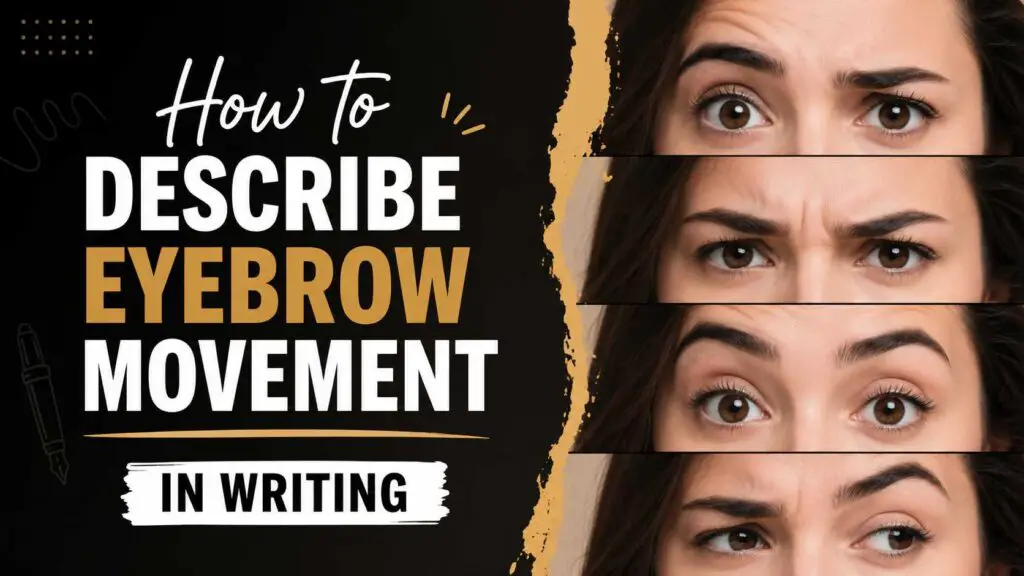
Eyebrows are the face’s punctuation marks — a millimeter of movement turns a statement into a question, a question into a threat, agreement into visible doubt. They’re also fiction’s most overworked body part: characters raise them so often the gesture has become invisible. The repertoire is actually enormous, and most of it never gets written. Below are the techniques for describing eyebrow movement with fresh precision, each with examples you can study and adapt.
How to Describe Eyebrow Movement in Writing
#1. Learn the Full Repertoire Beyond “Raised”
Eyebrows lift, knit, pinch, flick, waggle, climb, flatten, and draw together — each a distinct signal — yet most fiction uses only “raised,” collapsing a whole vocabulary into one word. Distinguishing the single arched brow from the double lift from the slow climb multiplies your expressive range immediately.
One eyebrow went up — just the one, the skeptical soloist — while the rest of her face remained perfectly polite.
His brows didn’t rise so much as climb, a slow ascent that tracked the story’s improbability line by line.
Her brows drew together and pinched a small vertical crease between them, the face’s way of underlining a worry.
#2. Use the Flash — the Fastest Hello in the Body
The eyebrow flash — both brows popping up for a fraction of a second — is a near-universal greeting and recognition signal, performed and read unconsciously across cultures. Writing this tiny real gesture, which almost no fiction bothers to notice, instantly makes social scenes more closely observed.
Across the crowded platform he gave her the flash — brows up, down, done in half a second — and thirty years of friendship were confirmed without a word.
The bartender’s eyebrows flicked up when the regular walked in, which at that establishment constituted a warm embrace.
She flashed her brows at the baby and the baby, delighted, flashed back — the oldest conversation in the species.
#3. Write the Brows as a Dialogue Channel
Eyebrows conduct entire silent conversations — the questioning lift across a dinner table, the warning flatten, the “go along with this” waggle — and two characters who know each other can negotiate over other people’s heads. Writing the exchange as dialogue, with responses, treats the channel as the language it is.
Her eyebrows asked the question across the table; his answered it; and their daughter, watching, learned the sale had gone badly without a word being spent.
He lifted a brow toward the door — leaving? — and she pressed hers together — not yet — and the party continued around the negotiation.
The twins had a whole grammar up there, and their mother had spent years learning to eavesdrop on it.
#4. Anchor Emotions to Their True Brow Shapes
Each emotion has a signature configuration — surprise lifts both brows high, anger drives them down and in, worry angles the inner ends upward, grief makes them oblique — and matching the shape to the feeling keeps faces accurate. The sad brow slant is especially worth knowing: it’s the one readers recognize but writers rarely name.
Her brows tilted up at the inner corners — that oblique angle that means sorrow no actor can fake and no reader mistakes.
Anger brought his brows down like a drawn shade, the eyes going to shadow beneath them.
Surprise threw her eyebrows toward her hairline and held them there, pinned, while the news finished arriving.
#5. Catch the Micro-Movement That Betrays
The brows leak what the mouth conceals — a flicker at a lie detected, a twitch at a name mentioned, the briefest pinch before “I’m fine” — and characters who read those leaks gain quiet power. The micro-movement is subtext’s smallest visible unit, gone in a quarter second and worth a paragraph.
“Of course I trust you,” he said, but his brows had flickered on the name, one bad frame in an otherwise smooth performance.
The lawyer watched juror four’s eyebrows through the whole alibi — and juror four’s eyebrows didn’t believe a word of it.
Her brows pinched for a quarter second before the smile — and her mother, who missed nothing, canceled her afternoon.
#6. Give a Character a Signature Brow
A trademark eyebrow move — the professor’s single devastating arch, the coach’s slow lift that ends arguments, the aunt’s semaphore waggle — becomes shorthand the reader learns to dread or delight in. One well-established signature can replace pages of dialogue on later appearances.
The professor had one eyebrow that did all her grading in advance; students watched it the way sailors watch barometers.
Dad’s left brow rising meant the negotiation was over, and everyone at the dealership eventually understood this, including the dealer.
By chapter ten, the author needed only four words — “Marta’s eyebrow went up” — and readers braced on cue.
#7. Describe the Brows Themselves as Character
The eyebrows’ physical form carries personality — wild white thickets on an old man, plucked precision, a scar splitting one line, brows so pale the face reads as perpetually surprised — and grooming choices are biography. What someone’s brows look like tells us things before they ever move.
His eyebrows were two white hedgerows grown far beyond municipal control, and small children found them mesmerizing.
The scar cut her left brow into two clauses, and strangers always wanted the story of the semicolon.
Her brows were drawn on with an architect’s confidence, two decisions where other people had features.
#8. Use Stillness and Suppression Deliberately
Brows held deliberately still are their own message — the poker player’s frozen forehead, the diplomat’s trained neutrality, the effortful non-reaction to shocking news — and suppression under pressure reads as either discipline or deceit. The reader who’s told the brows didn’t move understands they wanted to.
Her eyebrows did not move at the number, which was itself the tell — nobody’s brows are naturally that calm around that many zeros.
He absorbed the insult with a perfectly level brow, and the table understood the response was merely being scheduled.
Keeping her forehead still through the verdict cost visible effort, a small weightlifting of composure.
#9. Pair Brow Movement With Its Facial Allies
Brows rarely act alone — the lift arrives with a head tilt, the frown with narrowed eyes, the arch with a smirk — and pairing the movement with one ally completes the expression the way brows-only description can’t. The combination is also where mixed signals live: warm mouth, warning brows.
The raised brow came with a head tilt and a slow blink — the full skeptical ensemble, performing nightly.
Her mouth said welcome; her brows, drawn a few millimeters down, said briefly, and he calibrated his visit accordingly.
He smiled with everything except the eyebrows, which stayed level and cold, supervising the smile.
#10. Cut the Reflexive “He Raised an Eyebrow”
“He raised an eyebrow” appears in drafts like a nervous tic — every surprise, every question, every beat — until the gesture means nothing and readers skate past it. Ration the brow work to moments that matter, upgrade each survivor with specifics, and the face’s finest instrument regains its voice.
The manuscript raised forty-one eyebrows; the published book raised six, and every one of them landed.
Instead of raising an eyebrow, this time he set down his fork — and the substitution said more than the brow ever had.
Search the draft for “eyebrow,” the note read. If they’re all “raised,” you have one gesture wearing forty disguises.
Closing Thoughts
A face is a broadcast and the brows are its headline type. Learn the repertoire, catch the quarter-second leaks, give your recurring characters a signature move — and then use the whole kit sparingly, because eyebrow work is seasoning, not the meal. The single best edit remains the simplest: find every “raised an eyebrow” in the draft and make each one prove it deserves to stay.