
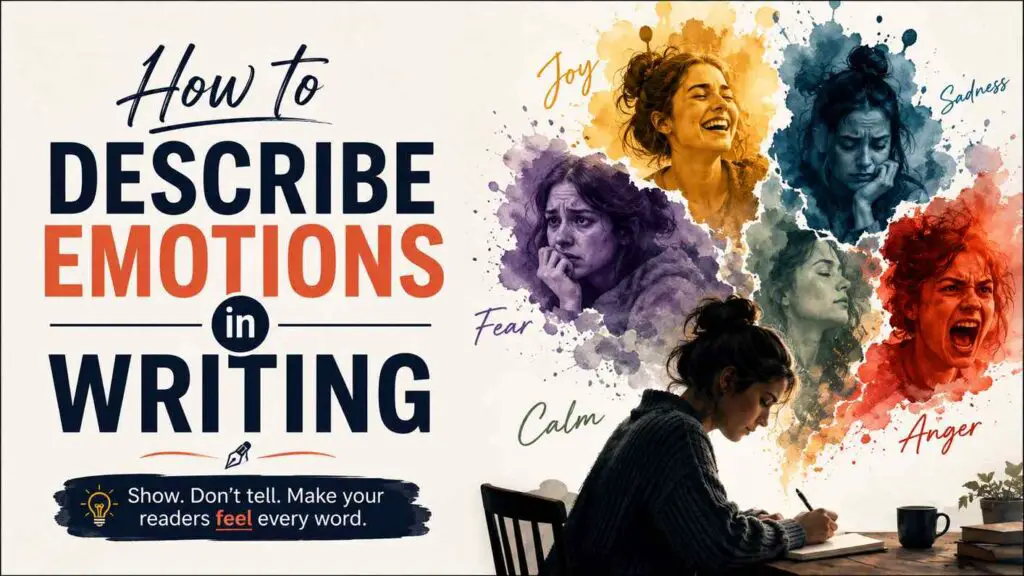
Emotions are at the heart of every memorable story. They shape how readers connect with characters, influence the impact of important scenes, and give meaning to the events that unfold throughout a narrative. No matter the genre—whether it is romance, mystery, fantasy, science fiction, or literary fiction—strong emotional writing helps transform a series of events into an engaging reading experience.
One of the biggest mistakes writers make is simply telling readers what a character feels. Statements like “he was nervous” or “she felt happy” communicate information, but they rarely create an emotional experience. Readers are much more likely to connect with a character when they can observe the emotion through the character’s actions, thoughts, dialogue, and reactions. Instead of being told what to think, readers are allowed to discover the emotion for themselves.
Learning to describe emotions effectively also adds depth to characterization. Different people experience and express the same emotion in different ways. One character may express anger through raised voices and dramatic gestures, while another becomes completely silent. One person may cry openly when grieving, while another throws themselves into work to avoid confronting their loss. These unique emotional responses make characters feel authentic and memorable.
The good news is that emotional writing is a skill that can be learned and improved with practice. By combining physical reactions, internal thoughts, meaningful actions, dialogue, sensory details, and carefully chosen descriptions, writers can create scenes that resonate with readers long after they finish the story. The following techniques are among the most effective ways to describe emotions in writing.
How to Describe Emotions in Writing
#1. Show the Emotion Through Body Language
Body language is one of the strongest ways to reveal emotion without directly naming it. Every emotion produces subtle physical reactions, and readers naturally recognize these cues because they see them every day in real life. Facial expressions, posture, eye contact, breathing, hand movements, and overall body posture can all communicate what a character is experiencing internally.
The key is to choose body language that fits both the emotion and the individual character. Two nervous characters may behave completely differently. One might fidget constantly, while another becomes unusually still. Likewise, anger might appear through clenched fists, narrowed eyes, rigid shoulders, or slow, controlled movements instead of shouting. Selecting details that feel natural prevents emotional descriptions from becoming repetitive.
Body language also works best when it appears naturally within the scene rather than as a list of physical reactions. Small, believable details often have a stronger emotional impact than exaggerated gestures because they feel authentic and allow readers to infer the emotion themselves.
Mara folded the letter twice, then unfolded it again. Her hands would not stay still, and every sound from the hallway made her look up.
Daniel’s jaw tightened. He placed the glass on the table carefully, too carefully, as if one wrong move would shatter the whole room.
#2. Use Internal Thoughts
A character’s thoughts can reveal emotion in a direct but natural way. This technique allows readers to experience the character’s emotional state from the inside instead of merely observing it from the outside. Internal thoughts are especially valuable when characters hide their feelings from those around them.
Rather than simply stating an emotion, internal monologue can reveal the fears, hopes, regrets, insecurities, or assumptions driving a character’s behavior. Readers gain insight into motivations that may never be spoken aloud, creating a stronger emotional bond with the character.
Internal thoughts should also sound authentic to the individual. Some characters think in short, fragmented sentences during stressful moments, while others analyze situations in great detail. Matching the internal voice to the character helps maintain consistency throughout the story.
She should have called him yesterday. No, last week. Maybe then his voice would not feel so far away now.
He smiled when they announced her name, but the thought came anyway: It should have been me.
#3. Describe Physical Sensations
Emotions are often experienced physically before a person consciously identifies them. Fear can cause a racing heartbeat, trembling hands, or shallow breathing. Anxiety may create tight muscles or a dry mouth. Happiness can bring lightness, warmth, or a feeling of energy. These physical sensations help readers experience the emotion alongside the character.
Including physical reactions grounds emotions in something tangible. Readers can easily imagine what it feels like to have a knot in their stomach, a lump in their throat, or tension across their shoulders. These concrete details often create a stronger emotional response than abstract descriptions.
Writers should avoid relying too heavily on familiar clichés. While some common expressions remain effective, varying the physical sensations and tailoring them to the specific situation keeps descriptions fresh and believable.
A cold pressure spread beneath his ribs, as if the room had suddenly run out of air.
Her face warmed before she could answer. Even her ears seemed to know she had been caught.
#4. Reveal Emotion Through Action
Characters often reveal what they feel through what they choose to do rather than what they choose to say. Their actions may intentionally express emotion, or they may unintentionally expose feelings they are trying to hide. This approach creates engaging scenes because readers become active participants in interpreting emotional behavior.
Meaningful actions can range from dramatic decisions to very small habits. Someone overwhelmed by grief may avoid entering a particular room. A guilty character may become unusually generous. A jealous character may ask innocent-sounding questions while secretly seeking reassurance. These actions provide insight into the character without requiring direct explanation.
Showing emotion through action also creates opportunities for subtle storytelling. Instead of pausing the narrative to explain a feeling, the emotion naturally becomes part of the unfolding events, keeping the story moving while still deepening characterization.
After the funeral, James polished every pair of shoes in the closet, including hers.
Lena said she was fine, then deleted the message, rewrote it, deleted it again, and finally turned off her phone.
#5. Use Dialogue Carefully
Dialogue is one of the most flexible tools for expressing emotion because people rarely communicate feelings through words alone. The way characters speak, pause, interrupt themselves, change subjects, or remain silent often reveals more than the actual words they choose.
Word choice, sentence length, pacing, and tone all contribute to emotional expression. A frightened character may stumble over words or ask repeated questions. Someone who is angry may use clipped, controlled sentences instead of shouting. A grieving character may struggle to answer even the simplest question.
Subtext is equally important. Characters often avoid saying exactly what they feel, especially during emotionally charged situations. Allowing readers to recognize the hidden emotion beneath the dialogue creates richer and more realistic conversations.
“I’m happy for you,” he said, and then reached for his coffee though the cup was already empty.
“I just thought…” She stopped, shook her head, and looked toward the window. “Never mind.”
#6. Let the Setting Reflect the Mood
The setting can strengthen the emotional atmosphere of a scene by reinforcing what the character is experiencing. Weather, lighting, sounds, smells, colors, and surrounding activity all influence how readers perceive the emotional tone. While the setting should never replace the character’s emotional journey, it can make those feelings more vivid.
A lonely character standing in an empty parking lot during a cold rain creates a different emotional impression than the same character sitting in a lively café surrounded by cheerful conversation. Neither setting automatically creates emotion, but each changes how readers experience the scene.
The most effective emotional settings feel like a natural part of the story rather than an obvious symbol. Small environmental details woven seamlessly into the narrative often produce a stronger effect than dramatic descriptions that draw attention to themselves.
Rain tapped against the windows while the house sat dark behind her, every room waiting for a voice that would not return.
The kitchen glowed with late afternoon light, and for the first time in months, the silence did not feel empty.
#7. Choose Strong, Specific Details
Specific details make emotional scenes believable because they give readers something concrete to picture. Instead of relying on broad emotional statements, writers can focus on individual objects, routines, sounds, or observations that quietly communicate what the character is feeling.
Often, the smallest details carry the greatest emotional weight. An untouched meal, an unanswered voicemail, a forgotten birthday card, or a jacket still hanging by the front door can communicate grief, loneliness, or regret without ever naming the emotion directly.
These carefully selected details also encourage readers to participate in the storytelling process. Rather than explaining everything outright, writers allow readers to connect the dots and experience the emotional significance on their own.
His side of the bed was still made, the pillow smooth and cold beneath her hand.
She kept the birthday candle in her pocket all day, the small blue one he had never gotten to blow out.
#8. Avoid Overexplaining the Feeling
One of the hallmarks of strong emotional writing is trusting the reader. Once enough evidence has been presented through actions, dialogue, body language, thoughts, and descriptive details, there is usually no need to explicitly state the emotion again. Overexplaining often weakens scenes because it removes the reader’s opportunity to interpret what is happening.
Readers enjoy discovering emotions for themselves. When every emotional cue is followed by a direct explanation, the writing can begin to feel repetitive or overly instructive. Allowing readers to reach their own conclusions often produces a more satisfying and immersive experience.
This does not mean writers should never name emotions. Direct emotional statements certainly have their place, particularly during moments of reflection or important turning points. However, in many scenes, showing first and explaining only when necessary creates a much stronger emotional impact.
He read the message once, then placed the phone face down on the table and walked outside without his coat.
Anna nodded through the apology, smiling at all the right moments. Only after he left did she lock the door and sink to the floor.
Closing Thoughts
Describing emotions in writing is about making readers feel what the character feels. The best emotional writing does not rely only on labels like angry, sad, afraid, or happy. It uses body language, thoughts, actions, dialogue, setting, and sensory detail to bring the feeling to life.
When emotion is shown with care, the reader does more than understand the scene. They enter it. They feel the tension, the heartbreak, the hope, and the silence between the words. That is what makes emotional writing memorable.