
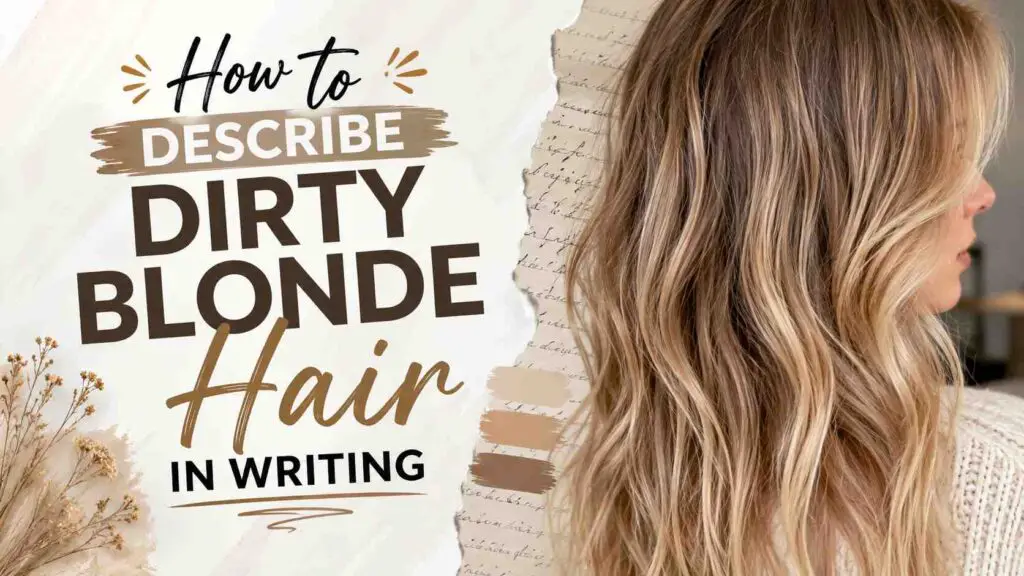
Dirty blonde is the in-between shade — not quite blonde, not quite brown, and often dismissed by the people who have it as unremarkable, which is precisely what makes it interesting to write. It’s a color defined by ambiguity, shifting between its two identities depending on light, season, and who’s doing the looking. Below are the techniques for describing dirty blonde hair with real specificity, each with examples you can study and adapt.
How to Describe Dirty Blonde Hair in Writing
#1. Lean Into the In-Between Quality
Dirty blonde’s defining feature is that it refuses to commit to either category, and describing that ambiguity directly — a color people argue about, a shade that answers differently depending on the light — captures what makes it distinct from true blonde or brown. The indecision itself becomes the most honest description available.
Her driver’s license said blonde, her sister insisted brown, and the truth lived stubbornly somewhere in between.
It was the kind of color that changed its answer depending on the room it was standing in.
He’d never once known what to write on a form — blonde felt like a lie, brown felt like a different one.
#2. Use Precise Comparisons for the Shade
Because “dirty blonde” is itself a vague label, anchoring it to a concrete comparison — wet sand, brass, weak tea, wheat past harvest — gives the reader an actual color to picture instead of a category dispute. The comparison you choose also quietly sets tone, from warm and rustic to muted and urban.
It was the color of wet sand, darker at the roots and drying lighter toward the ends.
The shade landed somewhere near old brass — blonde that had thought better of it.
It was wheat-colored, but late-season wheat, the gold already fading toward brown.
#3. Show the Natural Highlights Within It
Dirty blonde is rarely one uniform color — it’s usually a mix of lighter and darker strands that salons charge heavily to imitate. Describing that natural variation captures the shade’s actual texture rather than treating it as a single flat tone, and it rewards the close observation good description depends on.
Lighter strands threaded through the darker base, the kind of dimension her hairdresser friends kept telling her people paid real money for.
Up close it was a dozen colors at once — gold, ash, sand, brown — that only read as one from across the room.
The top layer had lightened naturally over the summer, leaving streaks no foil had ever touched.
#4. Show It Shifting With Light and Season
More than most colors, dirty blonde swings visibly between its blonde and brown identities depending on sun exposure and time of year — golden in July, flat brown by February. Tracking that shift makes the color feel alive rather than fixed, and gives a writer a natural calendar built into the character.
By late summer it had earned the blonde half of its name; by midwinter it had quietly given it back.
Direct sun pulled the gold out of it instantly, and indoor light put it right back away.
In the photo from the beach she looked almost fully blonde, a version of her hair that only existed in July.
#5. Use a Character’s Own Attitude Toward the Shade
People with dirty blonde hair often have opinions about it — wishing it would pick a side, dyeing it fully blonde, or coming to appreciate its low-maintenance middle ground. That relationship adds characterization beyond the color itself, since how someone treats an ambiguous feature says plenty about how they treat themselves.
She’d spent her teens bleaching it fully blonde and her thirties letting it settle back into whatever it actually was.
He’d always thought of it as indecisive hair, which, his sister pointed out, was a strange thing to hold against it.
She’d made peace with the color mostly because it asked nothing of her — no upkeep, no appointments, no roots to hide.
#6. Use Others’ Descriptions to Show Its Ambiguity
Different characters describing the same head of dirty blonde hair differently — blonde to one person, light brown to another — is a realistic, low-key way to convey the shade while adding small texture to the perspectives in a scene. It can even do quiet plot work in mysteries and mistaken identities.
The police report said light brown; her mother, reading it, said “she’s blonde,” with surprising force.
His girlfriend called it blonde, his barber called it brown, and he’d long since stopped weighing in.
Depending on who was telling the story, the man they’d seen was either blonde or brown-haired, which turned out to describe the same person.
#7. Ground It in Texture and Everyday Detail
Pairing the color with texture and habit — how it’s worn, how it behaves, what it does at the end of a long day — keeps the description attached to a living character rather than a paint swatch. These practical, daily details are usually what make hair description feel genuinely observed.
She wore it in the same loose knot most days, sandy strands escaping by noon no matter how she pinned it.
It went flat and darker when it needed washing, the blonde disappearing entirely by day three.
The ends had lightened past the rest of it, evidence of a ponytail worn outside all season.
#8. Avoid Making “Dirty” Sound Unwashed — Get Specific
The name itself can mislead if handled carelessly — “dirty” refers to the muted, darkened tone, not to hygiene, and clumsy phrasing can accidentally imply the wrong thing entirely. Choosing language that conveys the dimmed, antique gold accurately keeps the description flattering, precise, and free of unintended implications about the character.
It wasn’t dirty in any literal sense — just blonde with the brightness turned down, gold muted to something quieter.
The shade read as darkened blonde rather than unwashed, a warm, dimmed gold that never fully committed to brown.
She’d always hated the name for it, since the color itself was closer to antique gold than anything resembling dirt.
Closing Thoughts
Dirty blonde hair works on the page when its defining ambiguity becomes the description’s strength — a color that shifts with season and light, reads differently to different observers, and carries natural variation salons try to imitate. Anchor it in concrete comparison and a character’s own relationship to the shade, and the most in-between hair color becomes one of the most specific.